
Understanding the Advantages of Using a Solicitor
Understanding the Advantages of Using a Solicitor: Discover the benefits of professional conveyancing guidance for your UK property journey.
PJ Singh
Co-Founder, Conveyancer Plus | Conveyancing Industry Expert
Co-Founder, Conveyancer Plus \| Conveyancing Industry Expert
Thursday 18 December 202515 min read
Buying or selling property in the UK can feel straightforward at first glance. You might even be surprised to learn that over 20 percent of property transactions face unexpected legal or financial problems before completion. But it is not just the paperwork that trips people up. It is the hidden risks and costly pitfalls that only a skilled solicitor can spot before they become your problem.
Table of Contents
Quick Summary
| Takeaway | Explanation |
|---|---|
| **Hiring a solicitor is essential for property transactions** | Engaging a solicitor ensures legal compliance and protects buyer and seller interests throughout the transaction process. |
| **Solicitors manage critical legal documentation** | They prepare contracts and conduct thorough property checks to prevent legal complications during property transactions. |
| **Effective risk management reduces potential financial losses** | Solicitors identify and mitigate legal risks, preventing issues that could lead to costly disputes or devaluation of properties. |
| **Solicitors provide long-term financial guidance** | Their expertise helps clients make informed decisions aligning with immediate financial needs and future investments. |
| **Expect preventative benefits from solicitor fees** | Investing in legal services can save money in the long run by avoiding costly legal issues or financial losses in property transactions. |
What Does a Solicitor Do in Property Transactions?
A solicitor plays a critical role in navigating the complex legal landscape of property transactions. Unlike general legal professionals, property solicitors specialise in handling intricate legal aspects of buying, selling, or transferring property ownership. Their expertise ensures that every transaction proceeds smoothly, legally, and with comprehensive protection for their clients.
Legal Documentation and Property Checks
Property solicitors meticulously manage all critical legal documentation related to property transactions. Explore the comprehensive role of conveyancers in property transactions to understand their extensive responsibilities. They conduct thorough property searches and checks that protect buyers from potential legal complications, including:
- Verifying the property’s legal title
- Checking for any outstanding planning permissions
- Investigating potential boundary disputes
- Examining environmental search reports
- Confirming local authority land charges
Contract Preparation and Negotiation
Solicitors draft, review, and negotiate complex property contracts to safeguard their client’s interests. They examine every clause meticulously, identifying potential risks and ensuring fair terms. This process involves coordinating with estate agents, mortgage lenders, and the other party’s legal representatives to resolve any complications before finalising the transaction.
Their expertise extends beyond simple paperwork. A property solicitor acts as a strategic advisor, providing expert guidance on legal implications, potential risks, and recommended actions throughout the property transaction process. By anticipating potential challenges and proactively addressing them, they help clients navigate what could otherwise be an overwhelmingly complex legal journey.
Why Engaging a Solicitor is Crucial for Buyers and Sellers
Engaging a solicitor during property transactions is not merely an optional service but a strategic necessity for both buyers and sellers. Understand the critical role of a solicitor when selling your home to appreciate the comprehensive protection they provide throughout the transaction process.
Legal Risk Management
Property transactions involve substantial financial investments and complex legal frameworks that can expose individuals to significant risks. Solicitors serve as professional risk managers, identifying and mitigating potential legal complications before they escalate.
! Infographic comparing property transactions with and without a solicitor Their expertise helps prevent costly mistakes that could potentially derail a property sale or purchase.
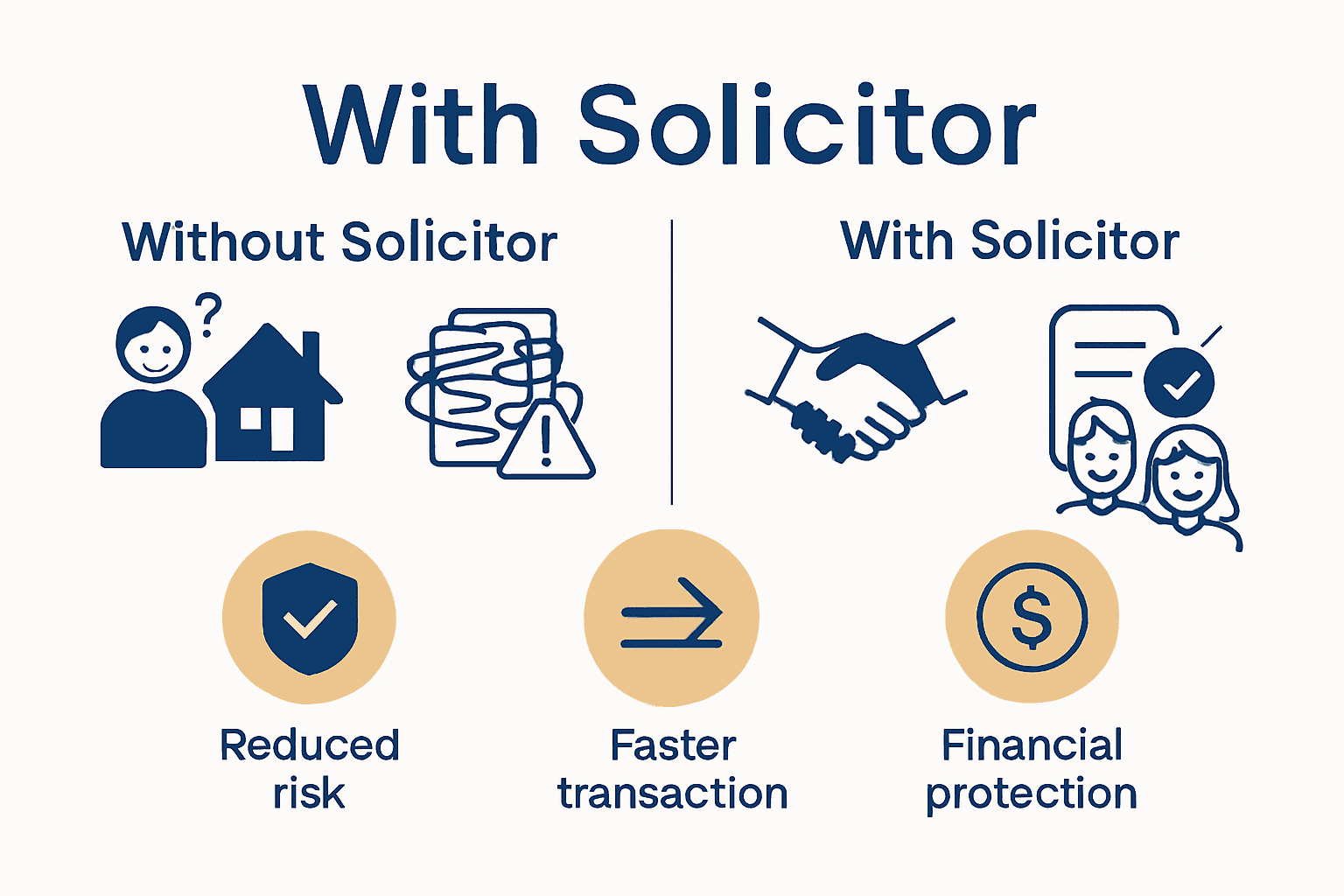
Key legal risks they manage include:
- Uncovering hidden property encumbrances
- Resolving boundary disputes
- Addressing potential planning permission issues
- Verifying clear property ownership transfer
- Ensuring compliance with local property regulations
Financial Protection and Negotiation
Beyond legal documentation, solicitors act as strategic financial advisors who protect their clients’ monetary interests. They conduct thorough financial assessments, review contract terms, and negotiate conditions that safeguard their client’s investment. This includes scrutinising purchase agreements, identifying potential financial liabilities, and ensuring transparent transaction processes.
Their professional intervention can prevent significant financial losses by providing expert guidance through complex legal and financial landscapes. A skilled solicitor transforms a potentially stressful property transaction into a structured, secure, and professionally managed process, giving buyers and sellers peace of mind during one of life’s most significant financial decisions.
The table below summarises the ways in which solicitors protect clients from both legal and financial risks during property transactions, making the information easily scannable for comparison purposes.
| Aspect | Legal Risk Management | Financial Protection and Negotiation |
|---|---|---|
| Key Function | Identifies and resolves potential legal issues | Safeguards client’s monetary investment |
| Typical Risks Managed | Ownership disputes, planning issues, property encumbrances | Financial liabilities, contract penalties, property devaluation |
| Method of Protection | Conducts due diligence, ensures legal compliance | Reviews contracts, negotiates terms, advises on liabilities |
| Outcome | Mitigates possibility of costly legal disputes | Prevents unanticipated expenses and investment losses |
| Benefit for Client | Peace of mind, secure legal standing | Transparent transaction, informed financial decisions |
How Solicitors Mitigate Risks in Real Estate Deals
Real estate transactions involve complex legal landscapes with numerous potential pitfalls that can compromise financial investments and property ownership rights. Learn how to handle complex property transactions with expert guidance to understand the sophisticated risk mitigation strategies employed by professional solicitors.
Comprehensive Property Due Diligence
Solicitors conduct exhaustive investigations that go far beyond surface-level property assessments. Their meticulous due diligence process involves deep forensic examination of property records, legal histories, and potential encumbrances that could impact ownership or future property use. This thorough approach helps identify and neutralise risks before they can escalate into significant legal or financial challenges.
Key areas of comprehensive investigation include:
- Title deed verification
- Historical ownership records
- Potential legal disputes or claims
- Outstanding planning permissions
- Boundary line confirmations
Strategic Legal Shield and Contractual Protection
Beyond investigation, solicitors construct robust legal frameworks that protect their clients’ interests throughout the property transaction. They draft and negotiate contracts with precision, embedding specific clauses that limit potential risks and provide clear legal recourse in case of unexpected complications. Their expertise allows them to anticipate potential scenarios and build contractual safeguards that prevent future disputes.
By combining proactive investigation with strategic legal drafting, solicitors transform potentially risky property transactions into secure, well-structured investments. Their professional intervention ensures that clients can proceed with confidence, knowing that potential legal and financial vulnerabilities have been professionally identified and mitigated.
The Cost-Effective Benefits of Hiring a Solicitor
While many property buyers and sellers initially perceive solicitor fees as an additional expense, professional legal services often represent a strategic financial investment that can ultimately save significant money. Learn more about the role of a solicitor in selling a house to understand how their expertise translates into tangible economic advantages.
Preventing Expensive Legal Complications
Professional solicitors provide substantial financial protection by identifying and resolving potential legal issues before they transform into costly disputes. Their meticulous approach prevents expensive complications that could arise from overlooked legal details, such as unresolved property boundaries, undisclosed structural problems, or complex ownership histories.
Key financial risks they help mitigate include:
- Potential litigation expenses
- Property devaluation
- Unexpected repair costs
- Contract penalty clauses
- Potential mortgage rejection
Long-Term Financial Strategy
Beyond immediate transaction management, solicitors offer strategic financial guidance that extends far beyond the initial property purchase. They provide comprehensive insights into property legal standing, potential future value, and strategic recommendations that can influence long-term investment decisions. Their professional assessment helps clients make informed choices that align with both immediate financial constraints and future wealth-building objectives.
By investing in professional legal services, property buyers and sellers transform what might seem like an upfront cost into a sophisticated risk management strategy. Solicitors essentially function as financial guardians, ensuring that every aspect of a property transaction is carefully examined, legally sound, and aligned with the client’s best economic interests.
Real-World Examples of Successful Solicitor Engagement
Real estate transactions are intricate processes where professional legal intervention can transform potentially challenging scenarios into successful outcomes. Discover how no sale no fee solicitors protect your investment to understand the practical impact of expert legal support.
Complex Property Chain Resolution
In one illustrative case, a residential property transaction involving multiple interconnected sales was at risk of complete breakdown due to complicated ownership transfers and overlapping contractual obligations. A skilled solicitor meticulously navigated the complex legal landscape, coordinating between multiple parties, resolving title discrepancies, and ensuring each transaction segment remained legally compliant.
Typical challenges solicitors successfully resolve include:
This table summarises common challenges encountered in complex property transactions and how the intervention of a solicitor provides solutions, illustrating the practical impact of engaging legal expertise.
| Challenge Encountered | Solicitor’s Solution |
|---|---|
| Complicated inheritance property | Navigates probate and clarifies legal ownership |
| Boundary dispute complications | Mediates resolution and ensures clear legal boundaries |
| Incomplete property documentation | Sources missing records and verifies history |
| Overlapping contractual obligations | Coordinates negotiations and ensures compliance |
| Undisclosed structural or legal issues | Conducts searches and flags concealed risks |
| Multi-party transaction complexities | Manages communication and synchronises stages |
| Conflicting contractual terms | Reviews, renegotiates, and amends conflicting clauses |
- Untangling complicated inheritance property transfers
- Resolving boundary dispute complications
- Addressing incomplete historical property documentation
- Managing multi-party property transaction negotiations
- Reconciling conflicting contractual terms
Preventing Potential Financial Losses
Another compelling example demonstrates how solicitors can prevent substantial financial risks. In a scenario involving a potential property purchase with undisclosed structural issues, the solicitor’s comprehensive property search uncovered hidden legal complications that would have resulted in significant repair expenses. By identifying these issues during the due diligence phase, the solicitor saved the client from what could have been a financially devastating investment.
These real-world scenarios underscore the critical role solicitors play in transforming complex property transactions from potential legal minefields into secure, well-structured investments. Their expertise extends far beyond paperwork
! solicitor advantages real estate, representing a strategic safeguard that protects clients’ financial interests and legal standing throughout the property acquisition process.

Ready to Experience the True Advantages of Using a Solicitor?
Navigating property transactions without professional help can feel overwhelming. The article highlights just how crucial a qualified solicitor is for ensuring every legal detail is sorted and every risk is managed. If you want to avoid hidden pitfalls, confusing documents, and unexpected costs, it is wise to work with regulated experts who can make the process stress-free and transparent.
Do not leave your biggest investment to chance. See how easy it is to compare fixed, instant quotes from SRA- or CLC-regulated conveyancers across the UK with our Instant Quote tool. Discover how much you could save, enjoy peace of mind, and let our trusted team handle the legal work for you. Get started now for a seamless and affordable experience on Conveyancing-Solicitor.co.uk.
What are the main advantages of using a solicitor for property transactions?
Using a solicitor provides expert legal guidance, ensuring that all aspects of the property transaction are managed smoothly and legally. They identify potential legal risks and handle complex documentation, helping to avoid costly mistakes, so you can focus on the purchase or sale itself.
How can a solicitor help prevent legal issues during a property transaction?
A solicitor conducts thorough due diligence, verifying property titles, checking for encumbrances, and investigating planning permissions. By addressing these issues upfront, solicitors can mitigate risks that could lead to disputes or financial losses.
What should I expect from a solicitor during the property buying process?
Expect your solicitor to handle all legal documentation, conduct searches, and communicate with other parties involved in the transaction. You will also receive regular updates and advice, aiding you in making informed decisions throughout the transaction.
How do solicitor fees compare to the potential costs of not hiring one?
While solicitor fees may seem like an additional expense, they can save you from potential costs associated with legal disputes or property devaluation, which could total thousands. Investing in a solicitor might reduce your overall transaction risks and safeguard your financial interests.
What types of legal documents will a solicitor manage during a property transaction?
A solicitor manages various legal documents, including contracts, title deeds, and local authority searches. By overseeing these documents carefully, they ensure compliance with all legal requirements, which is crucial for a successful property transfer.
When is the best time to engage a solicitor in the property buying or selling process?
The best time to engage a solicitor is as soon as you decide to buy or sell property, ideally before negotiating terms or making offers. This proactive approach allows your solicitor to conduct necessary checks and prepare documentation, significantly smoothing out the transaction process.
About the Author
Verified Expert
PJ Singh
Co-Founder, Conveyancer Plus \| Conveyancing Industry Expert
BSc Computer Science, University of Hertfordshire \| 10+ Years Conveyancing Industry Experience
PJ Singh is Co-Founder of Conveyancer Plus, bringing over 10 years of expertise in the UK conveyancing and property sector. Previously Group Director of Sales and Marketing at Ackroyd Legal and Head of Business Development at Fitzalan Partners (Homeward Legal), PJ has worked with over 70 SRA-regulated solicitors nationwide. His deep understanding of the property transaction process and client journey makes him a trusted voice in simplifying conveyancing for homebuyers.
View all articles by PJ → LinkedIn
More Articles
Article\\ \\ Conveyancing Process Step by Step for UK Home Buyers \\ \\ Understand the UK conveyancing process step-by-step with our expert guide for home buyers. Get clear advice from a trusted conveyancing solicitor.\\ \\ 3 Feb 2026 Article\\ \\ Conveyancing Solicitor UK Delivers Trusted Local Specialist Conveyancing for New Builds England \\ \\ Find trusted, vetted conveyancing solicitors across the UK. Clear, Easy & Affordable conveyancing services with up to 75% savings on legal fees.\\ \\ 18 Dec 2025 Article\\ \\ Smooth Selling: How to Find the Right Conveyancing Solicitor for Your Home Sale \\ \\ 18 Dec 2025
View reviews →
Get Your Free Conveyancing Quote
Compare prices from trusted local solicitors. No obligation, no hidden fees.
Instant quotes
No obligation
Save up to 75%
Get Free Quotes Now
Easy and affordable conveyancing made simple. SRA regulated solicitors across the UK.
Services
Quick Links
Legal
Contact
- 0330 053 2229
- clientservices@conveyancing-solicitor.co.uk
- United Kingdom
Conveyancing-Solicitor.co.uk is a trading name of Home Movers Plus Ltd, with the company registration number 13764928. © 2026 Home Movers Plus Ltd –
About the Author
PJ Singh
Co-Founder, Conveyancer Plus | Conveyancing Industry Expert
PJ Singh is Co-Founder of Conveyancer Plus, bringing over 10 years of expertise in the UK conveyancing and property sector. Previously Group Director of Sales and Marketing at Ackroyd Legal and Head of Business Development at Fitzalan Partners (Homeward Legal), PJ has worked with over 70 SRA-regulated solicitors nationwide. His deep understanding of the property transaction process and client journey makes him a trusted voice in simplifying conveyancing for homebuyers.
More Articles
Budget Solicitor Conveyancing Services in Manchester: Quality Legal Help Without the Hidden Costs
Find trusted budget solicitor conveyancing services in Manchester with fixed fees, expert guidance, and transparent, no-hidden-cost legal support.
How to Get an Instant Conveyancing Quote Online
Discover how to get an instant conveyancing quote online. Learn about the process, benefits, costs, and tips for choosing the right service.
Conveyancing Solicitor UK Delivers Trusted Local Specialist Conveyancing for New Builds England
Conveyancing Solicitor UK Delivers Trusted Local Specialist Conveyancing for New Builds England. Learn about our expert services for your new home purchase.
Get Your Free Conveyancing Quote
Compare prices from trusted local solicitors. No obligation, no hidden fees.