
SRA Regulation – What It Means for UK Buyers
SRA Regulation – What It Means for UK Buyers: Understand how their rules, like those on fees, protect you when purchasing property in the UK.
PJ Singh
Co-Founder, Conveyancer Plus | Conveyancing Industry Expert
Co-Founder, Conveyancer Plus \| Conveyancing Industry Expert
Wednesday 4 February 202614 min read
Most British first-time buyers underestimate how complex conveyancing can be, especially when legal jargon and hidden costs creep in. With over 200,000 legal professionals regulated by the Solicitors Regulation Authority across England and Wales, understanding SRA standards helps you avoid costly pitfalls. This guide cuts through confusion and reveals how strict rules protect your rights, keep pricing transparent, and ensure your solicitor delivers reliable service every step of the way.
Table of Contents
Key Takeaways
| Point | Details |
|---|---|
| **SRA’s Role in Conveyancing** | The Solicitors Regulation Authority oversees solicitors ensuring high professional conduct and consumer protection. |
| **Mandatory Compliance Standards** | Solicitors must adhere to strict guidelines for transparency, client money protection, and professional behaviour. |
| **Consumer Protection Measures** | The SRA implements safeguards including pricing transparency and professional indemnity to protect home buyers and sellers. |
| **Comparison of Regulators** | SRA and CLC serve different regulatory purposes, with SRA offering broader legal oversight and CLC specialising in property law. |
What Is SRA Regulation in Conveyancing?
The Solicitors Regulation Authority (SRA) provides crucial oversight for legal professionals offering conveyancing services across England and Wales. This independent regulatory body ensures that solicitors maintain the highest standards of professional conduct, ethical practice, and consumer protection when handling property transactions.
Under the SRA Standards and Regulations, solicitors must adhere to comprehensive guidelines that cover every aspect of legal service delivery. These regulations mandate strict protocols for transparency, client money protection, and professional behaviour. The rules specifically require solicitors to provide clear pricing information, manage potential conflicts of interest, and maintain robust systems for handling client funds securely.
The regulatory framework established by the SRA serves multiple critical functions for property buyers. It provides a comprehensive system of checks and balances that protects consumers by ensuring solicitors operate with integrity, competence, and accountability. Conveyancing solicitors must demonstrate continuous compliance with these standards, which include maintaining professional indemnity insurance, implementing effective complaints procedures, and regularly updating their professional knowledge.
\_ Insider tip:\_ \_Always verify a solicitor’s SRA registration number before engaging their services to confirm they are currently regulated and authorised to practice conveyancing.\_
Who Does the SRA Regulate and Why?
The Solicitors Regulation Authority (SRA) plays a pivotal role in regulating legal professionals throughout England and Wales. Legal practitioners and law firms under their oversight include over 200,000 individuals, ranging from small single-solicitor offices to expansive global legal practices. This comprehensive regulation ensures that every solicitor meets rigorous professional standards and maintains ethical conduct.
The primary purpose of SRA regulation extends far beyond mere administrative oversight. By enforcing stringent professional guidelines, the SRA protects public interests and maintains consumer confidence in legal services. Their regulatory framework covers multiple critical aspects of legal practice, including professional competence, ethical behaviour, financial management, and client protection. Solicitors must demonstrate ongoing compliance with these standards, which include maintaining professional indemnity insurance, implementing robust client communication protocols, and continuously updating their professional knowledge.
The SRA’s regulatory scope is remarkably broad and detailed. They investigate potential misconduct, manage compensation funds to protect clients from financial losses, and provide transparent information to help consumers make informed choices about legal service providers. This comprehensive approach ensures that solicitors not only meet legal requirements but also uphold the highest standards of professional integrity and client care.
\_ Pro tip:\_ \_Always request and verify a solicitor’s SRA registration number to confirm their current regulatory status and professional credentials.\_
Core SRA Standards and Principles Explained
The SRA has established a comprehensive set of fundamental ethical standards that form the bedrock of professional legal practice in the United Kingdom. These core principles are designed to ensure solicitors maintain the highest levels of professional integrity, client protection, and public trust. The principles are not merely guidelines but mandatory requirements that shape every aspect of legal service delivery.
! Solicitor discusses compliance principles with clients

At the heart of these standards are seven critical principles that solicitors must consistently uphold. These include acting with integrity, maintaining absolute honesty, demonstrating independence, and always prioritising the best interests of their clients. Beyond individual client relationships, these principles extend to broader societal responsibilities, such as promoting equality, diversity, and inclusion while steadfastly upholding the rule of law. Each principle serves as a fundamental ethical benchmark that goes far beyond mere legal compliance, representing a holistic approach to professional conduct.
The implementation of these principles is both rigorous and nuanced. Solicitors must demonstrate these values in every interaction, whether negotiating complex legal documents, representing clients in court, or providing advisory services. The SRA’s regulatory framework allows for professional judgement while maintaining robust ethical standards, ensuring that legal professionals can adapt to complex scenarios without compromising their fundamental ethical obligations. This approach recognises the intricate nature of legal practice while providing clear, non-negotiable ethical guidelines.
\_ Pro tip:\_ \_When selecting a solicitor, request a clear explanation of how they interpret and implement the SRA’s core principles in their professional practice.\_
Key Rules for Conveyancing Solicitors
Conveyancing solicitors must adhere to a comprehensive set of professional standards that govern every aspect of property transactions. Conveyancing Protocol guidelines establish a robust framework for delivering transparent, efficient, and ethical legal services. These rules are designed to protect clients, ensure smooth property transfers, and maintain the highest standards of professional conduct.
The key rules encompass several critical areas of professional practice. Solicitors must maintain absolute transparency in communication, providing clear and timely updates throughout the property transaction process. They are required to identify and manage potential conflicts of interest, protect client funds using stringent financial protocols, and ensure all legal documentation is accurately prepared and processed. Additionally, solicitors must comply with consumer protection regulations, maintain professional indemnity insurance, and continuously demonstrate their commitment to ethical practice.
Professional collaboration and communication form another essential aspect of these rules. Conveyancing solicitors are expected to work cooperatively with all parties involved in a property transaction, including estate agents, mortgage lenders, and other legal professionals. This collaborative approach helps mitigate potential delays, resolve complex enquiries efficiently, and ensure a smooth, transparent process for clients. The rules emphasise the importance of proactive problem solving, detailed record keeping, and maintaining the highest levels of professional integrity throughout the entire conveyancing journey.
\_ Pro tip:\_ \_Request a detailed breakdown of your solicitor’s communication and compliance procedures before engaging their services to ensure they meet these professional standards.\_
How SRA Protects Home Buyers and Sellers
The Solicitors Regulation Authority implements comprehensive consumer protection measures designed to safeguard the interests of home buyers and sellers throughout property transactions. These protective mechanisms address critical vulnerabilities in the conveyancing process, reducing financial risks and ensuring professional standards are consistently maintained across legal services.
The SRA’s protection strategy encompasses multiple layers of consumer defence. This includes rigorous monitoring of solicitors’ pricing transparency, requiring clear and upfront communication about service costs and potential additional expenses. Solicitors must provide detailed service descriptions, maintain strict ethical standards, and demonstrate professional competence. The regulatory framework also mandates robust complaint resolution procedures, ensuring clients have recourse if professional misconduct or substandard service occurs. Moreover, solicitors are required to maintain professional indemnity insurance, which provides an additional financial safety net for clients in case of significant errors or negligence.
! Infographic showing SRA protection layers for buyers
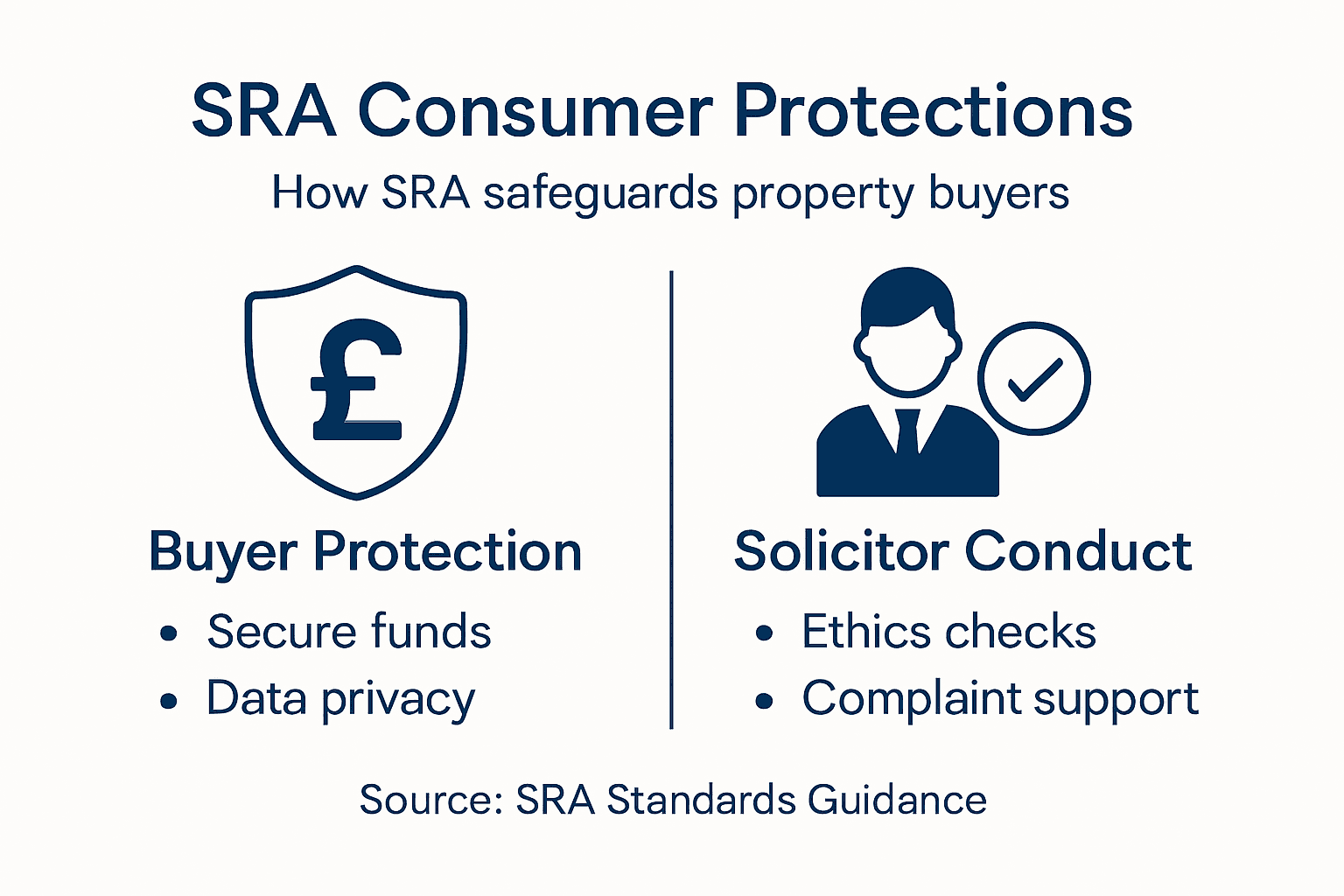
Beyond individual transaction protections, the SRA conducts ongoing thematic reviews to identify systemic risks in residential conveyancing. These proactive assessments help detect potential areas of consumer vulnerability, such as misleading cost estimates or insufficient client communication. By continuously evaluating and updating regulatory standards, the SRA creates a dynamic protective environment that adapts to evolving market challenges and technological changes in legal service delivery.
Here’s a summary of how the SRA safeguards property buyers and sellers:
| Protection Area | SRA Safeguard | Impact on Clients |
|---|---|---|
| Pricing transparency | Mandatory cost breakdowns | Prevents unexpected charges |
| Client money protection | Secure funds handling rules | Reduces risk of financial loss |
| Complaints procedures | Required resolution process | Ensures issues are swiftly addressed |
| Professional indemnity | Insurance requirement | Offers compensation for negligence |
| Continuous monitoring | Thematic reviews and audits | Identifies emerging risks |
\_ Pro tip:\_ \_Always request your solicitor’s SRA registration number and verify their current regulatory status before commencing any property transaction.\_
SRA vs CLC: Which Regulator Is Better?
Contrary to popular belief, there is no definitive answer to which regulator is superior, as each serves distinct purposes within the legal landscape. Regulatory differences between SRA and CLC reveal nuanced approaches to legal professional oversight that cater to different types of legal practitioners and firms.
The Solicitors Regulation Authority (SRA) provides broader regulatory coverage, overseeing solicitors and law firms across multiple legal domains, including conveyancing, litigation, and commercial law. In contrast, the Council for Licensed Conveyancers (CLC) specialises exclusively in property law, focusing specifically on conveyancing and probate services. This specialisation means CLC-regulated firms often demonstrate deeper expertise in property transactions, while SRA-regulated solicitors offer more comprehensive legal service capabilities.
Key distinctions emerge in the scope of regulation, professional standards, and client protections. SRA-regulated firms typically handle more complex legal scenarios and provide wider-ranging services, whereas CLC-regulated professionals concentrate intensively on property-related legal work. Both regulators maintain rigorous professional standards, require ongoing training, and mandate professional indemnity insurance. The choice between them depends on the specific legal services required, the complexity of the transaction, and the individual firm’s precise specialisation.
The table below compares key aspects of SRA and CLC regulation for legal firms:
| Feature | SRA | CLC |
|---|---|---|
| Scope of regulation | All legal domains | Property & probate focused |
| Type of professionals | Solicitors & firms | Licensed conveyancers |
| Expertise emphasis | Broad legal knowledge | In-depth property law |
| Consumer protection | Strong, multi-layered | Strong, property-centred |
| Training requirements | Ongoing for all staff | Regular, property-specific |
| Common client profile | Complex transactions | Routine conveyancing |
\_ Pro tip:\_ \_Request detailed information about a firm’s specific regulatory status and specialisation before engaging their services to ensure they perfectly match your legal requirements.\_
Secure Your Property Transaction with Regulated Conveyancing Experts
Understanding SRA regulation highlights just how important it is to choose a conveyancing solicitor who meets strict standards for integrity and client protection. Buyers often face uncertainty about costs, delays, and whether their solicitor is fully authorised to handle their property transaction. The key challenge is finding a trusted legal professional who complies fully with SRA rules to avoid unexpected fees or issues with client money protection.
At Conveyancing-Solicitor.co.uk, we solve those worries by connecting you with carefully vetted conveyancing solicitors and licensed conveyancers regulated by the SRA or CLC. Our transparent, fixed-fee quotes help you save up to 75% on legal fees compared to typical rates. With instant access to five-star firms nationwide, you get peace of mind knowing you are working with experts who uphold the highest professional standards outlined by the SRA. Avoid the stress of unregulated providers and choose a conveyancer who puts your interests first.
Get started today by requesting your personalised conveyancing quote through our Instant Quote service. Learn more about selecting the right conveyancer on our Find a Conveyancer page. Take control of your property journey with clear costs and trusted advice that make conveyancing simple and secure.
Frequently Asked Questions
What is the role of the SRA in conveyancing?
The Solicitors Regulation Authority (SRA) regulates solicitors in England and Wales, ensuring they maintain high professional and ethical standards in conveyancing services.
How can I verify if my solicitor is regulated by the SRA?
You can confirm a solicitor’s SRA registration number by checking directly on the SRA’s website to ensure they are authorised to practice conveyancing.
What protections does the SRA provide for home buyers?
The SRA implements consumer protection measures, including requirements for pricing transparency, secure handling of client funds, and effective complaints resolution procedures to safeguard home buyers.
What principles must solicitors adhere to under SRA regulation?
Solicitors must follow core principles such as acting with integrity, ensuring client interests are prioritised, maintaining professionalism, and promoting equality and diversity in their practice.
About the Author
Verified Expert
PJ Singh
Co-Founder, Conveyancer Plus \| Conveyancing Industry Expert
BSc Computer Science, University of Hertfordshire \| 10+ Years Conveyancing Industry Experience
PJ Singh is Co-Founder of Conveyancer Plus, bringing over 10 years of expertise in the UK conveyancing and property sector. Previously Group Director of Sales and Marketing at Ackroyd Legal and Head of Business Development at Fitzalan Partners (Homeward Legal), PJ has worked with over 70 SRA-regulated solicitors nationwide. His deep understanding of the property transaction process and client journey makes him a trusted voice in simplifying conveyancing for homebuyers.
View all articles by PJ → LinkedIn
More Articles
Article\\ \\ Conveyancing Process Step by Step for UK Home Buyers \\ \\ Understand the UK conveyancing process step-by-step with our expert guide for home buyers. Get clear advice from a trusted conveyancing solicitor.\\ \\ 3 Feb 2026 Article\\ \\ Conveyancing Solicitor UK Delivers Trusted Local Specialist Conveyancing for New Builds England \\ \\ Find trusted, vetted conveyancing solicitors across the UK. Clear, Easy & Affordable conveyancing services with up to 75% savings on legal fees.\\ \\ 18 Dec 2025 Article\\ \\ Transfer of Equity – How It Affects Family Property \\ \\ Understand UK Transfer of Equity & how it affects family property. Get expert conveyancing solicitor advice on changing ownership.\\ \\ 4 Feb 2026
View reviews →
Get Your Free Conveyancing Quote
Compare prices from trusted local solicitors. No obligation, no hidden fees.
Instant quotes
No obligation
Save up to 75%
Get Free Quotes Now
Easy and affordable conveyancing made simple. SRA regulated solicitors across the UK.
Services
Quick Links
Legal
Contact
- 0330 053 2229
- clientservices@conveyancing-solicitor.co.uk
- United Kingdom
Conveyancing-Solicitor.co.uk is a trading name of Home Movers Plus Ltd, with the company registration number 13764928. © 2026 Home Movers Plus Ltd –
About the Author
PJ Singh
Co-Founder, Conveyancer Plus | Conveyancing Industry Expert
PJ Singh is Co-Founder of Conveyancer Plus, bringing over 10 years of expertise in the UK conveyancing and property sector. Previously Group Director of Sales and Marketing at Ackroyd Legal and Head of Business Development at Fitzalan Partners (Homeward Legal), PJ has worked with over 70 SRA-regulated solicitors nationwide. His deep understanding of the property transaction process and client journey makes him a trusted voice in simplifying conveyancing for homebuyers.
More Articles
Remortgage your house: step-by-step guide for UK homeowners
Learn how to remortgage your house in the UK with this clear step-by-step guide covering timing, costs, legal fees, and how to save up to 75% on conveyancing.
Transparency in conveyancing: your guide to clear home moves
Discover what transparency in conveyancing really means, where it breaks down, and how to choose a solicitor who keeps you fully informed with no hidden fees.
Essential conveyancing terms every UK home seller must know
Learn the essential conveyancing terms every UK home seller must know, from TA6 forms to exchange and completion, to avoid costly delays and legal pitfalls.
Get Your Free Conveyancing Quote
Compare prices from trusted local solicitors. No obligation, no hidden fees.