
Ways to Save on Legal Fees During Conveyancing
Ways to Save on Legal Fees During Conveyancing: Discover practical tips to reduce costs, like being organised and understanding the conveyancing process.
PJ Singh
Co-Founder, Conveyancer Plus | Conveyancing Industry Expert
Co-Founder, Conveyancer Plus \| Conveyancing Industry Expert
Tuesday 3 February 202615 min read
More than 60 percent of British first-time buyers worry about hidden legal costs when purchasing property in London. Navigating the complexities of conveyancing can feel overwhelming, especially with so many fee structures and unexpected expenses. This guide breaks down how transparent, fixed-fee conveyancing services make the home-buying journey more affordable and straightforward for young buyers, highlighting practical strategies to cut costs and avoid costly surprises.
Table of Contents
Key Takeaways
| Point | Details |
|---|---|
| **Understanding Fees** | Conveyancing costs consist of legal fees and disbursements, which vary based on property type, location, and complexity. |
| **Fixed-Fee Advantages** | Opting for fixed-fee arrangements offers budget predictability and coverage of essential services, protecting against unexpected costs. |
| **Comparing Solicitors** | Thoroughly evaluate solicitors by considering regulatory accreditation, experience, and fee transparency to ensure the best value for your investment. |
| **Preventing Hidden Costs** | Request a detailed breakdown of all fees upfront to identify potential hidden charges and avoid surprises during the property transaction process. |
Legal fees in conveyancing explained
Legal fees in conveyancing represent the professional charges associated with transferring property ownership from one party to another. These fees encompass the comprehensive legal work performed by solicitors or licensed conveyancers during property transactions. Conveyancing fees typically consist of two primary components: the legal fees charged by the professional and disbursements paid to third-party service providers.
The cost of conveyancing can vary significantly depending on several crucial factors. Property type plays a substantial role in determining fees, with leasehold properties often incurring approximately £300 more in charges compared to freehold properties due to additional legal complexities. Location, transaction complexity, and whether you choose a traditional solicitor or an online conveyancer will also influence the final price. Typically, legal fees scale proportionally with property value, meaning higher-value properties require more intricate legal work and attract correspondingly higher charges.
Understanding the breakdown of conveyancing fees helps homebuyers budget effectively and avoid unexpected expenses. The legal fees cover essential services such as conducting property searches, reviewing contracts, providing legal advice, transferring funds, and registering the property with the appropriate authorities. Disbursements, which are separate from legal fees, include costs for local authority searches, land registry fees, environmental searches, and other third-party services required to complete the property transaction.
When selecting a conveyancing professional, it is crucial to request a comprehensive fee breakdown and understand exactly what services are included. Some firms offer fixed-fee packages, while others charge hourly rates or have more complex pricing structures. Always compare quotes from multiple providers and ask about potential additional costs that might arise during the conveyancing process.
\_ Pro tip:\_ \_Request a detailed, written quote that itemises all potential fees and disbursements to prevent unexpected financial surprises during your property transaction.\_
Types of conveyancing charges and fee structures
Conveyancing fees are fundamentally composed of two distinct categories: legal fees and disbursements. These fee structures vary depending on transaction complexity and service provider, with solicitors and licensed conveyancers offering different pricing models to suit various property transactions.
Legal fees typically fall into three primary structures: fixed fee, hourly rate, and percentage-based pricing. Fixed fee arrangements are increasingly popular among homebuyers, providing transparency and predictability. These packages usually cover standard property transactions and include core services such as contract review, property searches, and legal documentation preparation. Hourly rate structures, while less common, might be employed for more complex transactions involving unique legal challenges or extensive research requirements.
Here is a summary of the most common conveyancing fee structures and their key implications:
| Fee Structure | Typical Use Case | Cost Predictability | When to Consider |
|---|---|---|---|
| Fixed fee | Standard transactions | Highly predictable | Budgeting is a priority |
| Hourly rate | Complex or unique cases | Less predictable | Extensive legal complexities |
| Percentage-based | High-value properties | Varies with property value | Large scale or premium properties |
Disbursements represent the additional third-party costs incurred during the conveyancing process. These essential charges cover crucial services that are fundamental to property transfer. Typical disbursements include:
! Infographic showing main ways to save on fees
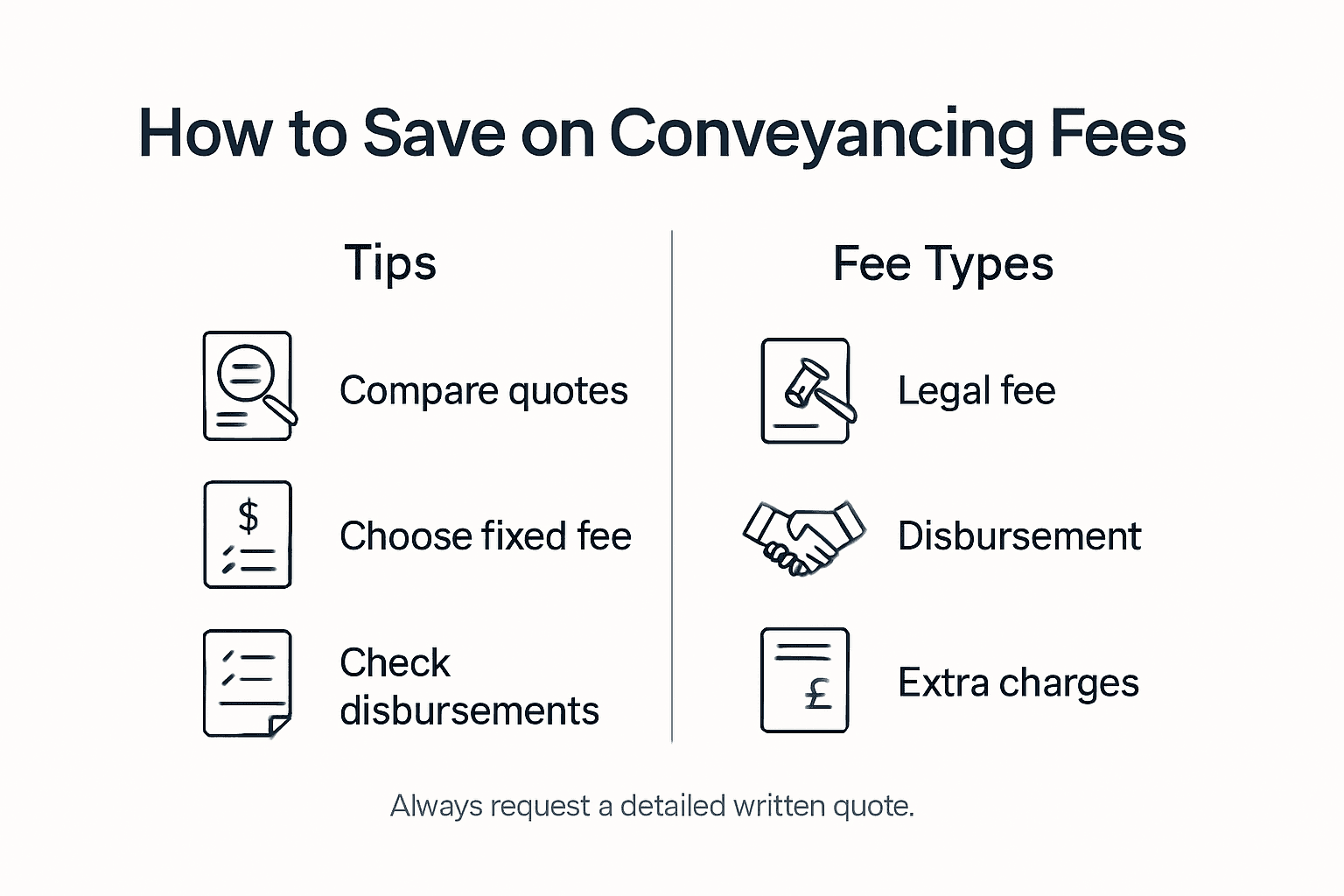
Below is a comparison of key fee types encountered during conveyancing:
| Fee Type | Who Charges It | Typical Examples | Impact on Total Cost |
|---|---|---|---|
| Legal fee | Solicitor/conveyancer | Contract review, advice, transfers | Directly affects legal spend |
| Disbursement | Third-party providers | Searches, land registry, tax | Essential, can vary widely |
- Local authority searches
- Land registry fees
- Environmental searches
- Drainage and water searches
- Bank transfer fees
- Stamp duty land tax calculations
The total cost can fluctuate significantly based on property type, with leasehold properties often attracting higher fees due to more intricate legal requirements. Urban locations and higher-value properties tend to incur more substantial charges, reflecting the increased complexity of legal work involved.
\_ Pro tip:\_ \_Request a comprehensive, itemised quote that clearly separates legal fees from disbursements to understand the exact breakdown of your conveyancing costs.\_
How fixed-fee quotes can cut costs
Fixed-fee conveyancing quotes represent a strategic approach for homebuyers to manage legal expenses and protect themselves from unexpected financial surprises. Unlike traditional hourly billing models, these transparent pricing structures provide a clear, upfront understanding of the total legal costs associated with property transactions.
The primary advantage of fixed-fee quotes lies in their predictability and comprehensive coverage. These packages typically include a range of essential services within a single, predetermined price point. Standard fixed-fee arrangements often encompass critical conveyancing tasks such as:
- Property title searches
- Contract preparation and review
- Land registry documentation
- Communication with the seller’s solicitor
- Handling initial client documentation
- Basic property searches
Homebuyers can potentially save significant amounts by selecting fixed-fee services, as these quotes eliminate the risk of escalating legal costs that can occur with hourly-rate billing. The transparent nature of fixed fees allows individuals to budget more effectively, removing financial uncertainty from the property purchasing process. Complex transactions might require supplementary services, but reputable conveyancing firms will clearly outline any additional charges before commencing work.
Comparing multiple fixed-fee quotes can reveal substantial variations in pricing and included services. Savvy property buyers should carefully review what each package covers, looking beyond the headline price to understand the comprehensive value offered. Factors such as the firm’s reputation, experience, and regulatory accreditation should be weighed alongside the quoted fee to ensure a balanced decision.
! Couple comparing legal quotes at kitchen table

\_ Pro tip:\_ \_Request a detailed breakdown of what is included in the fixed-fee quote and ask about any potential extra charges to avoid unexpected expenses during your property transaction.\_
Comparing solicitors for the best value
When searching for the most cost-effective conveyancing solution, homebuyers must approach solicitor selection strategically. Comparing multiple solicitors can help identify the best value for your specific property transaction, ensuring you receive quality legal services without overpaying.
Evaluating potential conveyancing solicitors requires a comprehensive approach that goes beyond simply comparing headline prices. Key factors to consider include:
- Regulatory accreditation (SRA or CLC registration)
- Experience with similar property transactions
- Transparent fee structures
- Mortgage lender panel membership
- Response times and communication quality
- Client reviews and testimonials
- Specialisation in your specific property type (leasehold, freehold, new build)
Cost should not be the sole determining factor when selecting a conveyancing solicitor. While online conveyancing services often appear cheaper, they may lack the personalised service and detailed attention that traditional firms provide. Some budget providers might have hidden charges or offer limited support, potentially creating additional stress during an already complex property transaction. Professional solicitors who charge slightly higher fees often deliver more comprehensive services, including proactive problem-solving and detailed communication throughout the buying process.
To maximise value, request detailed, itemised quotes from multiple solicitors that clearly outline all potential charges. Look for firms offering fixed-fee arrangements with explicit descriptions of included services. Be wary of quotes that seem unusually low, as these might indicate potential additional charges or reduced service quality. A reputable solicitor will be transparent about their pricing and willing to explain the scope of their services in detail.
\_ Pro tip:\_ \_Request a comprehensive written quote that breaks down all potential fees and ask about their experience with similar property transactions to ensure you’re getting true value for your investment.\_
Spotting and avoiding hidden legal costs
Understanding and preventing hidden legal costs requires vigilance and careful examination of your conveyancing quote. Homebuyers can protect themselves from unexpected expenses by thoroughly examining potential hidden charges in their solicitor’s initial proposal.
Hidden legal costs can emerge through various subtle mechanisms that are not immediately apparent in the initial quote. Common areas where unexpected charges may surface include:
- Additional search fees
- Complex property documentation review
- Electronic transfer charges
- Leasehold property supplementary checks
- Mortgage lender documentation fees
- Unexpected communications and correspondence costs
- Potential legal consultation charges
Most reputable conveyancing firms structure their fees with transparency, but some less scrupulous providers may intentionally obscure potential additional charges. Budget conveyancers might offer seemingly attractive low initial quotes that balloon with supplementary fees as the transaction progresses. Professional solicitors typically provide comprehensive, itemised quotes that outline potential additional costs upfront, allowing clients to understand the full financial commitment before proceeding.
To effectively mitigate hidden costs, homebuyers should request a detailed, written breakdown of all potential charges before engaging a conveyancing solicitor. This breakdown should explicitly state what services are included in the base fee and which services might attract supplementary charges. Pay particular attention to disbursement fees, which can vary significantly between different solicitors and regions. Always ask for a complete list of potential additional expenses and request confirmation that the quote represents the total expected cost of the transaction.
\_ Pro tip:\_ \_Insist on a comprehensive, written quote that includes a full breakdown of potential fees and explicitly asks about any circumstances that might trigger additional charges.\_
No sale, no fee options and alternatives
No sale, no fee conveyancing represents a strategic approach for homebuyers seeking financial protection during property transactions. These innovative arrangements offer significant risk mitigation for property buyers, ensuring clients are not financially penalised if their property transaction falls through.
The core principle of no sale, no fee conveyancing involves a straightforward agreement where solicitors only charge their legal fees if the property transaction successfully completes. This arrangement provides several key advantages for homebuyers:
- Reduced financial risk during uncertain transactions
- Protection against upfront legal expenses
- Motivation for solicitors to actively progress the sale
- Increased transparency in legal fee structures
- Flexibility during complex property negotiations
- Potential cost savings if the transaction fails
While no sale, no fee options offer substantial benefits, they are not universally applicable. Some solicitors may include specific conditions or partial fee structures that require careful examination. Typically, disbursement costs such as search fees, land registry charges, and third-party expenses might still be payable even if the transaction collapses. Homebuyers should meticulously review the terms, understanding exactly what is and is not covered under the no sale, no fee arrangement.
Alternative fee structures exist for those seeking different financial arrangements. Some solicitors offer reduced fees, sliding scale pricing, or fixed-price packages that provide varying levels of financial protection. Hybrid models might combine elements of traditional and no sale, no fee approaches, allowing greater flexibility for different property transaction scenarios.
\_ Pro tip:\_ \_Always request a detailed, written explanation of the no sale, no fee terms, focusing on what specific costs are included and excluded from the agreement.\_
Save More on Legal Fees with Trusted Conveyancing Experts
Navigating legal fees during conveyancing can be confusing and costly, especially with hidden charges and unclear fee structures. This article highlights common challenges like unexpected disbursements and variable quote types. If you want to gain clarity and save significantly on your property transaction costs, it is crucial to choose a conveyancer who offers both transparency and value.
At Conveyancing-Solicitor.co.uk, we connect you instantly with vetted, regulated conveyancing firms that provide fixed-fee quotes protecting you from surprise expenses. Whether you are dealing with complex leasehold checks or seeking no sale no fee options, our platform helps you compare multiple providers easily to find the best match for your needs and budget.
Take control of your conveyancing journey today by requesting your tailored, no-obligation quote from trusted experts. Don’t let legal fees derail your home buying plans. Get started now with Instant Fixed-Fee Quotes and explore advice on No Sale, No Fee Conveyancing alongside explains for Understanding Hidden Costs in Conveyancing. Save money with confidence and complete your property transaction smoothly.
Frequently Asked Questions
What are the main types of legal fees in conveyancing?
The main types of legal fees in conveyancing are legal fees, which are charged by solicitors or conveyancers for their services, and disbursements, which are third-party costs associated with property transactions, such as local authority searches and land registry fees.
How can I reduce legal fees during the conveyancing process?
You can reduce legal fees by opting for fixed-fee conveyancing quotes, comparing multiple solicitors, and ensuring that you understand the services covered in your fee package to avoid unexpected costs.
What is a fixed-fee conveyancing quote?
A fixed-fee conveyancing quote is a pricing model where solicitors provide a set price for their services, covering essential tasks such as property title searches and contract preparation, offering transparency and predictability in legal costs.
Are there any hidden costs to be aware of in conveyancing fees?
Yes, hidden costs can arise from additional search fees, complex documentation reviews, and electronic transfer charges. It’s crucial to request a detailed, itemised quote to understand all potential charges before proceeding.
About the Author
Verified Expert
PJ Singh
Co-Founder, Conveyancer Plus \| Conveyancing Industry Expert
BSc Computer Science, University of Hertfordshire \| 10+ Years Conveyancing Industry Experience
PJ Singh is Co-Founder of Conveyancer Plus, bringing over 10 years of expertise in the UK conveyancing and property sector. Previously Group Director of Sales and Marketing at Ackroyd Legal and Head of Business Development at Fitzalan Partners (Homeward Legal), PJ has worked with over 70 SRA-regulated solicitors nationwide. His deep understanding of the property transaction process and client journey makes him a trusted voice in simplifying conveyancing for homebuyers.
View all articles by PJ → LinkedIn
More Articles
Article\\ \\ Conveyancing Process Step by Step for UK Home Buyers \\ \\ Understand the UK conveyancing process step-by-step with our expert guide for home buyers. Get clear advice from a trusted conveyancing solicitor.\\ \\ 3 Feb 2026 Article\\ \\ Conveyancing Solicitor UK Delivers Trusted Local Specialist Conveyancing for New Builds England \\ \\ Find trusted, vetted conveyancing solicitors across the UK. Clear, Easy & Affordable conveyancing services with up to 75% savings on legal fees.\\ \\ 18 Dec 2025 Article\\ \\ Transfer of Equity – How It Affects Family Property \\ \\ Understand UK Transfer of Equity & how it affects family property. Get expert conveyancing solicitor advice on changing ownership.\\ \\ 4 Feb 2026
View reviews →
Get Your Free Conveyancing Quote
Compare prices from trusted local solicitors. No obligation, no hidden fees.
Instant quotes
No obligation
Save up to 75%
Get Free Quotes Now
Easy and affordable conveyancing made simple. SRA regulated solicitors across the UK.
Services
Quick Links
Legal
Contact
- 0330 053 2229
- clientservices@conveyancing-solicitor.co.uk
- United Kingdom
Conveyancing-Solicitor.co.uk is a trading name of Home Movers Plus Ltd, with the company registration number 13764928. © 2026 Home Movers Plus Ltd –
About the Author
PJ Singh
Co-Founder, Conveyancer Plus | Conveyancing Industry Expert
PJ Singh is Co-Founder of Conveyancer Plus, bringing over 10 years of expertise in the UK conveyancing and property sector. Previously Group Director of Sales and Marketing at Ackroyd Legal and Head of Business Development at Fitzalan Partners (Homeward Legal), PJ has worked with over 70 SRA-regulated solicitors nationwide. His deep understanding of the property transaction process and client journey makes him a trusted voice in simplifying conveyancing for homebuyers.
More Articles
Budget Solicitor Conveyancing Services in Manchester: Quality Legal Help Without the Hidden Costs
Find trusted budget solicitor conveyancing services in Manchester with fixed fees, expert guidance, and transparent, no-hidden-cost legal support.
How to Get an Instant Conveyancing Quote Online
Discover how to get an instant conveyancing quote online. Learn about the process, benefits, costs, and tips for choosing the right service.
Conveyancing Solicitor UK Delivers Trusted Local Specialist Conveyancing for New Builds England
Conveyancing Solicitor UK Delivers Trusted Local Specialist Conveyancing for New Builds England. Learn about our expert services for your new home purchase.
Get Your Free Conveyancing Quote
Compare prices from trusted local solicitors. No obligation, no hidden fees.