
Property Completion: What Buyers Need to Know
Property Completion: What Buyers Need to Know. Understand the final steps of your UK property purchase, from completing funds to getting your new keys.
PJ Singh
Co-Founder, Conveyancer Plus | Conveyancing Industry Expert
Co-Founder, Conveyancer Plus \| Conveyancing Industry Expert
Wednesday 4 February 202613 min read
Facing your first property purchase in England can feel overwhelming, especially when legal jargon and hidden fees cloud what should be an exciting milestone. Understanding property completion is vital because this step transforms you from hopeful buyer to official homeowner. This article brings clarity to the legal checks, paperwork, and financial details you need to confidently navigate the completion process and avoid costly surprises.
Table of Contents
Key Takeaways
| Point | Details |
|---|---|
| **Property Completion** | Represents the final stage in property transactions where legal ownership is transferred from seller to buyer. A precise execution of legal and financial steps is necessary for a smooth process. |
| **Key Documents** | Essential documents include the Contract of Sale, Transfer Deed, and verification of financial arrangements, which must be accurately prepared and registered to protect both parties. |
| **Delays and Mitigation** | Common delays arise from financial complications and administrative errors; proactive communication and early preparation can prevent these issues. |
| **Financial Awareness** | Buyers need to be aware of all associated costs, including legal fees and government charges, and should request a detailed completion statement at least a week before completion to ensure financial clarity. |
Defining Property Completion in Conveyancing
Property completion represents the pivotal final stage in a property transaction where legal ownership transfers from seller to buyer. This crucial moment marks the official transition of property rights and involves several intricate legal and financial processes that must be executed precisely.
In the United Kingdom, property completion involves a comprehensive sequence of legal steps that go far beyond a simple monetary exchange. The process encompasses multiple critical components:
- Executing transfer deeds
- Conducting pre-completion property searches
- Confirming financial arrangements
- Arranging practical property handover logistics
The specific mechanics of property completion require meticulous attention to detail. Legal ownership transfer occurs at the moment of completion, which represents more than just a financial transaction. It signifies the precise instant when the seller legally hands over the property and the buyer becomes the official property owner.
Key elements that define property completion include:
1. Final purchase price payment 2. Signed transfer documents 3. Property keys and access handover 4. Registration of new ownership with Land Registry
Property completion transforms a potential property transaction into a legally binding transfer of ownership, representing the culmination of weeks or months of complex legal preparations.
\_ Pro tip:\_ \_Always request a comprehensive completion statement from your conveyancer to understand exactly what financial transactions and legal transfers occur during this critical stage.\_
Step-by-Step Property Completion Timeline
The property completion timeline represents a meticulously orchestrated process that transforms a potential property transaction into a legally binding transfer of ownership. Understanding each stage helps buyers navigate this complex journey with confidence and clarity.
Completion typically begins after exchange of contracts and involves several critical stages that must be executed precisely. The timeline can vary depending on property complexity and the specific circumstances of the transaction.
Key stages in the property completion timeline include:
1. Final Contract Review
- Confirm all terms and conditions
- Verify property searches and survey results
- Ensure all legal requirements are met
2. Financial Preparation
- Transfer funds to solicitor
- Confirm mortgage arrangements
- Prepare final payment
3. Legal Documentation
- Complete transfer deed
- Prepare title documents
- Arrange final signatures
4. Ownership Transfer
- Transfer legal ownership
- Exchange property keys
- Update Land Registry records
Property completion timelines can fluctuate, with most transactions completing around midday. However, timing depends on multiple factors including property chain complexity and individual solicitor efficiency.
\> Complex property transactions may require additional coordination and could extend beyond standard completion timeframes.
Buyers should maintain clear communication with their solicitor throughout the process to understand potential variations and manage expectations effectively.
\_ Pro tip:\_ \_Request a detailed timeline and communication plan from your conveyancer to track progress and anticipate potential delays during the completion process.\_
Legal Requirements and Key Documents
Property transactions in the United Kingdom involve a complex web of legal requirements and critical documentation that protect both buyers and sellers throughout the transfer process. Understanding these legal intricacies is essential for a smooth and legally compliant property purchase.
! Woman reviewing property completion paperwork

Completion requires strict compliance with legal formalities established under various property legislation, including the Law of Property Act 1925. This framework ensures that property transfers are conducted with transparency, legal precision, and appropriate safeguards for all parties involved.
Key legal documents essential for property completion include:
1. Contractual Documents
- Contract of sale
- Property title deeds
- Seller’s property information forms
2. Transfer Documentation
- Form TR1 (official transfer deed)
- Land Registry documentation
- Mortgage discharge paperwork
3. Financial Verification Documents
- Proof of funds
- Mortgage offer
- Bank statements
- Identification verification
\> Proper documentation is the foundation of a legally sound property transaction, protecting both buyer and seller’s interests.
Each document plays a crucial role in establishing legal ownership transfer. The transfer deed requires precise execution, including proper signing and witnessing as mandated by property law. Buyers must ensure all documentation is complete, accurate, and complies with current legal standards.
Legal requirements extend beyond mere paperwork, encompassing comprehensive property searches, financial verifications, and regulatory compliance. These steps protect buyers from potential legal complications and unexpected property issues.
\_ Pro tip:\_ \_Request a comprehensive document checklist from your conveyancer and maintain organised copies of all legal paperwork throughout the property transaction process.\_
Common Delays and How to Avoid Them
Property transactions are complex processes vulnerable to numerous potential delays that can frustrate buyers and sellers alike. Understanding these potential roadblocks is crucial for maintaining momentum and ensuring a smooth property completion experience.
! Infographic summarising property completion milestones
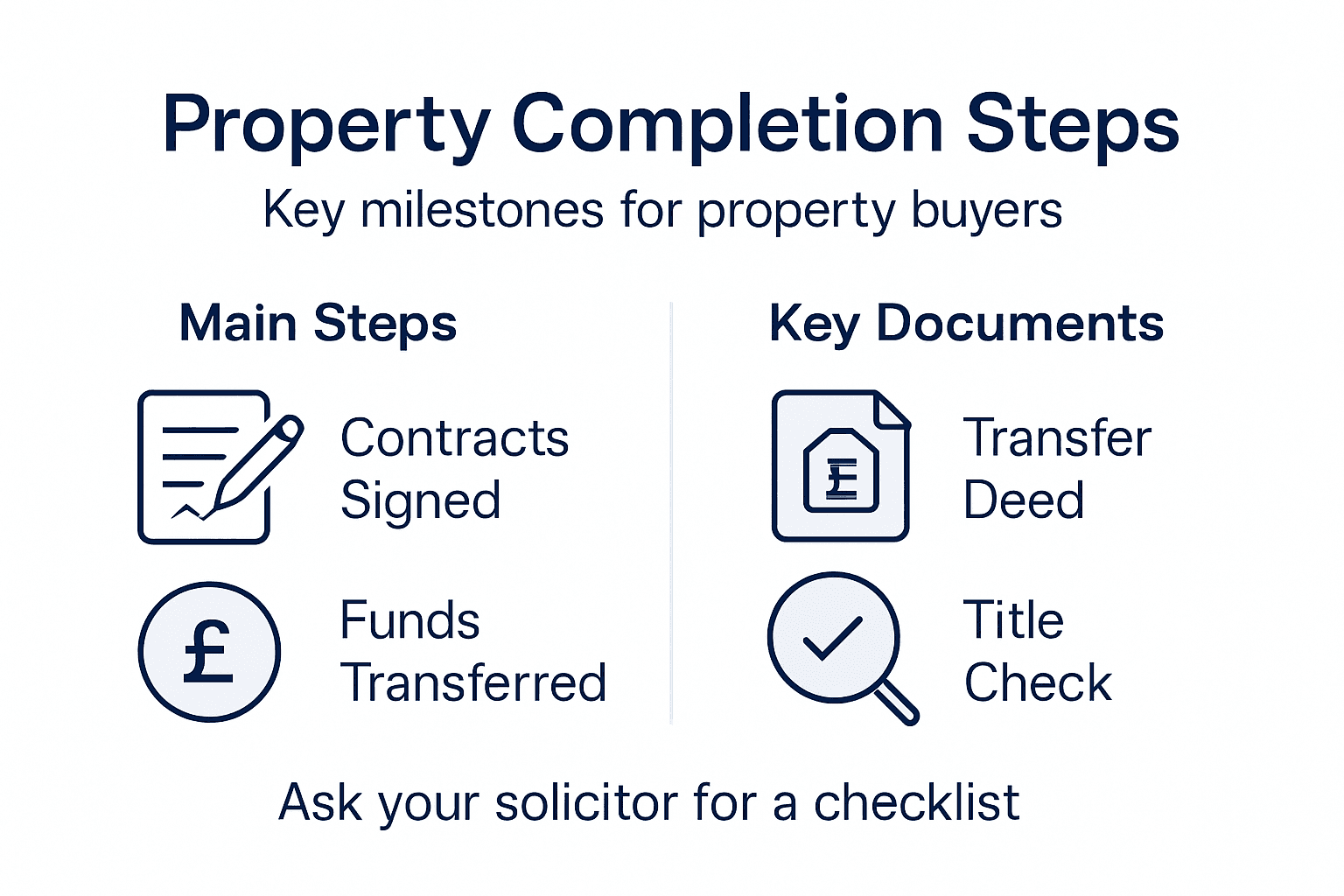
Delays frequently arise from administrative complexities involving multiple parties, including solicitors, lenders, and various administrative systems. Proactive management and clear communication can significantly mitigate these potential obstacles.
Common sources of property transaction delays include:
1. Financial Complications
- Mortgage approval issues
- Incomplete financial documentation
- Unexpected credit check problems
- Delays in fund transfers
2. Legal Documentation
- Incomplete property searches
- Title deed discrepancies
- Unresolved legal queries
- Lengthy local authority searches
3. Property Chain Challenges
- Delays from other transactions
- Communication breakdowns
- Simultaneous sale/purchase complexities
- Inconsistent transaction timelines
\> Preparation and proactive communication are the most effective strategies for preventing potential completion delays.
Buyers can take several strategic steps to minimise potential disruptions. Early preparation involves gathering all required documentation in advance, maintaining open communication channels with solicitors, and ensuring financial arrangements are comprehensively confirmed before critical stages.
Transaction delays can often be mitigated by maintaining a structured approach, responding promptly to queries, and having contingency plans for potential complications. Regular follow-ups and a collaborative mindset can significantly reduce the risk of unexpected setbacks.
Below is a comparison of common property transaction delays and mitigation strategies for each:
| Source of Delay | Typical Cause | Recommended Prevention |
|---|---|---|
| Financial Complications | Mortgage approval slowdowns | Early application and checks |
| Legal Documentation | Incomplete searches or legal errors | Prompt submission, double-check |
| Property Chain Issues | Linked sale/purchase causing hold-ups | Maintain chain communication |
| Administrative Errors | Missed paperwork or slow authorities | Regular follow-ups and reminders |
\_ Pro tip:\_ \_Create a dedicated digital folder with all transaction documents and set up weekly check-ins with your conveyancer to proactively identify and address potential delay risks.\_
Financial Implications and Final Costs
Property transactions involve a complex financial landscape where multiple costs converge, requiring buyers to maintain comprehensive financial awareness throughout the completion process. Understanding the nuanced financial implications helps prevent unexpected expenditures and ensures smooth monetary transitions.
A completion statement provides detailed financial transparency by outlining all transaction-related expenses and financial movements. This critical document serves as a comprehensive breakdown of monetary obligations and entitlements.
Typical financial components in property completion include:
1. Direct Transaction Costs
- Purchase price
- Property deposit
- Legal fees
- Conveyancing charges
- Land Registry registration fees
2. Government-Related Expenses
- Stamp duty
- Local authority search fees
- Property registration taxes
- Potential environmental search costs
3. Additional Financial Considerations
- Mortgage arrangement fees
- Valuation expenses
- Property survey costs
- Potential early repayment charges
\> Careful financial planning prevents unexpected monetary surprises during property completion.
Financial planning requires meticulous attention to detail and proactive communication with solicitors and mortgage providers. Buyers should request comprehensive cost breakdowns and maintain contingency funds to address potential unexpected expenses.
Transaction costs can vary significantly depending on property value, location, and individual transaction complexity. Transparent communication and early financial preparation are essential strategies for managing potential monetary challenges.
Here is a summary of the main financial elements to anticipate during property completion:
| Financial Element | Example Costs | Impact on Buyer |
|---|---|---|
| Direct Transaction Costs | Deposit, legal fees, registry | Immediate payment required |
| Government Charges | Stamp duty, search fees | Compulsory, varies by property |
| Additional Considerations | Valuation, survey, mortgage | May arise unexpectedly |
\_ Pro tip:\_ \_Request a detailed completion statement at least one week before the transaction date and cross-reference all listed expenses to ensure complete financial clarity.\_
Simplify Your Property Completion with Trusted Conveyancing Experts
Navigating the complexities of property completion demands precision, clarity, and timely communication. From managing final contracts and coordinating financial transfers to ensuring all legal documentation is perfect, buyers face many potential pitfalls that can cause costly delays or unexpected expenses. If you want to avoid these common challenges and ensure a smooth ownership transfer, partnering with experienced conveyancers who understand every step of the journey is vital.
At Conveyancing-Solicitor.co.uk, we connect you instantly to five-star, SRA- and CLC-regulated solicitors offering fixed-fee services that bring transparency and great savings. Whether you need help with verification of legal documents, handling financial complexities, or mitigating delays explained in our Conveyancing Delays guidance, our expert network supports you throughout the process. Don’t leave your property completion to chance. Request your personalised quote now from trusted conveyancing firms and take confident control of your property transaction today.
Frequently Asked Questions
What is property completion in conveyancing?
Property completion is the final stage in a property transaction where legal ownership transfers from the seller to the buyer. It involves several legal and financial processes, marking the official transition of property rights.
What are the key steps in the property completion process?
The key steps in the property completion process include final contract review, financial preparation, legal documentation, and ownership transfer, which involves executing transfer deeds and confirming financial arrangements.
What documents are required for property completion?
Essential documents for property completion include the contract of sale, transfer deed (Form TR1), property title deeds, proof of funds, mortgage offer, and identification verification. Proper documentation is vital for a legally sound transaction.
What are common delays during property completion and how can they be avoided?
Common delays include financial complications, incomplete legal documentation, and property chain challenges. To avoid them, proactive communication, early preparation of required paperwork, and timely mortgage arrangements are recommended.
About the Author
Verified Expert
PJ Singh
Co-Founder, Conveyancer Plus \| Conveyancing Industry Expert
BSc Computer Science, University of Hertfordshire \| 10+ Years Conveyancing Industry Experience
PJ Singh is Co-Founder of Conveyancer Plus, bringing over 10 years of expertise in the UK conveyancing and property sector. Previously Group Director of Sales and Marketing at Ackroyd Legal and Head of Business Development at Fitzalan Partners (Homeward Legal), PJ has worked with over 70 SRA-regulated solicitors nationwide. His deep understanding of the property transaction process and client journey makes him a trusted voice in simplifying conveyancing for homebuyers.
View all articles by PJ → LinkedIn
More Articles
Article\\ \\ Conveyancing Process Step by Step for UK Home Buyers \\ \\ Understand the UK conveyancing process step-by-step with our expert guide for home buyers. Get clear advice from a trusted conveyancing solicitor.\\ \\ 3 Feb 2026 Article\\ \\ Conveyancing Solicitor UK Delivers Trusted Local Specialist Conveyancing for New Builds England \\ \\ Find trusted, vetted conveyancing solicitors across the UK. Clear, Easy & Affordable conveyancing services with up to 75% savings on legal fees.\\ \\ 18 Dec 2025 Article\\ \\ Transfer of Equity – How It Affects Family Property \\ \\ Understand UK Transfer of Equity & how it affects family property. Get expert conveyancing solicitor advice on changing ownership.\\ \\ 4 Feb 2026
View reviews →
Get Your Free Conveyancing Quote
Compare prices from trusted local solicitors. No obligation, no hidden fees.
Instant quotes
No obligation
Save up to 75%
Get Free Quotes Now
Easy and affordable conveyancing made simple. SRA regulated solicitors across the UK.
Services
Quick Links
Legal
Contact
- 0330 053 2229
- clientservices@conveyancing-solicitor.co.uk
- United Kingdom
Conveyancing-Solicitor.co.uk is a trading name of Home Movers Plus Ltd, with the company registration number 13764928. © 2026 Home Movers Plus Ltd –
About the Author
PJ Singh
Co-Founder, Conveyancer Plus | Conveyancing Industry Expert
PJ Singh is Co-Founder of Conveyancer Plus, bringing over 10 years of expertise in the UK conveyancing and property sector. Previously Group Director of Sales and Marketing at Ackroyd Legal and Head of Business Development at Fitzalan Partners (Homeward Legal), PJ has worked with over 70 SRA-regulated solicitors nationwide. His deep understanding of the property transaction process and client journey makes him a trusted voice in simplifying conveyancing for homebuyers.
More Articles
Remortgage your house: step-by-step guide for UK homeowners
Learn how to remortgage your house in the UK with this clear step-by-step guide covering timing, costs, legal fees, and how to save up to 75% on conveyancing.
Transparency in conveyancing: your guide to clear home moves
Discover what transparency in conveyancing really means, where it breaks down, and how to choose a solicitor who keeps you fully informed with no hidden fees.
Essential conveyancing terms every UK home seller must know
Learn the essential conveyancing terms every UK home seller must know, from TA6 forms to exchange and completion, to avoid costly delays and legal pitfalls.
Get Your Free Conveyancing Quote
Compare prices from trusted local solicitors. No obligation, no hidden fees.