
How to Work Out Stamp Duty on a House Easily
How to Work Out Stamp Duty on a House Easily: Navigate UK property tax with our straightforward guide. Get an instant quote for conveyancing fees too!
PJ Singh
Co-Founder, Conveyancer Plus | Conveyancing Industry Expert
Co-Founder, Conveyancer Plus \| Conveyancing Industry Expert
Wednesday 4 February 202613 min read
Sorting out how much Stamp Duty Land Tax you need to pay can feel confusing when buying your first home in England or Northern Ireland. Missing key details like your buyer status or property price can lead to costly mistakes and stress later. This guide breaks down the information you must collect and how to apply the correct thresholds so you can approach your property purchase with confidence and avoid any unexpected tax bills.
Table of Contents
Quick Summary
| Key Message | Explanation |
|---|---|
| **1. Gather essential details** | Collecting property and buyer information is crucial for accurate stamp duty calculations. |
| **2. Identify relevant thresholds** | Understand specific stamp duty thresholds based on buyer status, property type, and price. |
| **3. Apply relevant reliefs** | Evaluate and apply available stamp duty reliefs to potentially lower your tax liability. |
| **4. Calculate total liability** | Break down the property purchase price into tax rate bands to accurately calculate stamp duty. |
| **5. Verify and plan payment** | Double-check calculations and prepare for payment within the required time frame to avoid penalties. |
Step 1: Gather essential property and buyer details
Calculating stamp duty accurately starts with collecting crucial information about your property purchase. You’ll need to compile specific details that directly impact your tax liability and determine the exact amount you’ll need to pay.
To kick things off, start by gathering these key pieces of information:
- The full purchase price of the property
- Whether the property is residential or non-residential
- Your specific buyer status (first-time buyer, additional property owner, etc.)
- Details about ownership structure (sole or joint purchase)
According to HMRC guidelines on stamp duty, your buyer status plays a critical role. For instance, first-time buyers must have never previously acquired a major interest in a dwelling anywhere globally. In joint purchases, this condition applies to all buyers.
\> Accurate information gathering is the foundation of correct stamp duty calculations.
Paying close attention to these details helps you avoid potential miscalculations and ensures you understand your precise tax obligations. The more precise your information, the more accurate your stamp duty assessment will be.
\_ Top tip:\_ \_Keep all property purchase documents organised and easily accessible to streamline your stamp duty calculation process.\_
Step 2: Identify the correct stamp duty thresholds for your case
Navigating stamp duty thresholds requires a systematic approach to ensure you’re calculating your tax liability accurately. By understanding the current residential property rates, you can precisely determine how much tax you’ll need to pay based on your specific property purchase.
The stamp duty thresholds vary depending on several key factors:
- Buyer status (first-time buyer, standard buyer, or additional property owner)
- Property purchase price
- Property type (residential or non-residential)
- Whether you are a UK resident or non-UK resident
For standard buyers, the initial threshold starts at £125,000, while first-time buyers enjoy a more generous threshold of £300,000 up to £500,000. Additional property owners face higher rates that increase the stamp duty liability.
To help you differentiate between buyer categories and their initial threshold amounts, see the comparison below:
| Buyer Category | Initial Threshold | Typical Impact on Stamp Duty |
|---|---|---|
| First-time buyer | £300,000 | Often pays less tax |
| Standard homebuyer | £125,000 | Standard rates apply |
| Additional property owner | £40,000 | Higher rates, surcharge due |
| Non-UK resident | £40,000 | Subject to 2% surcharge |
\> Correctly identifying your specific threshold is crucial to avoiding unexpected tax expenses.
Understanding these nuanced thresholds helps you budget accurately and prevent potential financial surprises. Each category of buyer has unique considerations, so carefully assess which group you fall into before calculating your stamp duty.
\_ Pro tip:\_ \_Always cross-reference the latest government guidelines and consider consulting a professional if your property purchase involves complex circumstances.\_
Step 3: Apply relevant reliefs and surcharges
Reducing your stamp duty liability requires a strategic approach to understanding and applying available stamp duty reliefs and exemptions. Different scenarios can significantly impact the amount of tax you’ll need to pay, making it crucial to carefully evaluate your specific circumstances.
Key reliefs and surcharges to consider include:
- First-Time Buyers’ Relief: Applies if purchase price is up to £500,000
- Shared Ownership Relief: Helpful for properties purchased through part-ownership schemes
- Additional Property Surcharge: 5% extra tax for second homes or investment properties
- Non-UK Resident Surcharge: 2% additional tax for international buyers
- Charitable Organisation Relief: Special provisions for property purchases by registered charities
\> Identifying and correctly applying the right reliefs can substantially reduce your stamp duty tax burden.
Each relief has specific eligibility criteria, so it’s essential to review the requirements carefully. For instance, first-time buyers must intend to occupy the property as their main residence and meet specific price thresholds to qualify for reduced rates.
! Solicitor consulting client about stamp duty relief

\_ Pro tip:\_ \_Consider consulting a tax professional who can help you navigate complex relief scenarios and ensure you’re maximising potential tax savings.\_
This summary clarifies the main reliefs and surcharges affecting most purchases:
| Relief or Surcharge | Eligibility Highlights | Typical Tax Consequence |
|---|---|---|
| First-Time Buyer Relief | Never owned global property | Reduces or eliminates SDLT |
| Additional Property Surcharge | Any existing ownership at purchase | 3%–5% extra, all price bands |
| Non-UK Resident Surcharge | Not UK tax resident (last 183 days) | Pays standard rate + 2% |
| Charity Relief | Registered charity is buyer | May pay reduced or nil SDLT |
Step 4: Calculate your total stamp duty liability
Working out your total stamp duty bill requires carefully navigating the complex tiered tax calculation system. Understanding how different portions of your property’s price are taxed at varying rates is crucial to accurately determining your final liability.
The calculation process involves several key steps:
- Identify the total property purchase price
- Break down the price into specific tax rate bands
- Apply the corresponding percentage for each price segment
- Add up the calculated amounts to determine total stamp duty
For example, on a £295,000 property, you would calculate tax as follows:
1. 0% on the first £125,000 2. 2% on the next £125,000 3. 5% on the remaining £45,000
\> Precise tax calculations require careful attention to current rate thresholds and your specific buyer circumstances.
Remember that additional factors like property type, buyer status, and any applicable reliefs can significantly impact your final stamp duty calculation. Taking time to break down each component ensures you don’t overpay or miss potential savings.
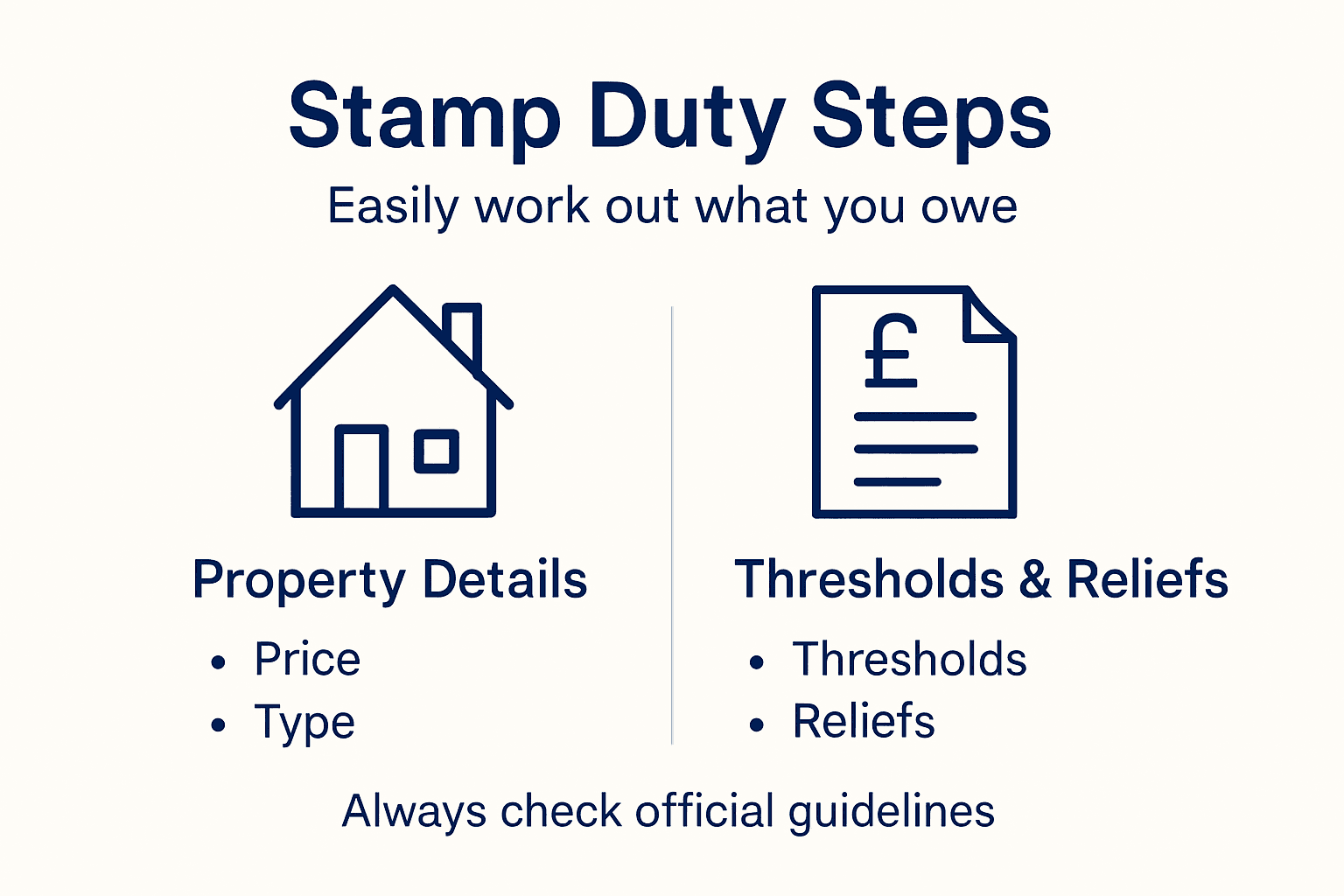
! Infographic shows key steps for stamp duty
\_ Pro tip:\_ \_Use official online stamp duty calculators as a double-check to verify your manual calculations and catch any potential errors.\_
Step 5: Verify your result and plan payment
The final stage of your stamp duty journey involves carefully confirming your calculations and preparing for timely payment through the SDLT online and paper returns process. Ensuring accuracy and understanding payment requirements is crucial to avoiding potential penalties.
Key verification and payment steps include:
- Double-check your original stamp duty calculations
- Confirm the total amount due
- Prepare sufficient funds for payment
- Understand the 14-day payment window after property completion
- Arrange payment through your solicitor or directly to HMRC
1. Review each calculation segment meticulously 2. Cross-reference with official online calculators 3. Consult your solicitor for final verification
\> Precise verification prevents unexpected financial complications during your property purchase.
Most buyers rely on their solicitor to file the SDLT return and manage the payment process. However, understanding the requirements ensures you’re actively involved and prepared for this critical financial obligation.
\_ Pro tip:\_ \_Set up a dedicated savings account or transfer stamp duty funds several weeks before completion to ensure you have the full amount readily available.\_
Simplify Your Stamp Duty Calculation with Expert Conveyancing Support
Understanding all the details involved in calculating stamp duty can be overwhelming. From identifying the correct thresholds based on your buyer status to applying the right reliefs and surcharges, errors can lead to unexpected costs or delays. If you want clear guidance through each step and a reliable team to handle the legal process, help is at hand.
At Conveyancing-Solicitor.co.uk, we connect you with trusted, five-star solicitors and conveyancers regulated by the SRA or CLC. Save up to 75% on fees with fixed price quotes and get personalised advice that ensures your stamp duty calculations and payments are correct and timely. Take the stress out of your property purchase by requesting your instant fixed-fee quote today without any obligation. Avoid costly mistakes now and proceed with confidence.
Ready to get started? See how easy conveyancing can be with expert help tailored to your stamp duty needs.
Frequently Asked Questions
How do I gather the essential details for calculating stamp duty on a house?
To calculate stamp duty accurately, start by collecting key information such as the property’s purchase price, whether it’s residential or non-residential, your buyer status, and ownership structure. Compile this information to ensure precise calculations and prevent miscalculations.
What are the different stamp duty thresholds I need to know?
Stamp duty thresholds vary depending on factors like buyer status and property type. Be aware that first-time buyers have a higher initial threshold of £300,000 compared to standard buyers at £125,000, which can significantly impact your tax liability.
How can I apply for reliefs to reduce my stamp duty?
To reduce your stamp duty liability, identify relevant reliefs such as First-Time Buyers’ Relief or Shared Ownership Relief. Check eligibility requirements for each relief, like ensuring you plan to live in the property, to maximise your savings.
What steps should I follow to calculate my total stamp duty?
Break down the total purchase price into specific tax rate bands and apply the corresponding percentage for each segment. For instance, on a property costing £295,000, the first £125,000 is taxed at 0%, and the next £125,000 at 2%, resulting in an accurate total stamp duty calculation.
How do I verify my stamp duty calculation and make the payment?
Double-check your calculations to confirm the total stamp duty due before payment. Prepare sufficient funds for payment, and ensure you pay within 14 days of property completion, either through your solicitor or directly to the authority responsible for tax collection.
About the Author
Verified Expert
PJ Singh
Co-Founder, Conveyancer Plus \| Conveyancing Industry Expert
BSc Computer Science, University of Hertfordshire \| 10+ Years Conveyancing Industry Experience
PJ Singh is Co-Founder of Conveyancer Plus, bringing over 10 years of expertise in the UK conveyancing and property sector. Previously Group Director of Sales and Marketing at Ackroyd Legal and Head of Business Development at Fitzalan Partners (Homeward Legal), PJ has worked with over 70 SRA-regulated solicitors nationwide. His deep understanding of the property transaction process and client journey makes him a trusted voice in simplifying conveyancing for homebuyers.
View all articles by PJ → LinkedIn
More Articles
Article\\ \\ Conveyancing Process Step by Step for UK Home Buyers \\ \\ Understand the UK conveyancing process step-by-step with our expert guide for home buyers. Get clear advice from a trusted conveyancing solicitor.\\ \\ 3 Feb 2026 Article\\ \\ Conveyancing Solicitor UK Delivers Trusted Local Specialist Conveyancing for New Builds England \\ \\ Find trusted, vetted conveyancing solicitors across the UK. Clear, Easy & Affordable conveyancing services with up to 75% savings on legal fees.\\ \\ 18 Dec 2025 Article\\ \\ Transfer of Equity – How It Affects Family Property \\ \\ Understand UK Transfer of Equity & how it affects family property. Get expert conveyancing solicitor advice on changing ownership.\\ \\ 4 Feb 2026
View reviews →
Get Your Free Conveyancing Quote
Compare prices from trusted local solicitors. No obligation, no hidden fees.
Instant quotes
No obligation
Save up to 75%
Get Free Quotes Now
Easy and affordable conveyancing made simple. SRA regulated solicitors across the UK.
Services
Quick Links
Legal
Contact
- 0330 053 2229
- clientservices@conveyancing-solicitor.co.uk
- United Kingdom
Conveyancing-Solicitor.co.uk is a trading name of Home Movers Plus Ltd, with the company registration number 13764928. © 2026 Home Movers Plus Ltd –
About the Author
PJ Singh
Co-Founder, Conveyancer Plus | Conveyancing Industry Expert
PJ Singh is Co-Founder of Conveyancer Plus, bringing over 10 years of expertise in the UK conveyancing and property sector. Previously Group Director of Sales and Marketing at Ackroyd Legal and Head of Business Development at Fitzalan Partners (Homeward Legal), PJ has worked with over 70 SRA-regulated solicitors nationwide. His deep understanding of the property transaction process and client journey makes him a trusted voice in simplifying conveyancing for homebuyers.
More Articles
Remortgage your house: step-by-step guide for UK homeowners
Learn how to remortgage your house in the UK with this clear step-by-step guide covering timing, costs, legal fees, and how to save up to 75% on conveyancing.
Transparency in conveyancing: your guide to clear home moves
Discover what transparency in conveyancing really means, where it breaks down, and how to choose a solicitor who keeps you fully informed with no hidden fees.
Essential conveyancing terms every UK home seller must know
Learn the essential conveyancing terms every UK home seller must know, from TA6 forms to exchange and completion, to avoid costly delays and legal pitfalls.
Get Your Free Conveyancing Quote
Compare prices from trusted local solicitors. No obligation, no hidden fees.