
How to Instruct a Solicitor When Buying a House Easily
How to Instruct a Solicitor When Buying a House Easily: Navigate the process with our step-by-step guide, from initial contact to completion.
PJ Singh
Co-Founder, Conveyancer Plus | Conveyancing Industry Expert
Co-Founder, Conveyancer Plus \| Conveyancing Industry Expert
Wednesday 4 February 202619 min read
Buying your first home in England should be exciting, not stressful, yet one confusing legal step can quickly turn anticipation into anxiety about surprise fees. With so many documents, forms, and solicitor choices lined up, it is easy to feel lost before you even start. This guide breaks down each step clearly, highlighting the documents, questions, and checks that keep you in control and help prevent hidden costs when instructing a solicitor for your property purchase.
Table of Contents
Quick Summary
| Key Point | Explanation |
|---|---|
| **1. Gather crucial property documents** | Collect proof of identity, address, and property details to prevent delays and meet regulatory requirements. |
| **2. Choose regulated solicitors carefully** | Verify that solicitors are regulated by SRA or CLC for client protection and to ensure professional standards. |
| **3. Request and compare fixed-fee quotes** | Obtain accurate fixed-fee quotes from multiple firms, checking what’s included and any additional costs. |
| **4. Confirm terms in writing** | Ensure the solicitor’s letter of engagement clarifies fees, services, and protections before signing. |
| **5. Maintain active communication** | Regularly check in with your solicitor to monitor progress and quickly address any issues that arise. |
Step 1: Gather essential documents and property details
Before your solicitor can move forward effectively, you need to collect the key documents and information about the property you’re buying. This step prevents delays later and ensures your solicitor has everything needed to protect your interests from day one.
Start by gathering proof of your identity and address. Your solicitor will need these for anti-money laundering (AML) checks, which are mandatory for all UK property transactions. A valid passport or driving licence works well for identity, alongside a recent utility bill or bank statement showing your current address. These documents might feel routine, but they’re non-negotiable and save valuable time when your solicitor submits them to meet regulatory requirements.
Next, collect all documents related to the property itself. Request property particulars and the fittings form from the estate agent or seller’s solicitor. The fittings form (known as TA10) clearly sets out which items are included in the sale, such as fitted wardrobes, carpets, or kitchen appliances. Without this, disagreements can arise later about what stays and what goes. You’ll also want copies of the title deeds, which prove ownership and reveal any restrictions on the property.
If you’re buying a leasehold property, ask for the full lease document and any recent service charge accounts. For new builds or recently renovated homes, warranties and building certificates matter greatly. Gather any survey reports you’ve already commissioned, along with records of recent maintenance or repairs the seller has completed.
Here is a summary of essential documents depending on the property type:
| Property Type | Key Additional Documents | Reason for Requirement |
|---|---|---|
| Freehold | Title deeds, TA10, TA6 | Prove ownership and sale details |
| Leasehold | Lease agreement, service charge accounts | Understand lease terms and costs |
| New build/renovated | Warranties, building certificates | Verify construction standard and guarantees |
| Any purchase | Identity and address proofs, survey reports | Regulatory compliance and buyer protection |
Your solicitor will also need the property information form (TA6), which the seller completes with details about the property’s age, council tax band, disputes, and any structural work. This form answers essential questions about the property that affect both value and your legal position. Create a simple folder—digital or physical—and keep everything organised by category. This small step transforms the entire process into something manageable rather than chaotic.
\_ Professional tip\_ \_Scan all documents to PDF and upload them to a secure cloud folder that you can share with your solicitor, saving weeks of back-and-forth emails and ensuring nothing gets lost in transit.\_
Step 2: Shortlist and compare SRA- or CLC-regulated solicitors
Now that you have your documents ready, it’s time to find solicitors worth instructing. Regulation matters far more than you might think, so start your search by identifying firms that are properly authorised and overseen by the right bodies.
! Woman comparing solicitor quotes at home

Begin by checking whether a solicitor is regulated by the Solicitors Regulation Authority (SRA) or the Council for Licensed Conveyancers (CLC). Both bodies impose strict professional standards, require indemnity insurance, and offer client protection schemes if something goes wrong. Why SRA regulation matters becomes clear when you realise that unregulated firms offer you zero recourse if they breach your trust or mishandle your money. Spend a few minutes on the SRA or CLC websites to verify any firm you’re considering. Type their name into the search box and confirm they’re active and in good standing. If a firm won’t give you their regulatory reference number, that’s a red flag.
This table helps compare regulation and what to expect from regulated solicitors:
| Regulator | Main Protections Offered | Typical Verification Method |
|---|---|---|
| SRA (Solicitors Regulation Authority) | Professional conduct, client money safety | Check SRA website for firm status |
| CLC (Council for Licensed Conveyancers) | Experience standards, indemnity insurance | Search CLC directory for membership |
| Unregulated firms | No formal safeguards, no compensation | Absence from SRA/CLC records |
Next, gather at least three to five firms on your shortlist. Don’t just pick the first result on Google or the cheapest quote you find. Look for solicitors with experience in your specific situation, whether that’s a first-time purchase, leasehold property, or new build home. Check their online reviews on Trustpilot or Google, but read carefully. A firm with mostly five-star reviews from recent conveyances is more telling than generic praise. Pay attention to comments about communication, hidden fees, and how quickly they resolved issues.
Once you have your shortlist, request fixed fee quotes from each firm. Ask specifically what’s included in their fee and what costs extra as disbursements. Fixed fees remove the anxiety of unexpected bills, and comparing quotes side by side shows you exactly what you’re paying for. Some firms charge £800, others £1,500, and knowing the difference helps you spot value rather than just price.
Finally, have a short conversation with your top two or three choices. Ask how they’d handle delays, what their communication process looks like, and whether they have availability to complete your transaction on your timeline. You want a solicitor who feels responsive and knowledgeable, not one who makes you chase them for updates.
\_ Professional tip\_ \_Request a list of recent client references or testimonials from the solicitor’s previous conveyancing cases, then follow up with at least one to hear firsthand about their experience.\_
Step 3: Request and review fixed-fee conveyancing quotes
With your shortlist ready, it’s time to get concrete numbers. Fixed-fee quotes give you certainty about costs upfront, which is exactly what you need when budgeting for your purchase.
! Infographic showing steps to instruct a solicitor
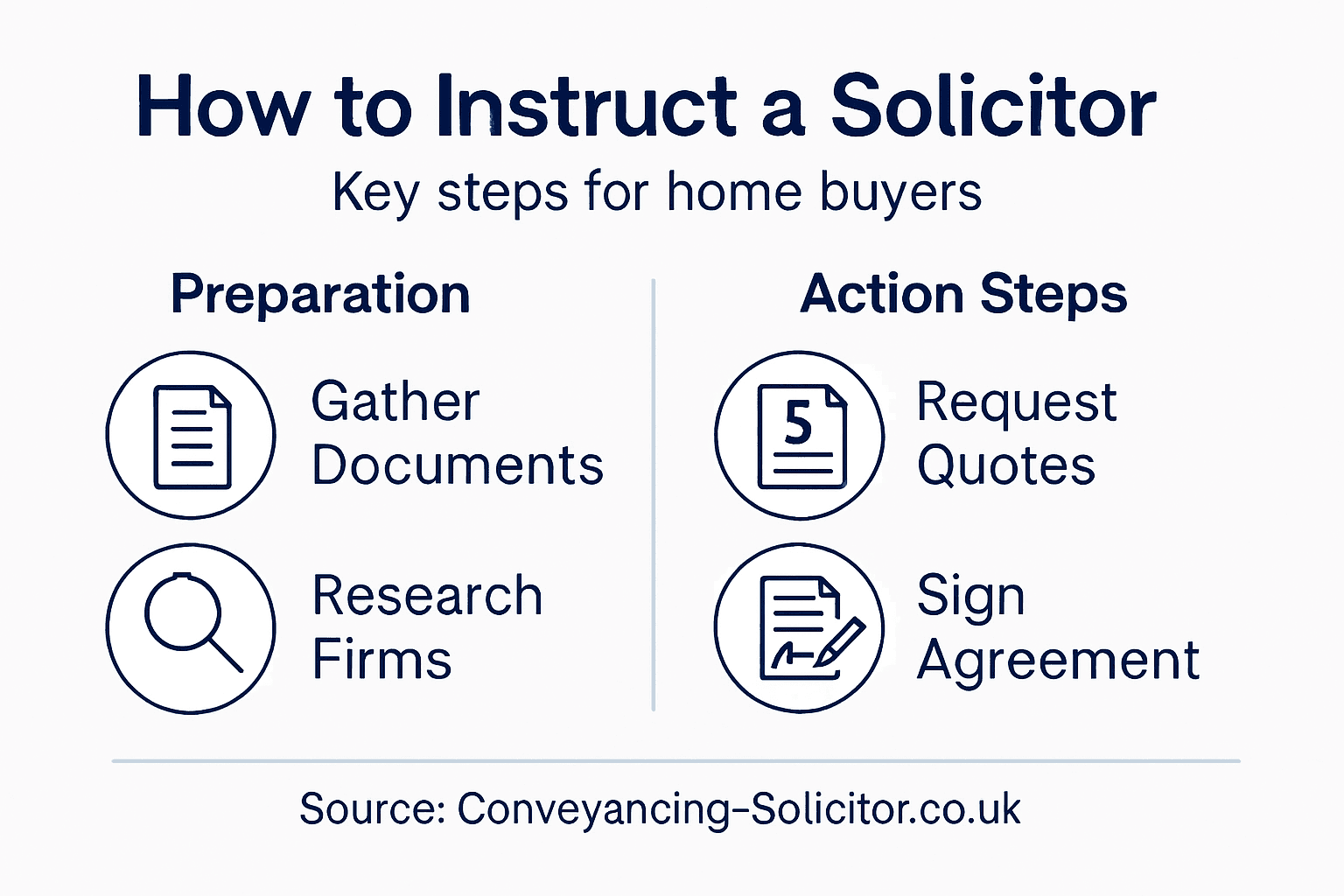
Contact each firm on your shortlist and ask for a fixed-fee quote for conveyancing. Be specific about what you’re buying, whether it’s freehold or leasehold, and whether you need a mortgage. The more detail you provide, the more accurate the quote will be. Most solicitors can provide quotes within 24 hours, either by email or through their website. When you receive a quote, read it carefully. Look for the total fee amount, then check what’s included and what appears as separate disbursements like search fees, Land Registry fees, and anti-money laundering checks.
Disbursements are costs that solicitors pay on your behalf to third parties. These vary depending on your property, but they’re not optional charges the firm invents. A quote of £950 plus £400 in disbursements is transparent and honest. What you’re looking for is clarity, not necessarily the lowest number. Compare your quotes side by side. Are the core fees similar but disbursements wildly different? Ask why. Are some firms quoting significantly lower than others? Find out what they’re not including, because if their quote seems too good to be true, it probably is.
Check whether the quote includes how to compare conveyancing quotes online features like unlimited telephone support, progress updates, or whether you’ll be charged extra for these services. Some firms build communication costs into their fee, whilst others charge for each phone call or email update. This matters when you’re an anxious first-time buyer wanting regular contact.
Once you’ve reviewed all quotes, narrow down to your top choice. Look at the total package: regulation, experience, fixed fee transparency, and how the firm made you feel during your initial contact. Don’t delay once you’ve decided. Good solicitors book up quickly, especially in busy seasons.
\_ Professional tip\_ \_Request the quote in writing and ask the solicitor to confirm that the fee is fixed regardless of delays caused by the seller, surveyor, or mortgage lender, so you’re never surprised by hidden charges later.\_
Step 4: Confirm instructions and agree on terms in writing
Once you’ve chosen your solicitor, the next step is formalising the relationship. Getting everything in writing protects both you and your solicitor, creating a clear record of what you’ve agreed to.
Your solicitor will send you a letter of engagement or terms of business document. This outlines their fixed fee, what’s included, the disbursements you’ll pay, and their complaints procedure. Read it thoroughly. This is your chance to clarify anything that seemed vague in the quote conversation. If they quoted £900 for their fee but the letter says £1,200, ask why before you sign. The document should also specify their communication methods, how long completion typically takes, and what happens if costs exceed the quoted amount.
Look specifically for sections covering the fixed fee guarantee. Your terms should confirm that the solicitor’s fee remains fixed even if the transaction takes longer than expected. Delays happen regularly due to mortgage lenders, surveyors, or the seller’s solicitor being slow. You shouldn’t pay more simply because circumstances beyond anyone’s control caused a delay. If the terms don’t mention this protection, email your solicitor asking for clarity before you sign.
Check what the document says about your money. Your solicitor will hold funds in a client account when you pay your deposit and later at completion. The terms should explain how they protect client money, including indemnity insurance details. They should also outline when they’ll forward money to the seller’s solicitor and when your keys arrive after completion.
Send the signed letter of engagement back promptly along with your identity documents for the anti-money laundering checks. Once the solicitor receives both, they’re officially instructed and can begin work. From this point, you have a contractual relationship with clear expectations on both sides.
\_ Professional tip\_ \_Keep a copy of your signed terms of engagement in a safe folder throughout the entire transaction, as you’ll need to reference specific clauses if questions arise about fees, timescales, or services during the conveyancing process.\_
Step 5: Monitor solicitor progress and address questions promptly
Your solicitor is now working on your behalf, but this doesn’t mean you can sit back passively. Active communication throughout the transaction keeps everything moving smoothly and catches issues early before they derail your completion date.
Stay in regular contact with your solicitor. Ask them what their preferred communication method is and how quickly you can expect responses. Some firms offer daily updates during busy periods, whilst others provide weekly summaries. Both approaches work, but you need to know what to expect. When your solicitor sends you documents or requests information, respond within 48 hours if possible. Delays on your end ripple through the entire transaction and can push back your completion date by weeks.
Your solicitor will keep you updated on key stages. These include survey results being reviewed, mortgage lender searches being returned, property searches being completed, and contract negotiations with the seller’s solicitor. Keeping close contact with your solicitor helps resolve issues efficiently and ensures you understand what’s happening at each milestone. When they send you a contract to review, don’t delay reading it. If something doesn’t make sense, ask. That’s what you’re paying them for.
Watch for red flags. If your solicitor goes silent for more than a week without explanation, chase them. If they seem confused about your property details or keep asking the same questions repeatedly, that’s concerning. If they’re being evasive about costs or won’t explain why disbursements have increased, push back. A good solicitor welcomes questions and provides clear answers.
Keep your own records of what your solicitor tells you. Write down completion dates mentioned, fees confirmed, and key information about the property. If discrepancies arise later, you’ll have documentation to reference.
\_ Professional tip\_ \_Create a simple spreadsheet listing key milestones your solicitor mentioned, expected completion dates, and important deadlines for document submission, then cross-reference it against weekly updates to ensure nothing slips through the cracks.\_
Step 6: Verify completion and final checks before exchange
You’re approaching one of the most critical moments in your property purchase. Before exchanging contracts, you need to complete a thorough final verification to ensure everything is in order and ready to proceed.
Start by confirming your mortgage offer is still valid and hasn’t been withdrawn or made conditional on anything new. Your solicitor should have received formal confirmation from your lender that they’re satisfied with the property searches and survey. If your lender has imposed any conditions, these must be completely cleared before exchange. Common conditions include remedial work or further inspection, so don’t skip this step. A mortgage offer withdrawal at the last minute can collapse your entire purchase.
Review all property searches that have come back from the local authority and other search providers. These reveal information about planning history, environmental risks, flooding, and structural concerns. Thorough final checks must be completed including confirming property searches clearance before you’re ready to exchange contracts. If any search reveals something unexpected, discuss it with your solicitor immediately. Sometimes issues are minor and easily resolved, but occasionally they affect your willingness to proceed. Better to discover this now than after you’ve exchanged.
Confirm your deposit amount with your solicitor. This is the money you’ll transfer to the seller’s solicitor when contracts are exchanged, typically 5 to 10 percent of the purchase price. Know exactly how much you’re paying and when you need to transfer it. Your solicitor will tell you the deadline, usually 24 hours before exchange. Missing this deadline can cause the seller to withdraw from the sale.
Ask your solicitor for a detailed summary of everything that will happen on completion day. When will funds transfer? When will you get the keys? What time do you need to be available? Understanding the sequence of events removes anxiety and helps you plan accordingly.
\_ Professional tip\_ \_Request a final checklist from your solicitor the week before exchange, confirming all searches have arrived, your mortgage lender is satisfied, and the deposit is ready to transfer, so you can exchange with complete confidence.\_
Make Instructing a Solicitor Easy with Trusted Conveyancing Experts
Navigating the legal maze of buying a house can feel overwhelming especially when you worry about finding a properly regulated solicitor who offers clear fixed fees and communicates promptly. This article highlights the crucial steps to gather your documents, compare regulated conveyancers, and secure fixed-fee quotes — all designed to protect your interests and avoid hidden costs.
At Conveyancing-Solicitor.co.uk, we understand these challenges and make it simple to connect with top rated, SRA- or CLC-regulated solicitors who specialise in exactly the kind of property purchase you are making. Our service delivers instant fixed-fee quotes that save you time and money by cutting out the guesswork around pricing and service standards. By using our platform you benefit from vetted professionals committed to transparent terms, prompt updates, and no nasty surprises. Whether you need help understanding the conveyancing process or want peace of mind with a trustworthy solicitor, we are here to guide you.
Ready to get started? Discover how easy it is to find the right conveyancer for your home purchase by getting your instant fixed-fee quote today. Make the next step confident and stress free by reading our comprehensive step-by-step conveyancing process guide or learn more about the importance of choosing a regulated conveyancer who will safeguard your transaction from start to finish.
Frequently Asked Questions
What documents do I need to gather before instructing a solicitor?
Before instructing a solicitor, collect proof of your identity and address, such as a passport or driving licence and a recent utility bill. Gather documents related to the property, including the title deeds and fittings form, to ensure everything is ready for your solicitor to proceed without delays.
How do I know if a solicitor is properly regulated?
To verify a solicitor’s regulation, check if they are authorised by the Solicitors Regulation Authority (SRA) or the Council for Licensed Conveyancers (CLC). You can search their names on the respective websites to confirm their current status and compliance.
What should I include in my request for a fixed-fee conveyancing quote?
When requesting a fixed-fee conveyancing quote, specify the property type—such as freehold or leasehold—and whether you have a mortgage. Be clear about any additional details that might affect the quote, ensuring you receive an accurate estimate tailored to your situation.
How can I keep the conveyancing process on track after instructing a solicitor?
Stay proactive by regularly communicating with your solicitor and responding promptly to any requests for information. Set a system to monitor key milestones and deadlines, which will help prevent any delays in the process and keep everything moving smoothly.
What final checks should I complete before exchanging contracts?
Before exchanging contracts, confirm your mortgage offer’s validity and review all property searches for any potential issues. Ensure you understand the deposit amount and have a clear timeline for completion to ensure a smooth exchange process.
About the Author
Verified Expert
PJ Singh
Co-Founder, Conveyancer Plus \| Conveyancing Industry Expert
BSc Computer Science, University of Hertfordshire \| 10+ Years Conveyancing Industry Experience
PJ Singh is Co-Founder of Conveyancer Plus, bringing over 10 years of expertise in the UK conveyancing and property sector. Previously Group Director of Sales and Marketing at Ackroyd Legal and Head of Business Development at Fitzalan Partners (Homeward Legal), PJ has worked with over 70 SRA-regulated solicitors nationwide. His deep understanding of the property transaction process and client journey makes him a trusted voice in simplifying conveyancing for homebuyers.
View all articles by PJ → LinkedIn
More Articles
Article\\ \\ Conveyancing Process Step by Step for UK Home Buyers \\ \\ Understand the UK conveyancing process step-by-step with our expert guide for home buyers. Get clear advice from a trusted conveyancing solicitor.\\ \\ 3 Feb 2026 Article\\ \\ Conveyancing Solicitor UK Delivers Trusted Local Specialist Conveyancing for New Builds England \\ \\ Find trusted, vetted conveyancing solicitors across the UK. Clear, Easy & Affordable conveyancing services with up to 75% savings on legal fees.\\ \\ 18 Dec 2025 Article\\ \\ Transfer of Equity – How It Affects Family Property \\ \\ Understand UK Transfer of Equity & how it affects family property. Get expert conveyancing solicitor advice on changing ownership.\\ \\ 4 Feb 2026
View reviews →
Get Your Free Conveyancing Quote
Compare prices from trusted local solicitors. No obligation, no hidden fees.
Instant quotes
No obligation
Save up to 75%
Get Free Quotes Now
Easy and affordable conveyancing made simple. SRA regulated solicitors across the UK.
Services
Quick Links
Legal
Contact
- 0330 053 2229
- clientservices@conveyancing-solicitor.co.uk
- United Kingdom
Conveyancing-Solicitor.co.uk is a trading name of Home Movers Plus Ltd, with the company registration number 13764928. © 2026 Home Movers Plus Ltd –
About the Author
PJ Singh
Co-Founder, Conveyancer Plus | Conveyancing Industry Expert
PJ Singh is Co-Founder of Conveyancer Plus, bringing over 10 years of expertise in the UK conveyancing and property sector. Previously Group Director of Sales and Marketing at Ackroyd Legal and Head of Business Development at Fitzalan Partners (Homeward Legal), PJ has worked with over 70 SRA-regulated solicitors nationwide. His deep understanding of the property transaction process and client journey makes him a trusted voice in simplifying conveyancing for homebuyers.
More Articles
Remortgage your house: step-by-step guide for UK homeowners
Learn how to remortgage your house in the UK with this clear step-by-step guide covering timing, costs, legal fees, and how to save up to 75% on conveyancing.
Transparency in conveyancing: your guide to clear home moves
Discover what transparency in conveyancing really means, where it breaks down, and how to choose a solicitor who keeps you fully informed with no hidden fees.
Essential conveyancing terms every UK home seller must know
Learn the essential conveyancing terms every UK home seller must know, from TA6 forms to exchange and completion, to avoid costly delays and legal pitfalls.
Get Your Free Conveyancing Quote
Compare prices from trusted local solicitors. No obligation, no hidden fees.