
Essential Steps in House Buying: A Simple UK Guide
Essential Steps in House Buying: A Simple UK Guide. Navigate your property journey with our clear blog post, from offer to completion.
PJ Singh
Co-Founder, Conveyancer Plus | Conveyancing Industry Expert
Co-Founder, Conveyancer Plus \| Conveyancing Industry Expert
Wednesday 4 February 202615 min read
Most British first-time buyers are shocked to learn that moving costs alone can reach £1,500. Navigating the property process in the United Kingdom often feels complicated when every pound counts and decisions come fast. This guide breaks down the steps with practical advice, highlighting how fixed-fee conveyancing can give you clarity about expenses from day one and help make informed choices at every stage.
Table of Contents
Quick Summary
| Key Point | Explanation |
|---|---|
| **1. Assess Financial Preparedness** | Calculate savings and budget for a deposit and additional costs before house hunting. |
| **2. Define Your Property Criteria** | Identify must-have features such as location, type, and budget to narrow your options effectively. |
| **3. Make Informed Offers** | Research local property values to ensure your offer is competitive while leaving room for negotiation. |
| **4. Select a Qualified Conveyancer** | Choose a regulated conveyancer promptly to ensure a smooth legal process and transaction success. |
| **5. Verify Completion and Conditions** | Prior to moving in, check the property’s condition and confirm all agreed repairs or conditions have been fulfilled. |
Step 1: Assess your financial readiness
Buying a home begins with understanding your financial landscape. This critical step involves checking your savings, income stability, and overall financial health to determine whether you are ready to make one of the biggest purchases of your life.
Start by calculating your total savings and evaluating how much you can realistically allocate towards a home deposit. Check your mortgage borrowing potential through online calculators or mortgage advisers. Most lenders require a deposit between 5% and 20% of the property value. Beyond the deposit, you will need to budget for additional costs such as legal fees, property surveys, stamp duty, and moving expenses.
Review your monthly income and expenditure carefully. Financial experts recommend that your mortgage payments should not exceed 28% to 30% of your monthly take home pay. This means creating a comprehensive budget that accounts for mortgage repayments, council tax, utilities, insurance, and potential maintenance costs. Comprehensive budgeting helps prevent financial strain and ensures you select a property within your means.
Here is a comparison of key costs commonly encountered when buying a home in the UK:
| Cost Type | Typical Range | Purpose |
|---|---|---|
| Deposit | 5%-20% property value | Secures mortgage, shows commitment |
| Legal Fees | £800-£2,000 | Covers solicitor or conveyancer fees |
| Stamp Duty | 0%-12% of property | Government tax on property purchase |
| Survey/Valuation | £250-£1,500 | Identifies property issues |
| Moving Expenses | £300-£1,500 | Covers removal and logistics |
| Mortgage Fees | £0-£2,000 | Application and arrangement charges |
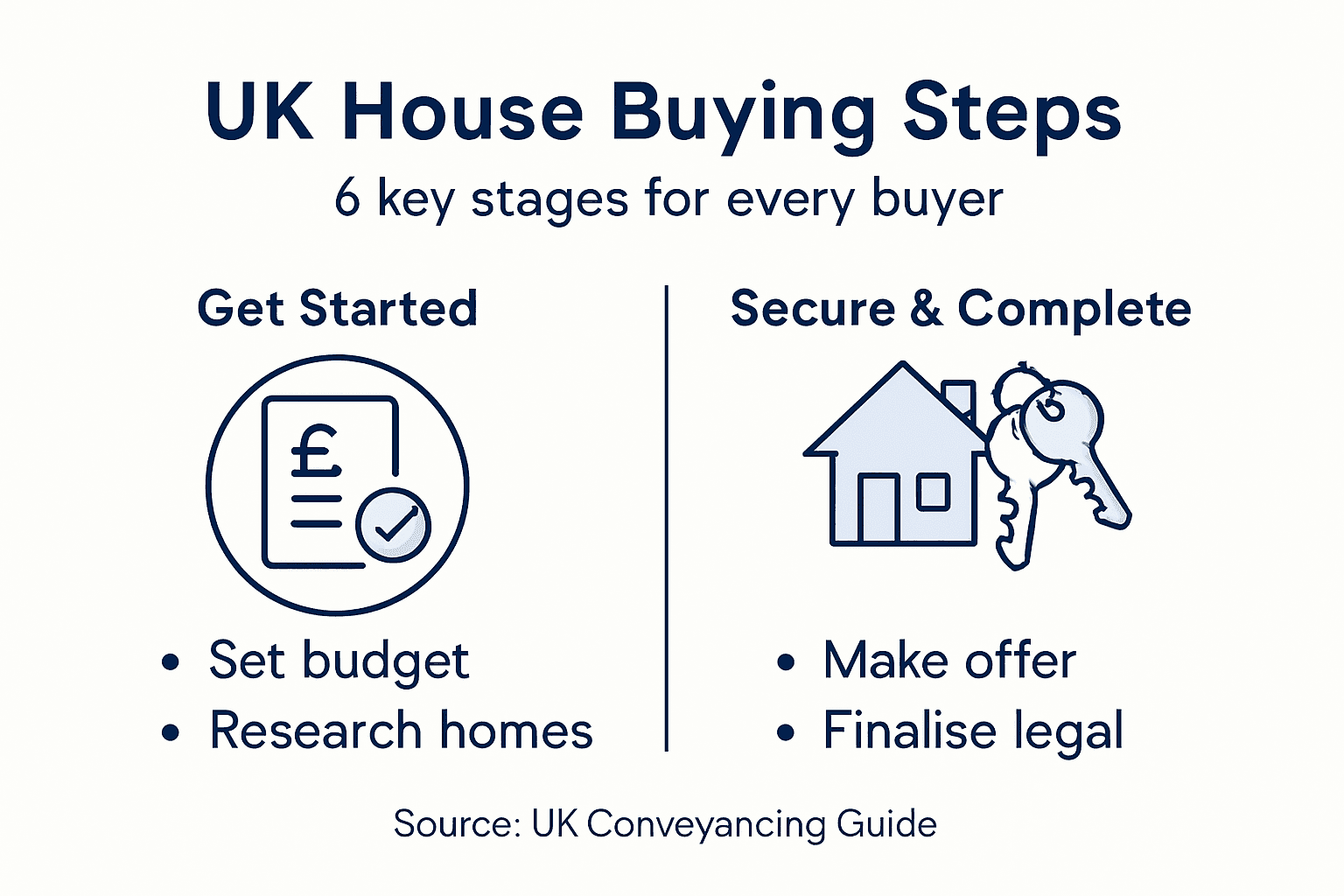
! Infographic showing UK home buying steps
\_ Top tip:\_ \_Consider getting a mortgage agreement in principle before house hunting to understand exactly how much you can borrow and demonstrate your seriousness to sellers.\_
Step 2: Research and shortlist suitable properties
Finding the perfect property requires strategic research and a systematic approach to understanding what you truly want and need in a home. This stage is about transforming your property dreams into a realistic and achievable shortlist.
! Viewing property with agent at entryway

Begin by defining your must have criteria such as location, property type, number of bedrooms, and budget range. Use online property market resources to explore different areas and property types. Look beyond aesthetic appeal and consider practical aspects like commute times, local amenities, school districts, and future resale potential. Create a spreadsheet to track properties that match your requirements, noting details such as asking price, square footage, condition, and unique features.
Expand your search beyond online listings by registering with local estate agents who can provide insider knowledge about upcoming properties. Attend viewings with a critical eye understanding that each property represents not just a building but a potential home. Take photographs and notes during viewings to help compare properties objectively. Remember that your first viewing is about gathering information and getting a feel for the property your second viewing will be more detailed.
\_ Top tip:\_ \_Schedule property viewings during different times of day to get a comprehensive understanding of the neighbourhood and potential noise or traffic levels.\_
Step 3: Make an offer and secure a mortgage
Making an offer on a property and securing a mortgage represents a critical milestone in your home buying journey. This stage transforms your property search from theoretical exploration to a concrete commitment to purchasing your new home.
Strategic offer negotiation requires careful preparation and confidence. Begin by researching comparable property prices in the area to determine a fair offer price. Most buyers start around 5% to 10% below the asking price, leaving room for negotiation. Prepare your offer with supporting evidence such as recent sold prices of similar properties. When presenting your offer, demonstrate you are a serious buyer by having a mortgage agreement in principle ready and showing you can proceed quickly.
Securing a mortgage involves submitting a formal application after your offer is accepted. Understanding mortgage options is crucial for finding the right financial product. Gather all necessary documentation including proof of income, bank statements, and identification. Lenders will conduct a thorough assessment of your financial circumstances, including credit history and affordability checks. Be prepared to provide detailed financial information and respond promptly to any additional requests from your chosen lender.
\_ Top tip:\_ \_Get your paperwork organised in advance and consider speaking with a mortgage broker who can help match you with the most suitable mortgage product for your specific financial situation.\_
Step 4: Instruct a regulated conveyancer
Selecting the right legal professional to handle your property transaction is a crucial step that can significantly impact the smoothness and success of your home purchase. Your conveyancer will be your primary guide through the complex legal landscape of property buying.
Choose a regulated legal professional who is registered with either the Solicitors Regulation Authority (SRA) or the Council for Licensed Conveyancers (CLC). Research potential candidates by checking their professional credentials, reading client reviews, and requesting transparent quotes. During initial consultations, ask about their experience with similar property types and their typical communication approach. Request a comprehensive breakdown of their fees upfront to avoid unexpected costs and ensure you understand exactly what services are included.
Once you have selected your conveyancer, provide them with all necessary documentation promptly. Understand the conveyancer’s legal responsibilities which include conducting property searches, reviewing contracts, liaising with the seller’s solicitor, and protecting your interests throughout the transaction. Maintain open communication and respond quickly to any requests for additional information to prevent potential delays in your property purchase.
The following table summarises the main roles of professionals involved in a property purchase:
| Professional | Main Responsibility | Regulating Body |
|---|---|---|
| Estate Agent | Markets and negotiates property | Property Ombudsman |
| Mortgage Adviser/Broker | Finds suitable mortgage deals | Financial Conduct Authority (FCA) |
| Solicitor/Conveyancer | Legal transfer and checks | SRA / CLC |
| Surveyor | Assesses property condition | Royal Institution of Chartered Surveyors (RICS) |
\_ Top tip:\_ \_Ask your conveyancer about their estimated timeline for completion and request regular update intervals to keep yourself informed throughout the process.\_
Step 5: Complete legal checks and finalise contracts
This critical stage transforms your property purchase from an aspiration to a legally binding transaction. Your conveyancer will conduct comprehensive checks to protect your interests and ensure a smooth transfer of property ownership.
Legal checks are essential for property transactions, covering multiple aspects of property verification. Your conveyancer will perform local authority searches to uncover any potential planning issues, environmental concerns, or restrictions that might affect the property. These searches include checking for planned road developments, mining activities, flood risks, and other factors that could impact property value or future use. They will also review the property title to confirm legal ownership and check for any existing charges or restrictions.
Finalising contracts requires meticulous legal scrutiny from your solicitor. This involves carefully reviewing the draft contract, negotiating any necessary amendments, and ensuring all terms are clear and fair. Your conveyancer will liaise with the seller’s legal representative to resolve any queries or concerns. Once both parties are satisfied, you will reach the critical exchange of contracts stage where the agreement becomes legally binding. At this point, you will typically pay a deposit and agree on a completion date.
\_ Top tip:\_ \_Request a comprehensive written report from your conveyancer detailing all search results and potential issues to fully understand the property’s legal standing before committing to purchase.\_
Step 6: Verify completion and collect your keys
Completion day marks the exciting final stage of your property purchase where ownership legally transfers and you become a homeowner. This momentous occasion requires careful coordination and understanding of the final procedural steps.
Completion involves precise financial transfer orchestrated by your solicitor. Your conveyancer will transfer the full purchase funds to the seller’s solicitor, who will then confirm receipt. Once the funds are confirmed, the estate agent will release the keys to you. Ensure you have arranged multiple copies of the keys and understand the exact time and location for key collection. Some sellers leave keys with estate agents, while others might hand them directly to you at the property.
After collecting your keys, conduct a thorough property walkthrough to ensure everything is as expected during the final inspection. Check that the property is in the agreed condition and that any negotiated repairs or changes have been completed. Take meter readings for utilities, confirm the property’s condition matches the initial survey, and begin planning your move. This is the moment your property journey reaches its culmination transforming your dream of homeownership into reality.
\_ Top tip:\_ \_Bring a measuring tape and notebook on key collection day to start planning furniture placement and potential home improvements.\_
Make Your Home Buying Journey Clear and Affordable with Expert Conveyancing Support
Navigating the essential steps of buying a home can feel overwhelming, especially when it comes to securing a trustworthy conveyancer to handle legal checks, contracts, and completion. You want to avoid delays, unexpected fees, and legal pitfalls while making sure your purchase proceeds smoothly. With key challenges like understanding legal responsibilities and managing conveyancing fees, finding the right expert is critical to protect your investment and peace of mind.
Conveyancing-Solicitor.co.uk connects you instantly to top-rated, SRA- or CLC-regulated conveyancers across the UK who offer transparent, fixed-fee quotes that could save you up to 75% compared to standard rates. Whether you are a first-time buyer or moving to your forever home, our trusted network ensures clarity, fast communication, and thorough legal support every step of the way. Don’t let confusion or hidden costs slow your progress.
Ready to secure expert conveyancing that matches your home buying needs? Take control now and get your instant fixed-fee quote from premium conveyancers local to you at Conveyancing-Solicitor.co.uk Instant Quote. Discover how simple and affordable conveyancing can be with our trusted quotes team supporting your journey from initial offer to key collection.
Explore how to find a good conveyancer and learn more about why choosing a regulated conveyancing solicitor is crucial to successful property buying. Make your next step today — your new home and a secure legal process await.
Frequently Asked Questions
What is the first step in the house buying process?
The first step is to assess your financial readiness. Calculate your total savings and determine how much you can afford for a deposit, typically between 5% and 20% of the property’s value.
How do I research and shortlist properties effectively?
Begin by defining your must-have criteria such as location, property type, and budget range. Use online property resources and create a spreadsheet to track suitable properties and their details.
What should I consider when making an offer on a property?
When making an offer, research comparable property prices to determine a fair price, typically starting 5% to 10% below the asking price. Prepare your offer with evidence of similar sales and have a mortgage agreement in principle ready.
Why is it important to choose a regulated conveyancer?
Selecting a regulated conveyancer is crucial because they will handle the legal aspects of your property transaction, ensuring your interests are protected. Research potential candidates and request transparent quotes for their services.
What legal checks does my conveyancer conduct before completion?
Your conveyancer will conduct various legal checks, including local authority searches and reviewing the property’s title to confirm ownership and uncover any potential issues. These checks are essential to ensure you make an informed purchase.
What should I do on completion day?
On completion day, your conveyancer will transfer the purchase funds to the seller’s solicitor. Ensure you have your keys, conduct a walkthrough of the property, and check that it is in the agreed condition before moving in.
About the Author
Verified Expert
PJ Singh
Co-Founder, Conveyancer Plus \| Conveyancing Industry Expert
BSc Computer Science, University of Hertfordshire \| 10+ Years Conveyancing Industry Experience
PJ Singh is Co-Founder of Conveyancer Plus, bringing over 10 years of expertise in the UK conveyancing and property sector. Previously Group Director of Sales and Marketing at Ackroyd Legal and Head of Business Development at Fitzalan Partners (Homeward Legal), PJ has worked with over 70 SRA-regulated solicitors nationwide. His deep understanding of the property transaction process and client journey makes him a trusted voice in simplifying conveyancing for homebuyers.
View all articles by PJ → LinkedIn
More Articles
Article\\ \\ Conveyancing Process Step by Step for UK Home Buyers \\ \\ Understand the UK conveyancing process step-by-step with our expert guide for home buyers. Get clear advice from a trusted conveyancing solicitor.\\ \\ 3 Feb 2026 Article\\ \\ Conveyancing Solicitor UK Delivers Trusted Local Specialist Conveyancing for New Builds England \\ \\ Find trusted, vetted conveyancing solicitors across the UK. Clear, Easy & Affordable conveyancing services with up to 75% savings on legal fees.\\ \\ 18 Dec 2025 Article\\ \\ Transfer of Equity – How It Affects Family Property \\ \\ Understand UK Transfer of Equity & how it affects family property. Get expert conveyancing solicitor advice on changing ownership.\\ \\ 4 Feb 2026
View reviews →
Get Your Free Conveyancing Quote
Compare prices from trusted local solicitors. No obligation, no hidden fees.
Instant quotes
No obligation
Save up to 75%
Get Free Quotes Now
Easy and affordable conveyancing made simple. SRA regulated solicitors across the UK.
Services
Quick Links
Legal
Contact
- 0330 053 2229
- clientservices@conveyancing-solicitor.co.uk
- United Kingdom
Conveyancing-Solicitor.co.uk is a trading name of Home Movers Plus Ltd, with the company registration number 13764928. © 2026 Home Movers Plus Ltd –
About the Author
PJ Singh
Co-Founder, Conveyancer Plus | Conveyancing Industry Expert
PJ Singh is Co-Founder of Conveyancer Plus, bringing over 10 years of expertise in the UK conveyancing and property sector. Previously Group Director of Sales and Marketing at Ackroyd Legal and Head of Business Development at Fitzalan Partners (Homeward Legal), PJ has worked with over 70 SRA-regulated solicitors nationwide. His deep understanding of the property transaction process and client journey makes him a trusted voice in simplifying conveyancing for homebuyers.
More Articles
Remortgage your house: step-by-step guide for UK homeowners
Learn how to remortgage your house in the UK with this clear step-by-step guide covering timing, costs, legal fees, and how to save up to 75% on conveyancing.
Transparency in conveyancing: your guide to clear home moves
Discover what transparency in conveyancing really means, where it breaks down, and how to choose a solicitor who keeps you fully informed with no hidden fees.
Essential conveyancing terms every UK home seller must know
Learn the essential conveyancing terms every UK home seller must know, from TA6 forms to exchange and completion, to avoid costly delays and legal pitfalls.
Get Your Free Conveyancing Quote
Compare prices from trusted local solicitors. No obligation, no hidden fees.