
Conveyancing Tips for Families – Stress-Free Moves
Conveyancing Tips for Families – Stress-Free Moves: Navigate property law with ease. Our guide helps families achieve smooth UK moves.
PJ Singh
Co-Founder, Conveyancer Plus | Conveyancing Industry Expert
Co-Founder, Conveyancer Plus \| Conveyancing Industry Expert
Wednesday 4 February 202618 min read
Every parent faces that moment when the excitement of finding your ideal home turns into anxiety about legal paperwork, hidden fees, and strict moving timelines. Buying a property in the United Kingdom means understanding the legal process known as conveyancing, which protects your family’s future while keeping costly pitfalls at bay. This guide explains, in plain terms, how the right conveyancer simplifies everything, helps you avoid delays, and ensures your move is as stress-free as possible.
Table of Contents
Key Takeaways
| Point | Details |
|---|---|
| **Understanding Conveyancing** | Conveyancing is the legal process of transferring property ownership, requiring a conveyancer to manage legal complexities and protect family interests. |
| **Selecting a Conveyancer** | Choose a conveyancer based on expertise rather than cost; effective communication and understanding of your specific needs are crucial. |
| **Anticipating Costs** | Be aware of hidden costs beyond the initial quote, including disbursements and additional fees, to budget accurately for your house move. |
| **Preventing Delays** | Prepare all required documentation upfront and maintain proactive communication with your conveyancer to minimise potential delays in the process. |
Conveyancing for Families Explained Clearly
Conveyancing is simply the legal process of transferring property ownership from a seller to a buyer. For families buying their first home or upgrading to somewhere larger, it’s the paperwork and legal steps that sit between finding the right property and getting your keys. While it sounds formal and intimidating, breaking it down into stages makes the journey far less daunting. The good news is that regulated conveyancers and solicitors handle the complex parts, so you’re not navigating this alone.
At its core, conveyancing involves several key stages. Your conveyancer begins by reviewing the property’s title documents, arranging searches to uncover any issues with the land or building, and handling the contracts that protect both you and the seller. They’ll liaise with the seller’s solicitor, your mortgage lender (if you have one), and local authorities to ensure everything checks out. The Law Society’s Conveyancing Protocol sets out a standardised framework that conveyancers follow, creating transparency and consistency throughout the process. This protocol applies whether you’re buying a freehold house, a leasehold flat, or anything in between, giving families confidence that their transaction follows best practice standards.
What makes conveyancing essential for families is that it protects your investment. Your conveyancer uncovers problems early, such as boundary disputes, outstanding debts on the property, or structural issues flagged by searches. They ensure your mortgage lender’s requirements are met, manage the exchange of contracts (the point where the deal becomes legally binding), and arrange the final completion when you take ownership and funds transfer. Without this layer of legal protection, families would face enormous financial and legal risks. The process typically takes 8 to 12 weeks, though this varies depending on how straightforward the sale is and how quickly all parties respond.
\_ Pro tip:\_ \_Instruct your conveyancer as soon as your offer is accepted, not after—this gives them time to conduct searches and spot potential issues before you’re emotionally invested in the property, allowing you to negotiate or withdraw without penalty during the early stages.\_
Choosing the Right Conveyancer for Your Needs
Selecting a conveyancer is one of the most important decisions you’ll make during your property purchase. Your conveyancer becomes your legal guardian throughout the transaction, protecting your interests and ensuring nothing falls through the cracks. The temptation to simply pick the cheapest quote is strong, particularly when you’re juggling moving costs, but the Legal Ombudsman’s guidance is clear: cheapest is not always best. A conveyancer who charges significantly less may cut corners on searches, skip thorough title checks, or provide limited communication when issues arise. Instead, focus on finding someone with the right expertise for your specific situation, whether that’s a straightforward first-time buyer purchase or a more complex leasehold transaction.
When comparing conveyancers, look beyond the initial quote. Ask about their experience with your type of property and whether they’ve handled similar transactions in your area. A solicitor familiar with local practices and the specific needs of families can anticipate problems before they develop and guide you through them smoothly. Request a full breakdown of costs, including searches, disbursements, and any additional fees, so there are no surprises later. Check that your chosen conveyancer is regulated by the Solicitors Regulation Authority (SRA) or the Council for Licensed Conveyancers (CLC)—this protection matters enormously if something goes wrong. Communication is equally crucial; speak to them on the phone before instructing them and gauge whether they explain things clearly and respond promptly to your questions.
The role of your conveyancer extends beyond just handling paperwork. They’ll advise you on legal issues, negotiate on your behalf, arrange searches to uncover problems with the property, and ensure your mortgage lender’s requirements are satisfied. This comprehensive support prevents costly mistakes and reduces stress during what can feel like an overwhelming process. Take time to shop around for quotes and compare at least three firms before deciding. Many conveyancers now offer fixed-fee services, which means you know exactly what you’re paying upfront with no hidden charges creeping in later.
\_ Pro tip:\_ \_Request a sample of what communication will look like—whether they send regular updates, how quickly they respond to emails, and whether you’ll have a dedicated point of contact—then choose the conveyancer whose approach matches how you prefer to be kept informed throughout your move.\_
Hidden Costs, Timelines, and How to Save
Conveyancing fees often feel like the tip of a much larger iceberg. Families budgeting for a house move frequently discover that the solicitor’s quote covers only part of the total cost. Beyond the base legal fee, you’ll encounter disbursements, which are third-party costs your conveyancer pays on your behalf. These include local authority searches (typically £100 to £300), environmental searches (£50 to £150), water and drainage searches (£20 to £50), and if applicable, specialist searches for listed buildings or mining areas. Then there’s the mortgage lender’s fee, usually £100 to £300 if your lender requires their own conveyancing work. Land Registry fees, post-completion reporting, and bank transfer charges add another £50 to £150 to the bill. When you add these together, what seemed like a £800 quote can easily become £1,200 or more. The key is understanding what these costs are upfront so you’re not blindsided on completion day.
Here is a comparison of typical conveyancing costs UK families may encounter:
| Cost Type | Typical Range | Description |
|---|---|---|
| Legal Fee | £800 – £1,200 | Professional fee for the conveyancer |
| Local Authority Searches | £100 – £300 | Searches for planning or disputes |
| Environmental Searches | £50 – £150 | Assess risks like flooding |
| Water & Drainage Search | £20 – £50 | Confirms services and liabilities |
| Land Registry Fee | £50 – £150 | Registers new owner |
| Lender’s Legal Fee | £100 – £300 | Lender’s conveyancing requirements |
| Specialist Searches* | £50 – £300 | Listed building or mining checks |
*Specialist searches only if required.
Timelines matter just as much as costs, especially for families with school moves or job start dates to consider. A straightforward conveyancing transaction typically takes 8 to 12 weeks from start to finish, but this assumes everyone cooperates and no complications arise. Delays frequently stem from slow responses from the seller’s solicitor, issues flagged by searches that need resolving, mortgage lender requirements that demand additional information, or survey problems that require negotiation. Some families discover their property sits on contaminated land or has unresolved boundary disputes only halfway through the process, which can add weeks or even months. To protect your timeline, instruct your conveyancer immediately after your offer is accepted and agree on specific response deadlines with all parties involved. Weekly check-ins with your conveyancer help identify bottlenecks early before they spiral into major delays.
! Infographic with family conveyancing costs and timeline
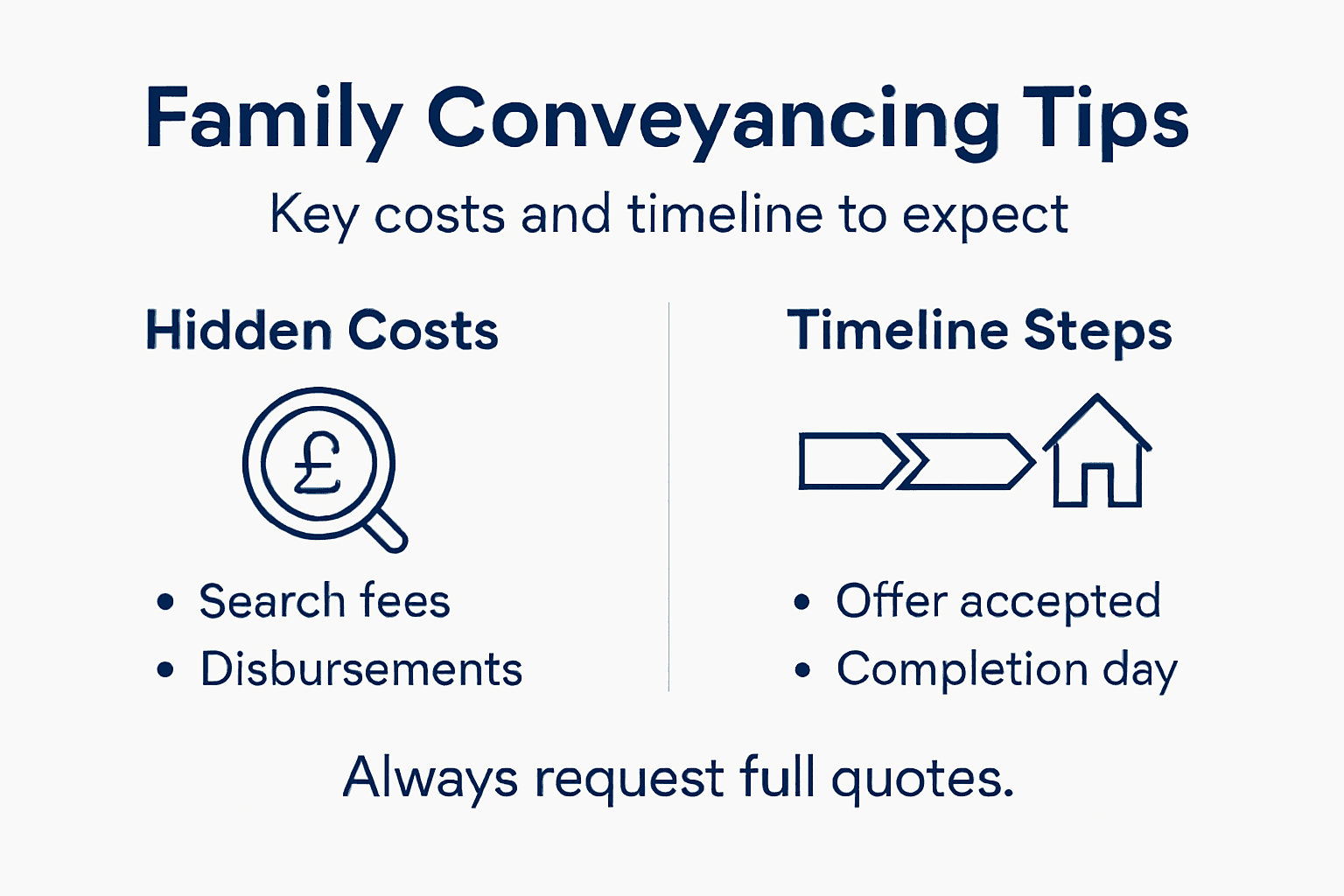
Saving money on conveyancing starts with transparency and comparison. Request itemised quotes from at least three firms that clearly separate their legal fee from disbursements, so you know exactly what you’re paying for. Ask whether your conveyancer offers fixed-fee conveyancing, which eliminates surprises and lets you budget with confidence. Some firms waive certain disbursements or offer discounts if you use their mortgage broker or estate agent services. Consider whether you genuinely need premium add-ons like additional insurance or expedited searches, or whether standard options suffice. Most importantly, avoid the temptation to choose solely on price. A conveyancer who misses a problem or communicates poorly may cost you far more in stress, delays, or legal headaches than you’d ever save on fees.
\_ Pro tip:\_ \_Request a detailed cost breakdown in writing before instructing your conveyancer, confirm which disbursements are included in their quote, and ask specifically about “no surprises” guarantees so you know the maximum you’ll pay regardless of complications that arise.\_
Legal Duties and Parental Responsibilities
When families purchase a property, the conveyancing process involves more than just transferring ownership of bricks and mortar. If children are involved in the transaction or will be living in the property, your conveyancer has specific legal duties to protect their interests and ensure all parental responsibilities are properly addressed. These duties extend beyond the typical buyer-seller transaction and require careful attention to family law implications. Your conveyancer must verify that all parties with parental responsibility have consented to the purchase, particularly in cases where a property is being bought in a child’s name or where guardianship arrangements are non-standard. The Law Society emphasises that conveyancers must act in clients’ best interests with particular attention to family-related legal complexities, meaning they need to understand whether both parents are involved, if one parent has sole custody, or if alternative guardianship arrangements exist.
! Conveyancer discussing legal documents with family

One common scenario families encounter is purchasing a property in a child’s name as part of inheritance planning or to protect assets. This requires specific legal documentation and parental consent to be properly recorded. Another situation arises when separated or divorced parents are jointly purchasing a property, which demands clarity about beneficial ownership and what happens to the property if circumstances change. Your conveyancer must ensure that powers of attorney are correctly executed if anyone acting on behalf of a child or vulnerable family member needs to sign documents. Additionally, if the property will be held in joint names (for example, both spouses), your conveyancer will discuss whether you hold it as “joint tenants” or “tenants in common,” which has significant implications for what happens to the property if one owner passes away or if the relationship breaks down. These decisions directly affect your children’s financial security and inheritance rights.
Safeguarding extends to protecting vulnerable family members throughout the conveyancing process. Your conveyancer should verify the identity and mental capacity of all parties involved, ensure no one is being coerced into the purchase, and flag any suspicious circumstances. CILEx guidance on conveyancing practice requires practitioners to understand guardianship, parental consent, and the safeguarding of legal rights involving children and family members. If your situation involves complexity such as a child with special needs, trusts set up for a child’s benefit, or guardianship by someone other than biological parents, tell your conveyancer upfront so they can handle these matters with appropriate care and expertise. Open communication about your family circumstances allows your conveyancer to anticipate issues and protect everyone involved.
\_ Pro tip:\_ \_If your purchase involves children, guardianship questions, or any non-standard family arrangement, disclose this to your conveyancer at the very first meeting so they can allocate sufficient time, involve relevant specialists if needed, and prevent delays caused by unexpected legal complexities.\_
Avoiding Delays and Common Family Pitfalls
Conveyancing delays don’t happen by accident. They result from predictable problems that families can prevent with the right preparation and communication. The most common culprit is incomplete or missing documentation. When your conveyancer requests papers from you, they need them quickly and in full. Missing bank statements, proof of identity, or information about joint owners creates bottlenecks that add weeks to your timeline. Before your purchase begins, gather everything your conveyancer might need: passport or driving licence, recent mortgage statements, proof of address, details of anyone else with a financial interest in the property, and any powers of attorney if applicable. Organised families who provide this upfront move significantly faster than those who hand things over piecemeal.
Poor communication between you and your conveyancer, or between your conveyancer and the seller’s solicitor, ranks as the second major delay culprit. The Legal Ombudsman highlights that clear expectations about fees and regular updates reduce stress and prevent misunderstandings that derail transactions. Set expectations from the start: ask how often your conveyancer will update you, what happens if urgent issues arise, and how you’ll receive communications (email, phone, post). When your conveyancer asks you for information or decisions, respond within 48 hours rather than waiting weeks. Request that the seller’s solicitor commits to specific response deadlines for enquiries and searches. The Conveyancing Association’s Technical Protocol encourages proactive case management through improved communication, meaning your conveyancer should flag potential problems early before they snowball into major obstacles.
Family-specific pitfalls require particular attention. If multiple family members are buying together, ensure everyone understands the financial and legal implications before signing anything. Disagreements about whether you hold the property as joint tenants or tenants in common, or disputes about who contributes what financially, often emerge during conveyancing and can halt the process entirely. If your situation involves inheritance planning, trusts, or non-standard ownership structures, tell your conveyancer immediately so they can guide you properly. Another pitfall is underestimating how long surveys take or assuming survey issues will resolve quickly. Budget extra time for structural problems, damp, or subsidence investigations, and be prepared to negotiate remedies or price reductions rather than expecting instant solutions. Finally, avoid making major financial commitments or life changes until completion is finalised. Families who move into temporary accommodation, change jobs, or spend their deposit on moving costs before completion create unnecessary pressure and stress.
Below are the main causes of conveyancing delays for families and how to minimise their impact:
| Cause of Delay | Why It Happens | How Families Can Prevent It |
|---|---|---|
| Missing Documentation | Incomplete or late paperwork | Prepare all documents in advance |
| Slow Response Times | Delayed replies by solicitors/parties | Set clear deadlines, follow up weekly |
| Unresolved Survey Issues | Problems found during checks | Budget extra time, negotiate promptly |
| Poor Communication | Unclear updates or infrequent contact | Choose a responsive conveyancer |
| Unexpected Legal Complexities | Guardianship or trust arrangements | Disclose all details early to solicitor |
\_ Pro tip:\_ \_Create a simple checklist of documents your conveyancer needs, tick items off as you gather them, and email everything together in one organised folder rather than sending fragments over weeks, which dramatically speeds up the conveyancing process.\_
Simplify Your Family Conveyancing With Trusted Experts
Conveyancing for families involves navigating complex legal duties, hidden costs, and timelines that can easily become overwhelming. You want a conveyancer who understands your unique situation, offers clear communication, and protects your family’s interests from unexpected delays or expenses. At Conveyancing-Solicitor.co.uk we connect you with vetted, regulated conveyancers who specialise in family property transactions and guide you every step of the way through this important process.
Don’t let legal complexities or unclear fees add stress to your move. Get instant, fixed-fee quotes from expert solicitors who prioritise transparency and responsive service. Whether you need advice on parental responsibilities, tailored legal checks, or want to avoid common conveyancing pitfalls, start your stress-free journey now. Experience how simple conveyancing can be with support from trusted professionals by requesting your quote today at Instant Quote. Explore expert advice and learn how to find the right conveyancer with our helpful guides on How to Find a Good Conveyancing Solicitor and Choosing a Conveyancer. Your family’s smooth move begins with the right legal partner right now.
Frequently Asked Questions
What is conveyancing and why is it important for families?
Conveyancing is the legal process of transferring property ownership from a seller to a buyer. It is essential for families as it protects their investment by uncovering potential issues with the property and ensuring all legal requirements are met, preventing financial and legal risks.
How long does the conveyancing process typically take for families?
The conveyancing process usually takes between 8 to 12 weeks. However, this can vary depending on the complexity of the sale and how quickly all parties respond during the transaction.
What should I consider when choosing a conveyancer for my family’s property purchase?
When choosing a conveyancer, consider their experience with similar property types, their communication style, and whether they are regulated by the Solicitors Regulation Authority or the Council for Licensed Conveyancers. Request itemised quotes to understand the full range of costs involved.
What are common costs associated with conveyancing that families might overlook?
Common costs include disbursements such as local authority searches, environmental searches, water and drainage searches, and Land Registry fees. These can significantly add to the initial legal fee, so it’s essential to request a detailed cost breakdown upfront.
About the Author
Verified Expert
PJ Singh
Co-Founder, Conveyancer Plus \| Conveyancing Industry Expert
BSc Computer Science, University of Hertfordshire \| 10+ Years Conveyancing Industry Experience
PJ Singh is Co-Founder of Conveyancer Plus, bringing over 10 years of expertise in the UK conveyancing and property sector. Previously Group Director of Sales and Marketing at Ackroyd Legal and Head of Business Development at Fitzalan Partners (Homeward Legal), PJ has worked with over 70 SRA-regulated solicitors nationwide. His deep understanding of the property transaction process and client journey makes him a trusted voice in simplifying conveyancing for homebuyers.
View all articles by PJ → LinkedIn
More Articles
Article\\ \\ Conveyancing Process Step by Step for UK Home Buyers \\ \\ Understand the UK conveyancing process step-by-step with our expert guide for home buyers. Get clear advice from a trusted conveyancing solicitor.\\ \\ 3 Feb 2026 Article\\ \\ Conveyancing Solicitor UK Delivers Trusted Local Specialist Conveyancing for New Builds England \\ \\ Find trusted, vetted conveyancing solicitors across the UK. Clear, Easy & Affordable conveyancing services with up to 75% savings on legal fees.\\ \\ 18 Dec 2025 Article\\ \\ Transfer of Equity – How It Affects Family Property \\ \\ Understand UK Transfer of Equity & how it affects family property. Get expert conveyancing solicitor advice on changing ownership.\\ \\ 4 Feb 2026
View reviews →
Get Your Free Conveyancing Quote
Compare prices from trusted local solicitors. No obligation, no hidden fees.
Instant quotes
No obligation
Save up to 75%
Get Free Quotes Now
Easy and affordable conveyancing made simple. SRA regulated solicitors across the UK.
Services
Quick Links
Legal
Contact
- 0330 053 2229
- clientservices@conveyancing-solicitor.co.uk
- United Kingdom
Conveyancing-Solicitor.co.uk is a trading name of Home Movers Plus Ltd, with the company registration number 13764928. © 2026 Home Movers Plus Ltd –
About the Author
PJ Singh
Co-Founder, Conveyancer Plus | Conveyancing Industry Expert
PJ Singh is Co-Founder of Conveyancer Plus, bringing over 10 years of expertise in the UK conveyancing and property sector. Previously Group Director of Sales and Marketing at Ackroyd Legal and Head of Business Development at Fitzalan Partners (Homeward Legal), PJ has worked with over 70 SRA-regulated solicitors nationwide. His deep understanding of the property transaction process and client journey makes him a trusted voice in simplifying conveyancing for homebuyers.
More Articles
Budget Solicitor Conveyancing Services in Manchester: Quality Legal Help Without the Hidden Costs
Find trusted budget solicitor conveyancing services in Manchester with fixed fees, expert guidance, and transparent, no-hidden-cost legal support.
How to Get an Instant Conveyancing Quote Online
Discover how to get an instant conveyancing quote online. Learn about the process, benefits, costs, and tips for choosing the right service.
Conveyancing Solicitor UK Delivers Trusted Local Specialist Conveyancing for New Builds England
Conveyancing Solicitor UK Delivers Trusted Local Specialist Conveyancing for New Builds England. Learn about our expert services for your new home purchase.
Get Your Free Conveyancing Quote
Compare prices from trusted local solicitors. No obligation, no hidden fees.