
Conveyancing Process Explained: 2025 Impact on Buyers
Conveyancing Process Explained: 2025 Impact on Buyers. Understand the UK conveyancing journey and how upcoming changes will affect your property purchase.
PJ Singh
Co-Founder, Conveyancer Plus | Conveyancing Industry Expert
Co-Founder, Conveyancer Plus \| Conveyancing Industry Expert
Tuesday 3 February 202614 min read
Buying your first british home can feel overwhelming, especially with over 90 percent of buyers reporting confusion about the legal steps involved. For young adults navigating the United Kingdom property market, avoiding hidden fees and stressful delays is more important than ever. This guide reveals how modern conveyancing makes the process simpler, safer, and more affordable—so you can secure your property with confidence and clarity.
Table of Contents
Key Takeaways
| Point | Details |
|---|---|
| **Modern Conveyancing** | The conveyancing process in 2025 incorporates advanced technology, enabling digital searches and real-time updates that enhance efficiency and transparency. |
| **Legal Checks Essential** | Comprehensive legal checks and searches are critical for identifying potential risks, ensuring informed decision-making regarding property purchases. |
| **Cost Awareness** | Understanding the full breakdown of conveyancing costs, including legal fees and disbursements, is vital for effective budgeting during property transactions. |
| **Engagement Timing** | Instructing a conveyancing firm early in the process can save time and help mitigate potential complications in the property transaction. |
What Is Conveyancing in 2025?
Conveyancing remains the critical legal process of transferring property ownership between sellers and buyers in the United Kingdom. In 2025, this complex transaction continues to involve precise legal work that ensures secure and official property transfers. The conveyancing process typically spans 8 to 12 weeks from offer acceptance, requiring meticulous coordination between solicitors, buyers, sellers, and mortgage lenders.
The modern conveyancing landscape in 2025 integrates advanced technological solutions that streamline traditionally time-consuming legal procedures. Buyers can expect digital searches, online document verification, and faster communication channels that reduce processing times. Key stages still include comprehensive property searches, contract drafting, detailed legal checks, and coordinating mortgage requirements. Each property transaction demands careful examination of title deeds, potential legal encumbrances, and ensuring all necessary documentation meets current regulatory standards.
Property buyers in 2025 will find the conveyancing process increasingly transparent and efficient. Solicitors and licensed conveyancers now leverage sophisticated digital platforms that provide real-time updates, track progress, and maintain clear communication throughout the transaction. The core objective remains protecting the buyer’s interests by conducting thorough due diligence, identifying potential risks, and facilitating a smooth property transfer.
The following table outlines how technology is changing conveyancing in 2025:
| Process Step | Traditional Approach | Modern (2025) Approach |
|---|---|---|
| Search processing | Manual, postal searches | Digital searches, rapid results |
| Contract exchange | Paper documents, meetings | Secure e-signatures, online portals |
| Communication | Phone, email delays | Real-time updates, online trackers |
| Document checks | Physical, time-consuming | Automated digital verification |
! Infographic conveying 2025 conveyancing process steps
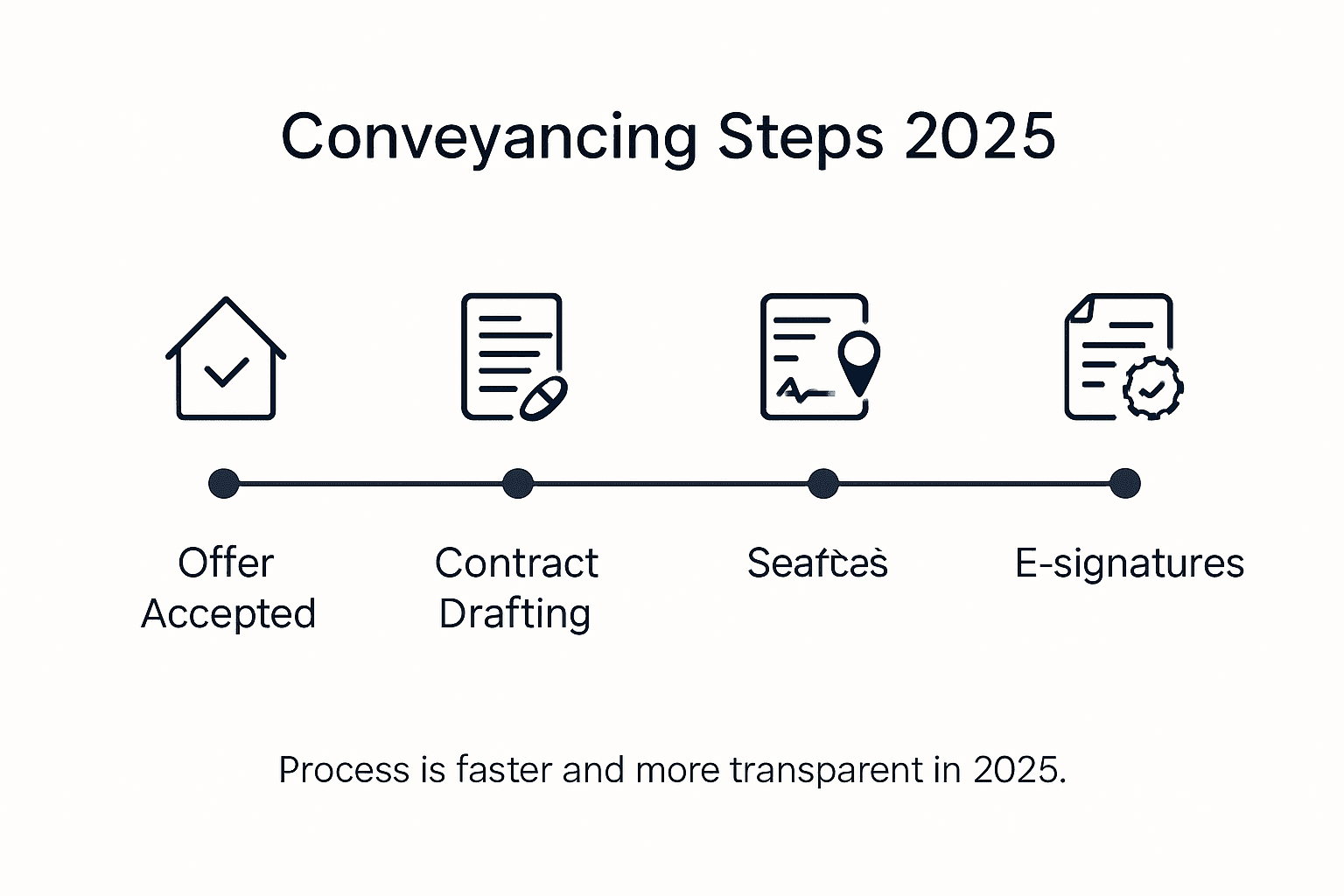
\_ Expert Tip:\_ \_Request digital progress tracking and communication channels from your conveyancer to stay informed about every stage of your property purchase.\_
Stages of the UK Conveyancing Process
The UK conveyancing process involves several critical stages that transform a property purchase from initial offer to legal ownership transfer. Comprehensive conveyancing processes typically unfold through a structured sequence of legal and administrative steps designed to protect both buyer and seller’s interests.
The initial stages begin with offer acceptance, where buyers and sellers agree on property price and terms. At this point, solicitors are instructed and commence critical background work. Key activities include conducting detailed property searches, reviewing title documents, and performing local authority checks. These searches investigate potential issues like planning restrictions, environmental concerns, and legal encumbrances that might impact property ownership. Buyers receive comprehensive reports detailing any risks or limitations associated with the property.
Subsequent stages involve contract drafting, exchange of contracts, and final completion. During contract exchange, both parties become legally committed to the transaction, with a predetermined completion date established. The buyer typically pays a deposit, and legal ownership is formally transferred. Final completion involves the remaining funds being transferred, keys being released, and the property’s legal title being updated with the new owner’s details at the Land Registry.
! Conveyancer handing contract to property buyer

\_ Expert Tip:\_ \_Request a detailed breakdown of all potential search results and disbursement costs from your conveyancer to avoid unexpected financial surprises during the property purchase process.\_
Key Legal Checks and Searches Explained
Legal checks and searches represent the critical investigative phase of the conveyancing process, designed to uncover potential risks and limitations associated with a property purchase. Comprehensive local authority searches provide prospective buyers with essential insights into the property’s legal and environmental status, helping them make informed decisions before finalising their investment.
The primary legal searches typically include local authority searches, environmental searches, drainage and water searches, and chancel repair liability checks. Local authority searches reveal crucial information about planning permissions, building regulations, proposed road developments, and any enforcement notices that might impact property value or usage. Environmental searches investigate potential land contamination, flood risks, and geological concerns that could affect the property’s structural integrity or insurability. These detailed investigations help buyers understand hidden risks that might not be immediately apparent during initial property viewings.
Additional specialist searches may be recommended depending on the property’s specific location and characteristics. These can include mining searches in areas with historical mining activity, flood risk assessments in vulnerable regions, and chancel repair liability checks for properties near historic church lands. Each search provides a layer of protection, enabling buyers to negotiate price adjustments, request repairs, or withdraw from the purchase if significant risks are discovered. Professional conveyancers carefully analyse these search results, providing expert interpretation and guidance on potential implications for the property purchase.
\_ Expert Tip:\_ \_Request a comprehensive breakdown of all search results and ask your conveyancer to explain the potential long-term implications of any identified risks or restrictions.\_
Costs, Fees, and Money-Saving Tips
Conveyancing costs in 2025 represent a significant investment for property buyers, with expenses typically ranging across multiple categories. Comprehensive cost breakdowns reveal that legal fees alone can fluctuate between £400 and £1,500, with additional disbursements potentially adding another £700 or more to the total transaction expenses.
The primary cost components include legal fees, professional conveyancer charges, search fees, and various administrative expenses. Leasehold properties generally incur higher costs due to increased complexity, with more detailed documentation and legal checks required. Buyers should anticipate expenses such as local authority searches, environmental investigations, drainage checks, and Land Registry fees. Each of these elements contributes to the overall transaction cost and provides critical protection for the property purchase. Specific cost variations emerge based on property type, location, and transaction complexity, making it essential for buyers to obtain detailed quotes from multiple conveyancing professionals.
Here is a comparison of typical disbursement costs based on property type in the UK:
| Disbursement Type | Freehold Property | Leasehold Property |
|---|---|---|
| Local authority search | £100-£250 | £100-£250 |
| Drainage/water search | £50-£100 | £50-£100 |
| Land Registry fee | £40-£910 (varies band) | £40-£910 (varies band) |
| Additional leasehold fees | Not applicable | £100-£400 |
Smart buyers can implement several strategic approaches to manage and potentially reduce conveyancing expenses. Comparing quotes from multiple regulated conveyancers, selecting fixed-fee services, and instructing professionals early in the process can help control costs. Some conveyancers offer transparent pricing models that include all expected disbursements, preventing unexpected financial surprises. Additionally, first-time buyers might qualify for specific fee reductions or government schemes that can offset some of the standard conveyancing expenses.
\_ Expert Tip:\_ \_Request a comprehensive, itemised quote that details all potential fees and disbursements upfront to avoid unexpected financial complications during your property purchase.\_
Common Pitfalls and How to Avoid Them
Navigating the conveyancing process requires keen awareness of potential obstacles that can derail property transactions. Understanding potential conveyancing challenges is crucial for buyers seeking a smooth property purchase, with several common pitfalls emerging that can significantly impact transaction success.
One of the most prevalent issues involves incomplete or inaccurate property searches, which can lead to unexpected legal complications. Buyers might encounter problems such as undisclosed planning restrictions, boundary disputes, or environmental hazards that were not initially apparent. Leasehold properties present additional complexity, with potential hidden costs like escalating ground rent, service charges, or restrictive lease conditions that can dramatically affect property value and future saleability. Inadequate communication between solicitors, estate agents, and mortgage lenders can also create unnecessary delays, potentially causing chain breakdowns or missed completion deadlines.
Professional buyers can mitigate these risks through proactive strategies. Instructing a comprehensive, experienced conveyancer who conducts thorough due diligence is paramount. This includes requesting detailed search reports, carefully reviewing all documentation, and asking direct questions about any potential concerns. Maintaining open communication channels, responding promptly to requests for information, and having a financial buffer to address unexpected costs can help navigate potential challenges. First-time buyers should particularly focus on understanding all contractual obligations, seeking clarification on any complex legal terminology, and ensuring they have a complete understanding of the property’s legal status before proceeding.
\_ Expert Tip:\_ \_Arrange a comprehensive consultation with your conveyancer before exchanging contracts to discuss and identify any potential risks specific to your property transaction.\_
When to Instruct Your Conveyancing Firm
Timing is crucial when instructing a conveyancing firm, with strategic early engagement potentially saving significant time and reducing transaction complications. Preparing for your first conveyancing consultation should ideally commence immediately after your property offer has been accepted, allowing professional legal support to begin protecting your interests from the earliest possible stage.
The optimal window for instructing a conveyancing firm typically spans the period between offer acceptance and initial property survey. Buyers should prioritise selecting a regulated, experienced solicitor who specialises in the specific property type they are purchasing. Different property categories such as leasehold, freehold, new build, or historic properties require nuanced legal expertise. During this critical phase, your chosen conveyancer will start essential preliminary work including reviewing initial documentation, preparing draft contracts, and conducting preliminary legal searches that form the foundation of a secure property transaction.
Professional buyers should conduct thorough due diligence when selecting their conveyancing firm. This involves comparing multiple regulated solicitors, checking their professional credentials, understanding their fee structures, and assessing their communication practices. Factors to consider include response times, digital communication capabilities, transparent pricing, and specialisation in your specific property type. First-time buyers particularly benefit from firms offering comprehensive guidance, explaining complex legal terminology, and providing step-by-step transaction support throughout the entire purchasing process.
\_ Expert Tip:\_ \_Request a detailed initial consultation and comprehensive service breakdown before officially instructing your conveyancing firm to ensure complete alignment with your specific property transaction needs.\_
Simplify Your 2025 Conveyancing Journey with Trusted Experts
The 2025 conveyancing landscape brings challenges such as navigating detailed legal checks, understanding search results, managing fees, and avoiding common pitfalls. If you are feeling overwhelmed by the complexities of property transfer stages or uncertain about the best time to instruct a conveyancer, you are not alone. Many buyers struggle with ensuring transparency, controlling costs, and maintaining clear communication throughout the process. Using up-to-date knowledge about the conveyancing process and working with experienced professionals can save you time, money, and stress.
At Conveyancing-Solicitor.co.uk we connect you instantly to reliable and regulated conveyancing firms that specialise in managing these exact challenges. Get instant fixed-fee quotes that could save you up to 75 per cent compared to standard legal fees. Whether you want expert advice on the conveyancing process for buyers or need help understanding local authority searches and how they impact your purchase, we have you covered.
Do not risk costly delays or missed deadlines. Take control of your property purchase today by securing a trusted conveyancer with a clear, upfront price. Discover how simple conveyancing can be when guided by professionals dedicated to your smooth completion. Start your journey now and get your free instant quote to begin protecting your investment immediately.
Frequently Asked Questions
What is the conveyancing process in 2025?
The conveyancing process in 2025 involves the legal transfer of property ownership, typically taking 8 to 12 weeks and including steps like property searches, contract drafting, and final completion. Modern technology has streamlined these procedures through digital searches and real-time updates.
How has technology impacted the conveyancing process in 2025?
In 2025, technology has transformed the conveyancing process by enabling digital searches, automated document verification, and faster communication, thereby reducing processing times and enhancing transparency between buyers and conveyancers.
What key legal checks are included in the conveyancing process?
Key legal checks in the conveyancing process include local authority searches, environmental searches, drainage and water searches, and chancel repair liability checks. These investigations help uncover potential risks associated with the property before finalising the purchase.
What should buyers know about costs and fees in the conveyancing process?
Buyers should expect conveyancing costs to vary, typically ranging from £400 to £1,500 in legal fees, with potential additional disbursements over £700. It’s essential to obtain detailed quotes and understand all potential expenses to avoid surprises during the transaction.
About the Author
Verified Expert
PJ Singh
Co-Founder, Conveyancer Plus \| Conveyancing Industry Expert
BSc Computer Science, University of Hertfordshire \| 10+ Years Conveyancing Industry Experience
PJ Singh is Co-Founder of Conveyancer Plus, bringing over 10 years of expertise in the UK conveyancing and property sector. Previously Group Director of Sales and Marketing at Ackroyd Legal and Head of Business Development at Fitzalan Partners (Homeward Legal), PJ has worked with over 70 SRA-regulated solicitors nationwide. His deep understanding of the property transaction process and client journey makes him a trusted voice in simplifying conveyancing for homebuyers.
View all articles by PJ → LinkedIn
More Articles
Article\\ \\ Conveyancing Process Step by Step for UK Home Buyers \\ \\ Understand the UK conveyancing process step-by-step with our expert guide for home buyers. Get clear advice from a trusted conveyancing solicitor.\\ \\ 3 Feb 2026 Article\\ \\ Conveyancing Solicitor UK Delivers Trusted Local Specialist Conveyancing for New Builds England \\ \\ Find trusted, vetted conveyancing solicitors across the UK. Clear, Easy & Affordable conveyancing services with up to 75% savings on legal fees.\\ \\ 18 Dec 2025 Article\\ \\ Transfer of Equity – How It Affects Family Property \\ \\ Understand UK Transfer of Equity & how it affects family property. Get expert conveyancing solicitor advice on changing ownership.\\ \\ 4 Feb 2026
View reviews →
Get Your Free Conveyancing Quote
Compare prices from trusted local solicitors. No obligation, no hidden fees.
Instant quotes
No obligation
Save up to 75%
Get Free Quotes Now
Easy and affordable conveyancing made simple. SRA regulated solicitors across the UK.
Services
Quick Links
Legal
Contact
- 0330 053 2229
- clientservices@conveyancing-solicitor.co.uk
- United Kingdom
Conveyancing-Solicitor.co.uk is a trading name of Home Movers Plus Ltd, with the company registration number 13764928. © 2026 Home Movers Plus Ltd –
About the Author
PJ Singh
Co-Founder, Conveyancer Plus | Conveyancing Industry Expert
PJ Singh is Co-Founder of Conveyancer Plus, bringing over 10 years of expertise in the UK conveyancing and property sector. Previously Group Director of Sales and Marketing at Ackroyd Legal and Head of Business Development at Fitzalan Partners (Homeward Legal), PJ has worked with over 70 SRA-regulated solicitors nationwide. His deep understanding of the property transaction process and client journey makes him a trusted voice in simplifying conveyancing for homebuyers.
More Articles
Remortgage your house: step-by-step guide for UK homeowners
Learn how to remortgage your house in the UK with this clear step-by-step guide covering timing, costs, legal fees, and how to save up to 75% on conveyancing.
Transparency in conveyancing: your guide to clear home moves
Discover what transparency in conveyancing really means, where it breaks down, and how to choose a solicitor who keeps you fully informed with no hidden fees.
Essential conveyancing terms every UK home seller must know
Learn the essential conveyancing terms every UK home seller must know, from TA6 forms to exchange and completion, to avoid costly delays and legal pitfalls.
Get Your Free Conveyancing Quote
Compare prices from trusted local solicitors. No obligation, no hidden fees.