
Conveyancers in Equity Release – Safeguarding Your Rights
Conveyancers in Equity Release – Safeguarding Your Rights. Understand how expert UK conveyancers protect your interests during equity release.
PJ Singh
Co-Founder, Conveyancer Plus | Conveyancing Industry Expert
Co-Founder, Conveyancer Plus \| Conveyancing Industry Expert
Thursday 5 February 202614 min read
Every homeowner who wants to help family or boost retirement income often wonders how to use the value stored in their property without selling up. With growing interest in equity release among those aged sixty and over in the United Kingdom, finding transparent guidance and clear legal support is more important than ever. This guide explains how equity release works, what options exist, and why expert, fixed-fee conveyancing can make passing on equity to loved ones safer and more straightforward.
Table of Contents
Key Takeaways
| Point | Details |
|---|---|
| **Equity Release Overview** | Equity release allows homeowners aged 55 and over to access cash from their property without selling it, primarily through lifetime mortgages or home reversion plans. |
| **Financial Considerations** | Homeowners should evaluate potential long-term implications, including interest rates and effects on inheritance, before opting for equity release. |
| **Legal Safeguards** | Independent legal advice is crucial for homeowners to ensure transparency and compliance with regulations during the equity release process. |
| **Risks and Costs** | Homeowners must understand the risks, such as compound interest and reduced inheritance, alongside evaluating associated costs like fees and interest rates. |
What Is Equity Release and How It Works
Equity release represents a financial strategy enabling homeowners aged 55 and over to unlock the monetary value trapped within their property without relocating. Homeowners can access funds by converting a portion of their home’s value into cash, providing financial flexibility during retirement.
There are two primary types of equity release mechanisms:
- Lifetime Mortgages: The most common equity release option where homeowners borrow money against their property’s value
- Home Reversion Plans: Schemes involving selling a percentage of your property to a provider while retaining the right to live there
The comprehensive UK equity release guide highlights several critical considerations homeowners must evaluate before pursuing these financial arrangements. Key factors include understanding potential long-term implications, interest rates, and impact on inheritance planning.
Homeowners typically choose equity release for various financial objectives:
1. Supplementing retirement income 2. Funding home improvements 3. Supporting family members financially 4. Covering unexpected healthcare expenses 5. Clearing existing debts
Eligibility criteria generally require homeowners to be:
- Aged 55 or older
- Owning a property valued above a specific threshold
- Residing in a property meeting specific condition standards
Important legal safeguards exist to protect homeowners. The Age UK guidance recommends comprehensive financial advice before committing to any equity release arrangement.
\_ Pro tip:\_ \_Always consult an independent financial advisor specialising in equity release to understand the complete financial implications and explore alternative retirement funding options.\_
Key Types of Equity Release Schemes
Equity release schemes in the United Kingdom primarily consist of two distinct financial products designed to help homeowners access property wealth during retirement: lifetime mortgages and home reversion plans. Unique equity release approaches offer different mechanisms for converting home equity into usable funds.
Lifetime Mortgages represent the most popular equity release option:
- Homeowners borrow money against their property’s value
- Interest accumulates on the borrowed amount
- No mandatory monthly repayments required
- Borrowers retain full property ownership
- Flexibility to withdraw funds in stages
Home Reversion Plans work differently:
- Homeowners sell a percentage of their property
- Receive a lump sum or regular payments
- Retain the right to live in the property
- No interest charges apply
- Property value shared with the provider
Each scheme offers unique advantages depending on individual financial circumstances. The comprehensive equity release guide highlights several critical considerations for potential participants:
1. Age restrictions (typically 55+ years) 2. Minimum property value requirements 3. Impact on inheritance planning 4. Potential effects on state benefits 5. Long-term financial implications
Key Comparison Points:
| Feature | Lifetime Mortgage | Home Reversion Plan |
|---|---|---|
| Ownership | Retained | Partially sold |
| Interest | Accumulates | No interest |
| Monthly Payments | Optional | Not required |
To clarify the main differences in homeowner experience, consider the following comparison:
| Aspect | Lifetime Mortgage Experience | Home Reversion Plan Experience |
|---|---|---|
| Repayment Schedule | Loan repaid upon death or sale | Share bought out when property is sold |
| Release Options | Drawdown or lump sum available | Usually lump sum or fixed income |
| Control Over Property | Retain all rights and responsibilities | Share future value with provider |
| Guarantee of No Negative Equity | Standard with regulated plans | Typically included but check terms |
\_ Pro tip:\_ \_Always obtain independent financial advice and carefully compare different equity release schemes to understand the full long-term financial consequences before making a decision.\_
Legal Duties of Conveyancers in Equity Release
Conveyancers play a critical role in protecting homeowners’ interests during equity release transactions, serving as independent legal professionals who ensure transparency and legal compliance. Comprehensive legal guidance highlights their multifaceted responsibilities in safeguarding clients’ rights throughout the process.
The primary legal duties of conveyancers in equity release include:
- Providing independent legal advice
- Assessing client’s mental capacity and consent
- Explaining complex legal terms and implications
- Identifying potential risks and conflicts of interest
- Ensuring full financial transparency
Regulatory Compliance is a fundamental aspect of a conveyancer’s role. They must adhere to strict professional standards set by:
1. Solicitors Regulation Authority (SRA) 2. Council for Licensed Conveyancers (CLC) 3. Financial Conduct Authority (FCA) guidelines
Key legal responsibilities involve:
- Verifying client identity and legal ownership
- Conducting thorough property searches
- Reviewing and explaining equity release contract terms
- Registering legal charges with appropriate authorities
- Protecting client’s long-term financial interests
\> Conveyancers must demonstrate an unwavering commitment to their client’s best interests, providing clear, impartial advice throughout the equity release process.
The UK Government’s Equity Mortgage Lender’s Handbook emphasises the critical nature of transparent communication and comprehensive documentation in equity release transactions.
! Conveyancer explaining contract to senior couple

\_ Pro tip:\_ \_Always request a detailed written explanation of all legal terms and potential long-term implications from your conveyancer before proceeding with any equity release arrangement.\_
Homeowner Protections and Compliance Standards
Equity release schemes in the United Kingdom are governed by robust consumer protection standards designed to safeguard homeowners’ financial interests and ensure transparent, ethical practices. These comprehensive frameworks establish critical safeguards against potential risks associated with property equity transactions.
Key homeowner protections include:
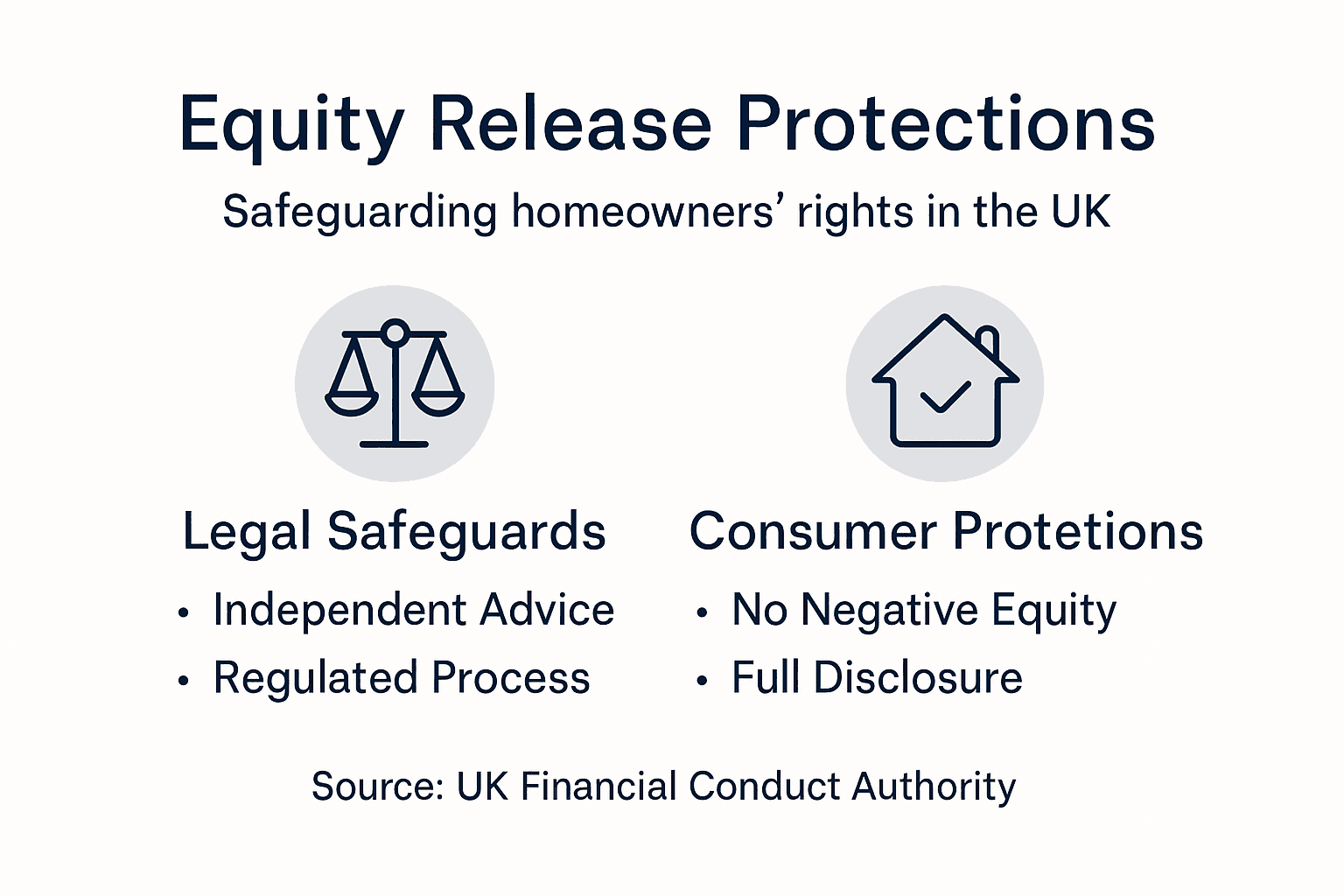
- No Negative Equity Guarantee: Ensures homeowners will never owe more than their property’s value
- Mandatory independent financial advice
- Clear, transparent contract terms
- Protection against repossession
- Right to remain in the property
Regulatory bodies enforcing these standards include:
1. Financial Conduct Authority (FCA) 2. Equity Release Council (ERC) 3. Solicitors Regulation Authority (SRA)
Minimum Compliance Requirements encompass several critical consumer protections:
- Minimum age threshold (typically 55 years)
- Comprehensive risk assessments
- Compulsory legal consultation
- Detailed affordability checks
- Full disclosure of potential financial implications
\> Regulatory standards exist to protect vulnerable consumers and ensure equity release remains a transparent, fair financial option.
The UK financial regulations mandate stringent checks to prevent financial exploitation and ensure consumers make fully informed decisions about their property equity.
! Infographic outlining equity release protections
\_ Pro tip:\_ \_Request a comprehensive written breakdown of all potential risks and protections from your equity release provider before signing any agreements.\_
Here’s a summary of key compliance standards and homeowner protections:
| Consumer Protection | Purpose | Enforced By |
|---|---|---|
| No Negative Equity Guarantee | Prevents unmanageable debt for heirs | Equity Release Council |
| Compulsory Legal Advice | Ensures informed decision making | Solicitors Regulation Authority |
| Full Fee Disclosure | Avoids unexpected financial charges | Financial Conduct Authority |
| Affordability Check | Safeguards against financial risk | FCA & ERC guidelines |
Costs, Risks, and Pitfalls to Avoid
Equity release schemes come with significant financial complexities that require careful consideration. Common equity release pitfalls highlight potential risks that can substantially impact long-term financial planning and inheritance strategies.
Primary Financial Risks include:
- Compound interest accumulation
- Reduced inheritance for beneficiaries
- Potential impact on means-tested benefits
- Early repayment penalties
- Reduced property equity over time
Key cost considerations homeowners must evaluate:
1. Initial setup fees 2. Arrangement charges 3. Solicitor legal fees 4. Valuation expenses 5. Ongoing interest rates
Hidden Financial Implications that demand thorough investigation:
- Potential reduction in state benefit eligibility
- Long-term debt escalation
- Limited flexibility in future financial planning
- Potential early exit restrictions
- Impact on future property sale options
\> Comprehensive financial advice is crucial before committing to any equity release arrangement to understand potential long-term consequences.
The comprehensive borrower risks guide emphasises the importance of understanding compound interest mechanisms and their potential impact on overall financial health.
\_ Pro tip:\_ \_Request a detailed, written projection of your equity release loan’s potential growth over 10-15 years to fully comprehend the long-term financial implications.\_
Choosing a Specialist for Equity Release Conveyancing
Selecting the right specialist for equity release conveyancing is crucial to protecting your financial interests and navigating complex legal processes. Expert equity release solicitors provide critical guidance through intricate legal requirements and potential financial complexities.
Key Qualifications to Seek in an equity release conveyancer:
- Specific expertise in equity release transactions
- Membership of professional regulatory bodies
- Proven track record in handling equity release cases
- Comprehensive understanding of financial regulations
- Experience with complex property legal arrangements
Essential criteria for selecting a specialist conveyancer:
1. Professional accreditations 2. Specialist equity release certifications 3. Transparent fee structures 4. Clear communication skills 5. Demonstrated independence and impartiality
Evaluation Checklist for potential conveyancers:
- Verify professional memberships (SRA/CLC)
- Request detailed case experience
- Check client testimonials and reviews
- Understand their communication approach
- Confirm specialisation in equity release
\> A specialist conveyancer acts as your financial guardian, ensuring every legal detail is meticulously examined and your interests are comprehensively protected.
The comprehensive guide to equity release solicitors emphasises the importance of choosing professionals with targeted expertise in this complex financial domain.
\_ Pro tip:\_ \_Request a preliminary consultation to assess the conveyancer’s specific experience and understanding of your unique equity release requirements.\_
Safeguard Your Interests with Expert Conveyancing in Equity Release
Navigating the complex legal responsibilities in equity release requires more than just understanding the basics it demands expert conveyancing support to protect your rights and financial future. This article reveals the vital role conveyancers play in ensuring transparency and compliance while guiding you through legal jargon and potential pitfalls. If you are considering equity release, the challenge is clear: finding a conveyancer who is knowledgeable, regulated, and committed to safeguarding your long-term interests.
At Conveyancing-Solicitor.co.uk, we connect you with fully regulated SRA or CLC conveyancers who specialise in equity release transactions. Our fixed-fee, instant quote system helps you avoid overpaying legal fees and secure professional advice tailored to your unique needs. Don’t let uncertainty or legal complexity hold you back from unlocking your property’s value safely.
Ensure you have trusted experts on your side Act now to get an instant, no-obligation quote from top-rated equity release conveyancers ready to protect your rights and financial wellbeing Visit Get Your Instant Conveyancing Quote and take the first step toward a secure and transparent equity release process. Explore also our guides on How to Find a Good Conveyancing Solicitor and Specialist Equity Release Conveyancing to fully understand what you should expect from your legal advisor.
Frequently Asked Questions
What role do conveyancers play in equity release transactions?
Conveyancers provide independent legal advice, ensure compliance with regulations, and protect homeowners’ interests throughout the equity release process.
Why is it important to obtain independent legal advice during equity release?
Independent legal advice is crucial to understand complex legal terms, potential risks, and long-term implications of equity release, ensuring informed decision-making.
What should I look for when choosing a conveyancer for equity release?
Seek a conveyancer with specific expertise in equity release, membership in professional regulatory bodies, transparent fee structures, and a proven track record in handling similar cases.
How do conveyancers ensure regulatory compliance during equity release?
Conveyancers adhere to strict professional standards set by regulatory bodies, verifying client identity, conducting property searches, and ensuring full transparency in contract terms.
About the Author
Verified Expert
PJ Singh
Co-Founder, Conveyancer Plus \| Conveyancing Industry Expert
BSc Computer Science, University of Hertfordshire \| 10+ Years Conveyancing Industry Experience
PJ Singh is Co-Founder of Conveyancer Plus, bringing over 10 years of expertise in the UK conveyancing and property sector. Previously Group Director of Sales and Marketing at Ackroyd Legal and Head of Business Development at Fitzalan Partners (Homeward Legal), PJ has worked with over 70 SRA-regulated solicitors nationwide. His deep understanding of the property transaction process and client journey makes him a trusted voice in simplifying conveyancing for homebuyers.
View all articles by PJ → LinkedIn
More Articles
Article\\ \\ Conveyancing Process Step by Step for UK Home Buyers \\ \\ Understand the UK conveyancing process step-by-step with our expert guide for home buyers. Get clear advice from a trusted conveyancing solicitor.\\ \\ 3 Feb 2026 Article\\ \\ Conveyancing Solicitor UK Delivers Trusted Local Specialist Conveyancing for New Builds England \\ \\ Find trusted, vetted conveyancing solicitors across the UK. Clear, Easy & Affordable conveyancing services with up to 75% savings on legal fees.\\ \\ 18 Dec 2025 Article\\ \\ Transfer of Equity – How It Affects Family Property \\ \\ Understand UK Transfer of Equity & how it affects family property. Get expert conveyancing solicitor advice on changing ownership.\\ \\ 4 Feb 2026
View reviews →
Get Your Free Conveyancing Quote
Compare prices from trusted local solicitors. No obligation, no hidden fees.
Instant quotes
No obligation
Save up to 75%
Get Free Quotes Now
Easy and affordable conveyancing made simple. SRA regulated solicitors across the UK.
Services
Quick Links
Legal
Contact
- 0330 053 2229
- clientservices@conveyancing-solicitor.co.uk
- United Kingdom
Conveyancing-Solicitor.co.uk is a trading name of Home Movers Plus Ltd, with the company registration number 13764928. © 2026 Home Movers Plus Ltd –
About the Author
PJ Singh
Co-Founder, Conveyancer Plus | Conveyancing Industry Expert
PJ Singh is Co-Founder of Conveyancer Plus, bringing over 10 years of expertise in the UK conveyancing and property sector. Previously Group Director of Sales and Marketing at Ackroyd Legal and Head of Business Development at Fitzalan Partners (Homeward Legal), PJ has worked with over 70 SRA-regulated solicitors nationwide. His deep understanding of the property transaction process and client journey makes him a trusted voice in simplifying conveyancing for homebuyers.
More Articles
Remortgage your house: step-by-step guide for UK homeowners
Learn how to remortgage your house in the UK with this clear step-by-step guide covering timing, costs, legal fees, and how to save up to 75% on conveyancing.
Transparency in conveyancing: your guide to clear home moves
Discover what transparency in conveyancing really means, where it breaks down, and how to choose a solicitor who keeps you fully informed with no hidden fees.
Essential conveyancing terms every UK home seller must know
Learn the essential conveyancing terms every UK home seller must know, from TA6 forms to exchange and completion, to avoid costly delays and legal pitfalls.
Get Your Free Conveyancing Quote
Compare prices from trusted local solicitors. No obligation, no hidden fees.