



Facing rising monthly payments after your initial fixed-rate period can be frustrating, especially when your home is your biggest investment. For many in England, remortgaging is a smart financial step that can lead to significant savings and improved peace of mind. This guide helps homeowners untangle common myths around remortgaging and reveals how clear, fixed-fee conveyancing can make switching deals transparent and stress-free.
Table of Contents
- Remortgaging Defined And Common Misconceptions
- Types Of Remortgage Deals Available
- How Remortgaging Works In 2026
- Lender Rules And Legal Requirements
- Costs, Risks, And Financial Implications
- Alternatives To Remortgaging Explained
Key Takeaways
| Point | Details |
|---|---|
| Understanding Remortgaging | Remortgaging is a financial strategy to switch your mortgage for better rates or to access equity, not merely finding a cheaper rate. |
| Types of Remortgage Deals | Various remortgage deals cater to different needs, such as fixed-rate or tracker mortgages, each with unique benefits and risks. |
| Importance of Preparation | Effective remortgaging requires careful financial assessment and understanding of costs, including potential fees and market conditions. |
| Alternatives to Remortgaging | Homeowners should explore alternatives like further advances or second charge mortgages, which can offer flexible financing options without full remortgaging. |
Remortgaging Defined and Common Misconceptions
Remortgaging represents a strategic financial move where homeowners switch their existing mortgage to a new deal, typically with a different lender, while remaining in their current property. Understanding mortgage alternatives can help homeowners make informed financial decisions about their most significant asset.
At its core, remortgaging involves replacing your current mortgage with a new mortgage product, which can happen with your existing lender or a completely different financial institution. The primary motivations are usually financial optimization, including:
- Securing lower interest rates
- Reducing monthly mortgage payments
- Releasing equity from your property
- Consolidating other high-interest debts
- Switching from variable to fixed-rate mortgages
Contrary to popular belief, remortgaging isn’t just about finding a marginally cheaper rate. Strategic financial planning involves carefully considering multiple factors like loan-to-value ratios, arrangement fees, and the overall mortgage market environment.
Many homeowners mistakenly believe remortgaging is complicated or involves moving house. In reality, it’s a straightforward process of transferring your mortgage debt from one lender to another, often with significant potential savings. The key is timing and understanding the associated costs and benefits.
Remortgaging can save you substantial money, particularly after your initial fixed-rate period expires and before falling onto a standard variable rate.
Common misconceptions about remortgaging include thinking it’s always expensive, believing you can only remortgage with your current lender, or assuming your credit history will prevent you from switching. Each of these beliefs can prevent homeowners from potentially saving thousands of pounds annually.
Pro tip: Always calculate the total cost of remortgaging, including arrangement fees and legal costs, to determine whether switching will genuinely save you money in the long term.
Types of Remortgage Deals Available
Remortgage deals come in various formats, each designed to meet different financial needs and circumstances. Mortgage types vary significantly depending on individual financial situations and market conditions.
The primary types of remortgage deals include:
- Fixed-rate mortgages: Provide stability with consistent interest rates for 2-5 years
- Tracker mortgages: Interest rates directly follow the Bank of England base rate
- Variable-rate mortgages: Rates can fluctuate based on lender’s standard variable rate
- Offset mortgages: Link your savings to your mortgage to reduce overall interest
- Interest-only mortgages: Pay only the interest, with the capital due at the end of the term
Each mortgage type offers unique advantages. Fixed-rate mortgages provide predictability, allowing homeowners to budget precisely, while tracker mortgages can offer lower initial rates but carry more uncertainty. Mortgage rates depend on multiple factors including loan-to-value ratios, credit history, and current market conditions.

Product transfers represent another important remortgaging option, where homeowners switch deals with their existing lender. This can be a simpler process compared to moving to an entirely new lender, often involving fewer administrative hurdles and potentially lower associated fees.
Here is a quick comparison of the main remortgage deal types available:
| Deal Type | Rate Structure | Typical Suitability | Key Consideration |
|---|---|---|---|
| Fixed-rate | Set for 2-5 years | Those needing predictable payments | May face early exit charges |
| Tracker | Follows Bank of England | People willing to accept rate shifts | Can rise unexpectedly |
| Variable-rate | Changes with SVR | Flexible planners | Uncertainty in monthly costs |
| Offset | Links to savings | Those with large savings | Savings interest foregone |
| Interest-only | Interest only monthly | Investors or cash-flow focused | Full repayment at term end |
Not all remortgage deals are created equal – the right choice depends on your individual financial goals and risk tolerance.
Homeowners should carefully evaluate their long-term financial objectives when selecting a remortgage deal. Factors like potential early repayment charges, arrangement fees, and the overall cost over the deal’s duration are crucial considerations.
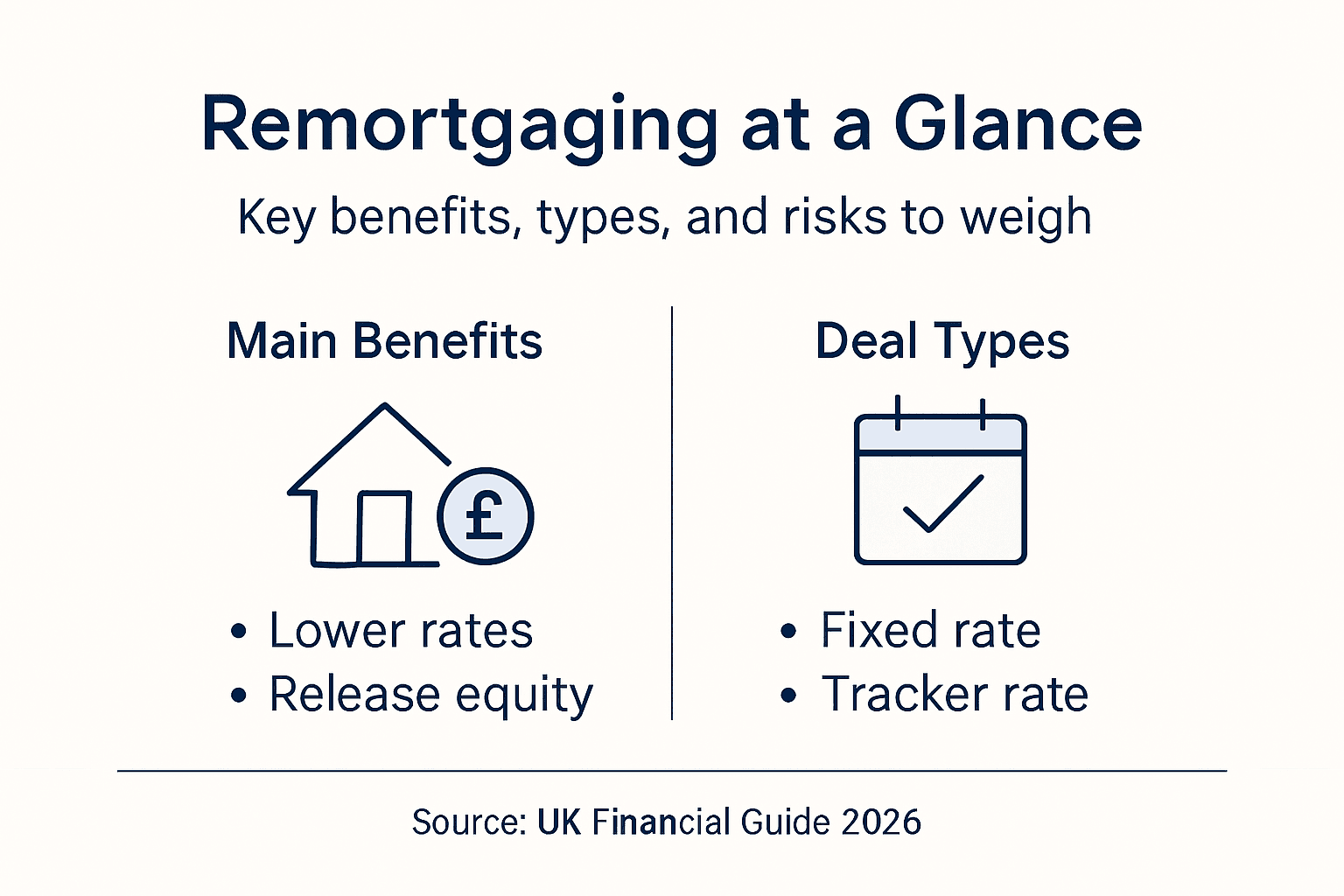
Pro tip: Compare at least three different remortgage deals and calculate the total cost over the entire term, not just the headline interest rate.
How Remortgaging Works in 2026
Remortgaging in 2026 requires a strategic approach that goes beyond simple rate comparison. Remortgage processes have become more complex with increasingly sophisticated financial assessments and stricter lending criteria.
The typical remortgaging journey involves several key stages:
- Reviewing current mortgage details
- Calculating your loan-to-value ratio
- Assessing current financial circumstances
- Comparing available mortgage deals
- Submitting a comprehensive application
- Completing financial and property valuations
Affordability checks have become more rigorous, with lenders implementing detailed scrutiny of personal finances. Financial planning is crucial in 2026 due to changing market conditions and more stringent lending requirements. Potential borrowers must demonstrate stable income, excellent credit history, and sustainable financial projessions.
The entire remortgaging process typically spans 4-8 weeks, requiring meticulous preparation and documentation. Homeowners should gather comprehensive financial records, including recent bank statements, proof of income, and detailed expenditure breakdowns. Many lenders now use advanced digital verification systems to assess applications more quickly and accurately.
Modern remortgaging is no longer just about finding a lower interest rate – it’s about strategic financial management.
Technology has transformed the remortgaging landscape, with many lenders offering online application platforms and instant decision-making tools. However, the human element remains critical, particularly for complex financial scenarios that require nuanced understanding.
Pro tip: Obtain a comprehensive credit report and address any potential issues at least six months before applying for a remortgage to improve your chances of approval.
Lender Rules and Legal Requirements
Remortgaging in the current financial landscape involves navigating complex mortgage regulations and legal frameworks. The Mortgage Charter establishes critical guidelines that protect both borrowers and lenders, ensuring transparent and responsible lending practices.
Key legal requirements for remortgaging include:
- Comprehensive affordability assessments
- Strict credit history evaluations
- Verification of stable income sources
- Assessment of existing debt commitments
- Property valuation and security checks
- Compliance with responsible lending principles
Regulatory compliance remains paramount in the remortgaging process. FCA guidelines mandate detailed lending protocols that protect consumers and maintain financial system integrity. Lenders must demonstrate thorough due diligence when assessing mortgage applications, considering multiple financial indicators beyond simple credit scores.
The Financial Conduct Authority (FCA) requires lenders to implement robust verification processes, ensuring borrowers can genuinely afford their mortgage repayments. This includes detailed examinations of income stability, existing financial commitments, and potential future financial changes.
Responsible lending is not just a legal requirement – it’s a commitment to sustainable financial well-being for borrowers.
Technology has transformed regulatory compliance, with advanced digital systems enabling more sophisticated and rapid assessment of mortgage applications. However, human oversight remains crucial in interpreting complex financial circumstances.
Pro tip: Maintain a comprehensive and up-to-date financial record, including tax returns, bank statements, and proof of income, to streamline your remortgage application process.
Costs, Risks, and Financial Implications
Remortgaging involves complex financial considerations beyond simply switching mortgage rates. Understanding potential remortgaging expenses is crucial for making informed financial decisions that genuinely benefit your long-term economic health.
Key financial costs associated with remortgaging include:
- Early repayment charges (up to 5% of outstanding balance)
- Legal processing fees
- Valuation assessment charges
- Arrangement fees for new mortgage products
- Potential administrative processing costs
- Potential broker consultation fees
Secured loan risks demand careful evaluation. Mortgage security implications mean your property remains at risk if repayments cannot be sustained. Interest-only and repayment mortgages carry different risk profiles, with potential consequences ranging from increased financial strain to potential property repossession.
Careful calculation is essential to determine whether remortgaging will generate genuine savings. While upfront costs can seem prohibitive, strategic timing and comprehensive market research can transform potential expenses into significant long-term financial advantages. Borrowers must meticulously compare current mortgage rates, potential new rates, and associated switching costs.
Remortgaging is not just a financial transaction – it’s a strategic decision that requires comprehensive understanding of short and long-term economic implications.
Technology and digital platforms have made comparing mortgage options more accessible, but human financial wisdom remains irreplaceable. Professional financial advice can help navigate complex remortgaging landscapes, identifying potential pitfalls and opportunities.
Pro tip: Calculate your total remortgaging costs and potential savings over a minimum three-year period before making a final decision.
Alternatives to Remortgaging Explained
Homeowners seeking financial flexibility have multiple options beyond traditional remortgaging. Home financing alternatives offer diverse strategies for accessing additional funds or managing existing mortgage commitments.
Key alternatives to full remortgaging include:
- Further advances from current mortgage lender
- Second charge mortgages
- Homeowner loans
- Personal unsecured loans
- Home equity lines of credit
- Savings and investment drawdown
Further advances represent a strategic option for borrowing additional funds without disrupting an existing mortgage arrangement. Equity release options vary significantly depending on individual financial circumstances and lender policies. These alternatives often provide more flexible borrowing terms compared to full remortgaging.
Second charge mortgages operate as separate loan products secured against home equity, typically featuring higher interest rates but offering more accessibility for borrowers with complex financial profiles. They allow homeowners to access additional funds without affecting their primary mortgage’s existing terms or potentially losing a favourable interest rate.
Not all financial solutions are created equal – each alternative carries unique risks and potential benefits.
Personal unsecured loans provide another potential route, though they generally come with higher interest rates and shorter repayment periods. The choice depends on individual financial goals, credit history, and specific funding requirements.
To help your financial decision, compare the costs and risks of remortgaging versus common alternatives:
| Option | Upfront Costs | Impact on Main Mortgage | Flexibility |
|---|---|---|---|
| Remortgaging | Higher (fees apply) | Replaces current deal | May improve overall rate |
| Further advance | Usually low | Increases main mortgage | Keeps existing rate |
| Second charge mortgage | Moderate to high | Leaves main deal unchanged | Access for lower credit score |
| Personal unsecured loan | Low to none | No effect | Higher rates/shorter terms |
Pro tip: Consult a financial advisor to comprehensively evaluate each alternative’s total cost and long-term implications before making a final decision.
Secure Expert Conveyancing to Support Your Remortgage Journey
Navigating the remortgaging process means facing careful financial planning, understanding lender requirements, and managing legal obligations with precision. If you are aiming to unlock savings through better mortgage deals or looking to release equity efficiently, you need trusted conveyancing support that simplifies legal complexities and saves you money. At Conveyancing-Solicitor.co.uk, we connect you with vetted, five-star, regulated conveyancers ready to handle your remortgage conveyancing with speed and transparency.
Understanding that avoiding unexpected fees and delays is key to maximising your remortgage benefits, our platform offers instant fixed-fee quotes that can cut your legal costs by up to 75 percent. Whether you want to compare your options, learn about when a solicitor is needed for remortgaging, or require personalised advice on remortgage conveyancing, we ensure you have expert guidance every step of the way.
Take control of your remortgage today by getting an instant conveyancing quote. Don’t let legal hurdles slow you down when savings and financial flexibility are within reach. Visit Conveyancing-Solicitor.co.uk and secure your competitive fixed-fee conveyancer now to move forward confidently.
Frequently Asked Questions
What does remortgaging mean?
Remortgaging involves switching your existing mortgage to a new deal, often with a different lender, while staying in the same property. It’s typically aimed at securing better financial terms.
Why should I consider remortgaging my home?
Remortgaging can help you secure lower interest rates, reduce monthly payments, release equity, consolidate debts, or switch mortgage types. It’s a strategy to optimise your financial situation.
Are there any fees associated with remortgaging?
Yes, remortgaging can involve several fees, including early repayment charges, legal fees, valuation costs, and arrangement fees. It’s vital to calculate these costs to ensure potential savings outweigh them.
How long does the remortgaging process take?
Typically, the remortgaging process takes 4-8 weeks, depending on the lender and the complexity of your financial situation. Proper preparation and documentation can help expedite the process.
Recommended
- How to Remortgage to Release Equity: Unlocking the Value of Your Home – Conveyancing Solicitor
- What Is a Remortgage? Benefits, Costs, and Pitfalls – Conveyancing Solicitor
- A Step-by-Step Guide to the Remortgage Process in the UK – Conveyancing Solicitor
- Timeline for Remortgaging – What to Expect and Avoid – Conveyancing Solicitor
