



Buying your first home in London often means trying to understand the difference between leasehold and freehold, two terms that shape your legal rights and future costs. For young buyers, avoiding hidden fees and confusing legal jargon matters just as much as finding somewhere you love. This guide explains leasehold and freehold ownership, highlights the rights and responsibilities you need to know, and shows how fixed-fee conveyancing can help you make confident, informed decisions.
Table of Contents
- Leasehold And Freehold Defined Clearly
- Types Of Property Ownership In UK
- Legal Rights And Restrictions Explained
- Costs, Charges And Ongoing Payments
- Risks, Common Pitfalls And Law Reforms
Key Takeaways
| Point | Details |
|---|---|
| Freehold Ownership | Offers complete control over the property and land, eliminating annual ground rent and allowing for unrestricted renovations. |
| Leasehold Characteristics | Involves long-term renting of a property, typically ranging from 99 to 125 years, with obligations such as ground rent and service charges. |
| Legal Rights for Leaseholders | Leaseholders have protections, including the right to challenge unreasonable service charges and to request lease extensions. |
| Financial Implications | Leasehold properties incur ongoing costs, such as ground rent and service charges, which require careful financial planning before purchase. |
Leasehold and Freehold Defined Clearly
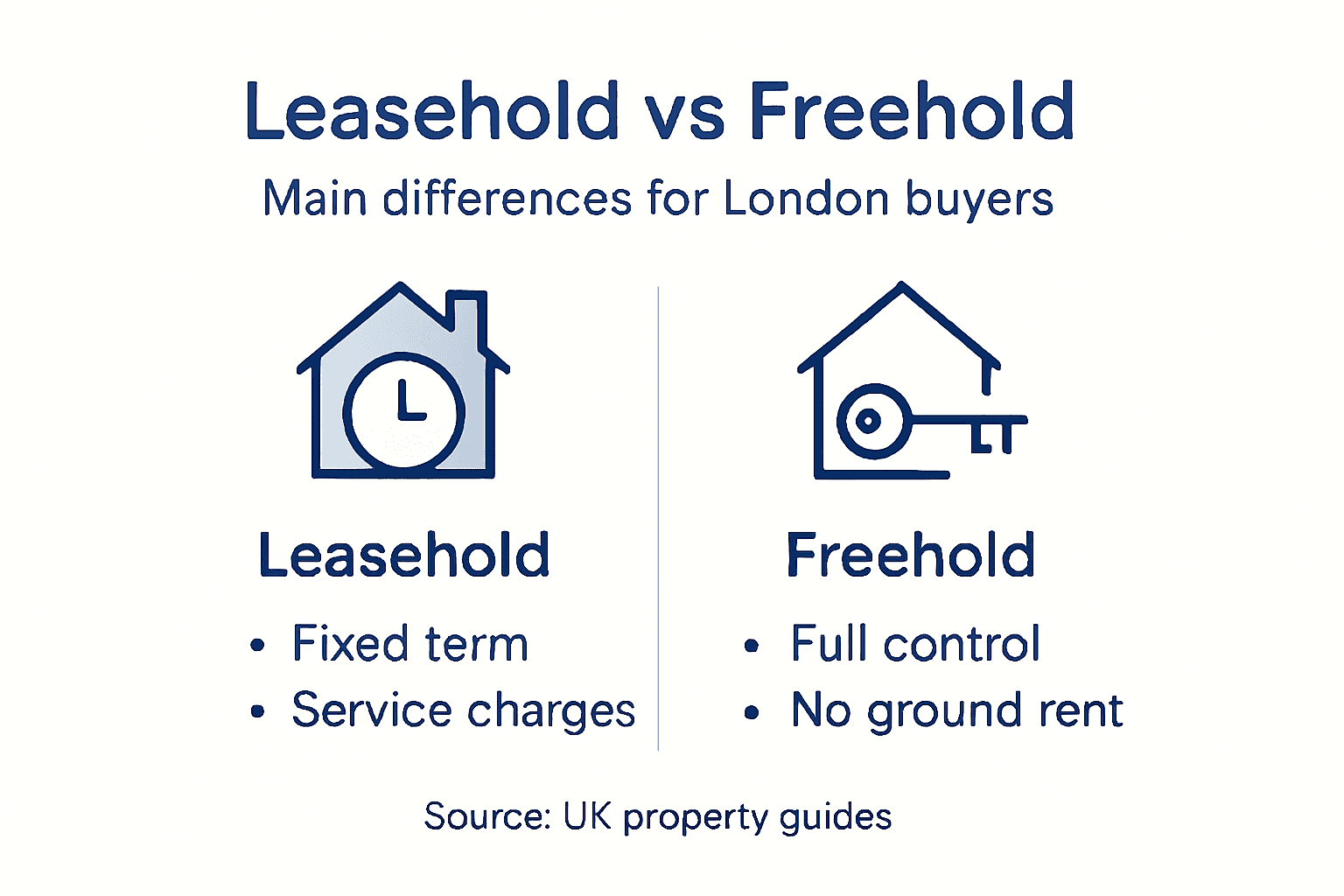
Understanding the fundamental differences between leasehold and freehold property ownership is crucial for any London buyer navigating the complex property market. Freehold means you own the property and the land it stands on outright, giving you complete control and ownership. Leasehold, by contrast, means you’re essentially renting the property for a long period from the freeholder, with specific legal obligations and potential restrictions.
In a freehold arrangement, you have absolute ownership of both the building and the land, which provides significant advantages. You won’t pay ground rent, won’t require permission for most home improvements, and have no landlord dictating terms. Conveyancing checks become simpler when dealing with freehold properties, as there are fewer legal complexities to navigate.
Leasehold properties, predominantly common in London’s apartment and flat market, involve purchasing the right to live in a property for a fixed term – typically between 99 and 125 years. During this period, you’ll usually pay annual ground rent to the freeholder and might need approval for significant alterations. The lease length can impact property value, with shorter leases potentially making resale more challenging.
The key distinctions between these ownership types extend beyond mere legal terminology – they fundamentally affect your property rights, financial obligations, and long-term investment potential. London buyers must carefully evaluate these differences to make informed purchasing decisions.
Pro tip: Always request a comprehensive lease review and check the remaining lease term before purchasing a leasehold property, as this can significantly impact future resale value and potential renovation restrictions.
Types of Property Ownership in UK
The United Kingdom offers several distinct property ownership models, each with unique legal implications and responsibilities. Property ownership types in England range from straightforward freehold and leasehold arrangements to more complex shared ownership structures, providing potential homeowners with multiple pathways to property acquisition.
The three primary ownership models are freehold, leasehold, and commonhold. Freehold represents complete ownership of both the property and the underlying land, giving homeowners absolute control and eliminating annual ground rent obligations. Leasehold involves purchasing the right to occupy a property for a specified period, typically between 99 and 125 years, with ongoing financial commitments to the freeholder. Commonhold represents a collective ownership model predominantly used for apartment complexes, where individual unit owners jointly manage common areas and shared spaces.
Beyond these primary categories, additional ownership variations exist. Sole ownership allows a single individual to hold legal title, while joint tenancy permits multiple owners to share equal property rights with automatic inheritance upon a co-owner’s death. Tenants in common offer another approach, enabling owners to hold specific, unequal property shares that can be independently transferred or inherited according to individual preferences.
Understanding these ownership structures is crucial for making informed property investment decisions. Each model carries distinct legal responsibilities, financial implications, and long-term considerations that can significantly impact your property experience and potential future resale value.
The following table highlights key benefits and considerations for each UK property ownership type:
| Ownership Type | Main Advantage | Common Challenge |
|---|---|---|
| Freehold | Full control, no ground rent | Responsibility for all repairs |
| Leasehold | Lower entry cost, communal amenities | Service charges, lease restrictions |
| Commonhold | Shared management of communal areas | Complex decision-making with neighbours |
| Joint Tenancy | Automatic inheritance for co-owners | Loss of share upon death |
| Tenants in Common | Flexible share allocation | More complex inheritance planning |
| Sole Ownership | Full independence and autonomy | Liability for all costs alone |
Pro tip: Consult a professional conveyancer to thoroughly understand the specific legal and financial nuances of each property ownership type before making your final purchase decision.
Legal Rights and Restrictions Explained
Leasehold property ownership comes with a complex set of legal rights and restrictions that every potential buyer must thoroughly understand. Leaseholder rights and responsibilities are carefully defined by law, establishing clear boundaries between the leaseholder’s entitlements and the freeholder’s powers.
Leaseholders possess several critical legal protections. They have the statutory right to request information about service charges, obtain the landlord’s contact details, and be consulted on major maintenance works. The lease agreement outlines specific permissions and restrictions, including rules about property alterations, subletting, and use of the property. Importantly, leaseholders can challenge unreasonable service charges and have legal mechanisms to extend their lease or potentially purchase the freehold under certain circumstances.
The legal framework surrounding leasehold properties creates a delicate balance of rights and obligations. Leaseholders must adhere to specific conditions, including timely payment of ground rent and service charges, and obtaining necessary permissions for significant property modifications. Failure to comply with lease terms can result in serious consequences, potentially including legal action or even forfeiture of the lease. Some key restrictions typically include limitations on structural changes, restrictions on pet ownership, and rules governing external appearances and use of communal spaces.
Navigating these legal intricacies requires careful consideration and professional guidance. The lease document serves as the primary legal contract defining the relationship between the leaseholder and freeholder, making it crucial to understand every clause and potential implication before committing to a purchase.
Pro tip: Always request a comprehensive lease review by a qualified conveyancer who can identify potential restrictions and hidden clauses that might impact your property enjoyment or future resale prospects.
Costs, Charges and Ongoing Payments
Leasehold properties involve a complex array of financial obligations that potential buyers must carefully understand before committing to a purchase. Service charges and property expenses represent a significant ongoing financial commitment that distinguishes leasehold from freehold ownership.
Ground rent traditionally formed a key component of leasehold expenses, though recent legislative changes have significantly altered this landscape. New leases since June 2022 typically feature zero ground rent, providing relief for leaseholders. However, existing leases may still include annual ground rent payments, which can escalate based on specific lease terms. Service charges represent the most substantial ongoing expense, covering essential maintenance, communal area upkeep, buildings insurance, and management fees. These charges are calculated annually and can vary significantly depending on the property’s size, location, and shared facilities.

Additional financial considerations for leaseholders include contributions to reserve funds or sinking funds, which protect against future major repair and renovation costs. These funds act as a financial buffer, ensuring that unexpected maintenance expenses can be covered without imposing sudden, significant financial burdens on individual leaseholders. Landlords are legally required to provide detailed documentation explaining how these charges are calculated, giving leaseholders transparency and the right to challenge unreasonable expenses through formal dispute mechanisms.
Unlike freehold properties where owners bear all maintenance costs independently, leasehold arrangements distribute these responsibilities and costs across multiple property owners. This shared financial model can provide economic advantages but also requires careful budgeting and understanding of potential future expenses. Prospective buyers should thoroughly review lease documentation to comprehend the full financial implications of their potential property investment.
Below is a summary of common ongoing payments associated with leasehold and freehold property ownership in the UK:
| Cost Type | Leasehold Property (Typical) | Freehold Property (Typical) |
|---|---|---|
| Ground Rent | Often required annually on older leases | Not applicable |
| Service Charges | Covers communal repairs and insurance | Not required, owner pays for own repairs |
| Reserve Funds | Contributions for major future works | No collective fund, owner bears full costs |
| Buildings Insurance | Included in service charge | Owner arranges independently |
Pro tip: Request a comprehensive breakdown of historical service charges and reserve fund contributions to accurately forecast your potential annual property expenses before finalising your leasehold purchase.
Risks, Common Pitfalls and Law Reforms
Leasehold property ownership carries numerous potential risks that prospective buyers must carefully navigate. Leasehold system reforms signal significant changes aimed at protecting homeowners from historical inequities in property ownership structures.
Lease length represents one of the most critical risk factors for leaseholders. Properties with shorter remaining lease terms can dramatically decrease in market value, potentially making resale challenging. As leases approach 80 years, marriage value calculations become more complex, and extending the lease becomes substantially more expensive. Common pitfalls include unexpected escalating ground rents, restrictive alterations clauses, and complex service charge calculations that can impose significant financial burdens on unsuspecting property owners.
The UK government has introduced multiple legislative reforms targeting historical leasehold injustices. These reforms aim to provide greater transparency and control for leaseholders, including mechanisms to challenge unreasonable service charges, simplify lease extensions, and potentially purchase freehold interests. Key developments include proposals to ban new leasehold flats, reduce ground rent to zero for new leases, and introduce more straightforward processes for leaseholders to manage their own properties. Potential risks remain for existing leaseholders with older contracts, who may face more complex legal and financial challenges.
Navigating the leasehold landscape requires meticulous due diligence and professional guidance. Prospective buyers must carefully review lease documentation, understand potential future costs, and consider the long-term implications of their property investment. The evolving legal landscape means that leasehold ownership continues to become more transparent, but historical complexities still pose significant challenges for many property owners.
Pro tip: Engage a specialist conveyancer with extensive leasehold experience to conduct a comprehensive review of the lease terms and identify potential hidden risks before completing your property purchase.
Simplify Your Leasehold or Freehold Property Purchase With Expert Conveyancing Help
Navigating the complexities of leasehold and freehold property ownership can feel overwhelming, especially with the many legal rights, ongoing costs, and recent reforms involved. Whether you’re concerned about lease length, ground rent, service charges, or ensuring your conveyancing checks cover all vital points, having trusted expert support makes all the difference. Understanding the unique challenges around lease reviews and financial commitments will protect your investment and ease the stress of buying property in London.
At Conveyancing-Solicitor.co.uk, we connect you instantly with vetted, five-star conveyancing solicitors who specialise in Leasehold vs Freehold Conveyancing Checks. Our transparent, fixed-fee quotes can save you up to 75% on legal fees compared to typical rates. Don’t risk unexpected costs or legal pitfalls when buying your home. Request a free, no-obligation quote today and take the first step to confident, clear, and affordable conveyancing tailored to your needs. Start now at Instant Quote and secure expert advice for your property purchase.
Frequently Asked Questions
What is the difference between leasehold and freehold property ownership?
Freehold means you own the property and the land outright, giving you complete control and no ground rent obligations. Leasehold means you own the right to use the property for a specific period, typically between 99 and 125 years, while paying ground rent and adhering to certain restrictions.
What are the costs associated with leasehold properties?
Leasehold properties usually involve costs like ground rent, service charges for communal maintenance, and contributions to reserve funds. It is essential to review the lease documents for historical service charges and projected costs before purchasing.
What legal rights do leaseholders have?
Leaseholders have rights to request information about service charges, challenge unreasonable costs, and be consulted on major works. They can also seek to extend their lease or purchase the freehold under certain conditions, as outlined in their lease agreement.
What risks should I be aware of when purchasing a leasehold property?
Key risks include shorter lease lengths affecting property value, unexpected increases in ground rent, and restrictions on alterations to the property. It’s important to carry out thorough due diligence and engage a specialist conveyancer to identify potential risks and legal complexities.
Recommended
- Why Buyers Prefer Fixed Price Conveyancing for Leasehold Flats London from Conveyancing Solicitor UK – Conveyancing Solicitor
- 7 Key Leasehold vs Freehold Conveyancing Checks – Conveyancing Solicitor
- Leasehold Conveyancing: Key Steps, Costs, and Pitfalls – Conveyancing Solicitor
- Fixed Price Conveyancing for Leasehold Flats in London: Know Exactly What You’ll Pay – Conveyancing Solicitor
