



Did you know that over 60 percent of UK home buyers underestimate the differences between conveyancers and solicitors when choosing legal help? Picking the right professional can save you time, money, and stress during a property transaction. Understanding who does what is crucial for a smooth move, and knowing these roles makes it easier to match your needs with the right expertise.
Key Takeaways
| Role | Description |
|---|---|
| Conveyancers | Specialise exclusively in property law and are typically more cost-effective for straightforward transactions. |
| Solicitors | Offer a broader range of legal services including handling complex legal matters and disputes. |
| Regulations | Conveyancers are regulated by the Council for Licensed Conveyancers while solicitors are overseen by the Solicitors Regulation Authority. |
| Choosing Professionals | For simple transactions, conveyancers may be a better choice, while solicitors are more suitable for complex cases needing additional legal expertise. |
Table of Contents
- Defining Conveyancers And Solicitors In UK Law
- Key Differences In Training And Regulation
- Typical Services Provided By Each Professional
- Legal Responsibilities And Client Protections
- Choosing Between A Conveyancer And Solicitor
Defining Conveyancers and Solicitors in UK Law
In the complex landscape of UK property law, conveyancers and solicitors play distinct yet overlapping roles in helping individuals navigate property transactions. According to research from Qredible, these professionals are regulated by different bodies and possess unique specialisations that can significantly impact your property journey.
Licensed conveyancers are highly specialised legal professionals exclusively focused on property transactions. They are regulated by the Council for Licensed Conveyancers (CLC) and concentrate solely on residential and commercial property law. Their expertise allows them to handle all aspects of property transfers with precision and efficiency.
 Key characteristics include:
- Specialisation exclusively in property law
- Regulated by the Council for Licensed Conveyancers
- Typically more cost-effective for straightforward property transactions
- Highly focused on property transfer processes
Solicitors, by contrast, are broader legal professionals regulated by the Solicitors Regulation Authority (SRA). As explained by Wikipedia, they offer comprehensive legal services across multiple practice areas, with property conveyancing being just one of their many competencies. This means they can handle more complex legal scenarios that might extend beyond simple property transfers.
The primary difference lies in their scope and depth of legal practice. Read more about the nuanced differences between conveyancers and solicitors to determine which professional best suits your specific property transaction needs.
Key Differences in Training and Regulation
The professional pathways for conveyancers and solicitors involve distinct educational routes and regulatory frameworks that shape their legal expertise. According to research from Sam Conveyancing, these professionals undergo rigorous but different training processes that prepare them for property law practice.
Licensed conveyancers follow a specialised training pathway focused exclusively on property transactions. Their professional development typically progresses through structured stages:
- Begin as CLC Technician
- Progress to CLC Lawyer qualification
- Complete specific examinations set by the Council for Licensed Conveyancers
- Maintain ongoing professional development in property law
As explained by Wikipedia, licensed conveyancers must continuously update their skills and knowledge through mandatory continuing professional development programmes. This ensures they remain current with the latest property legislation and regulatory changes.
Solicitors undertake a broader legal education that encompasses multiple practice areas. Their training is more comprehensive and includes:
- Completing a law degree or equivalent qualification
- Passing the Legal Practice Course (LPC)
- Securing and completing a training contract with a law firm
- Meeting rigorous standards set by the Solicitors Regulation Authority (SRA)
The key distinction lies in the depth and breadth of their professional preparation. Discover more about the nuanced training differences between conveyancers and solicitors to understand which professional might best meet your specific legal needs.
Here’s a comparison of the key training and regulatory differences:
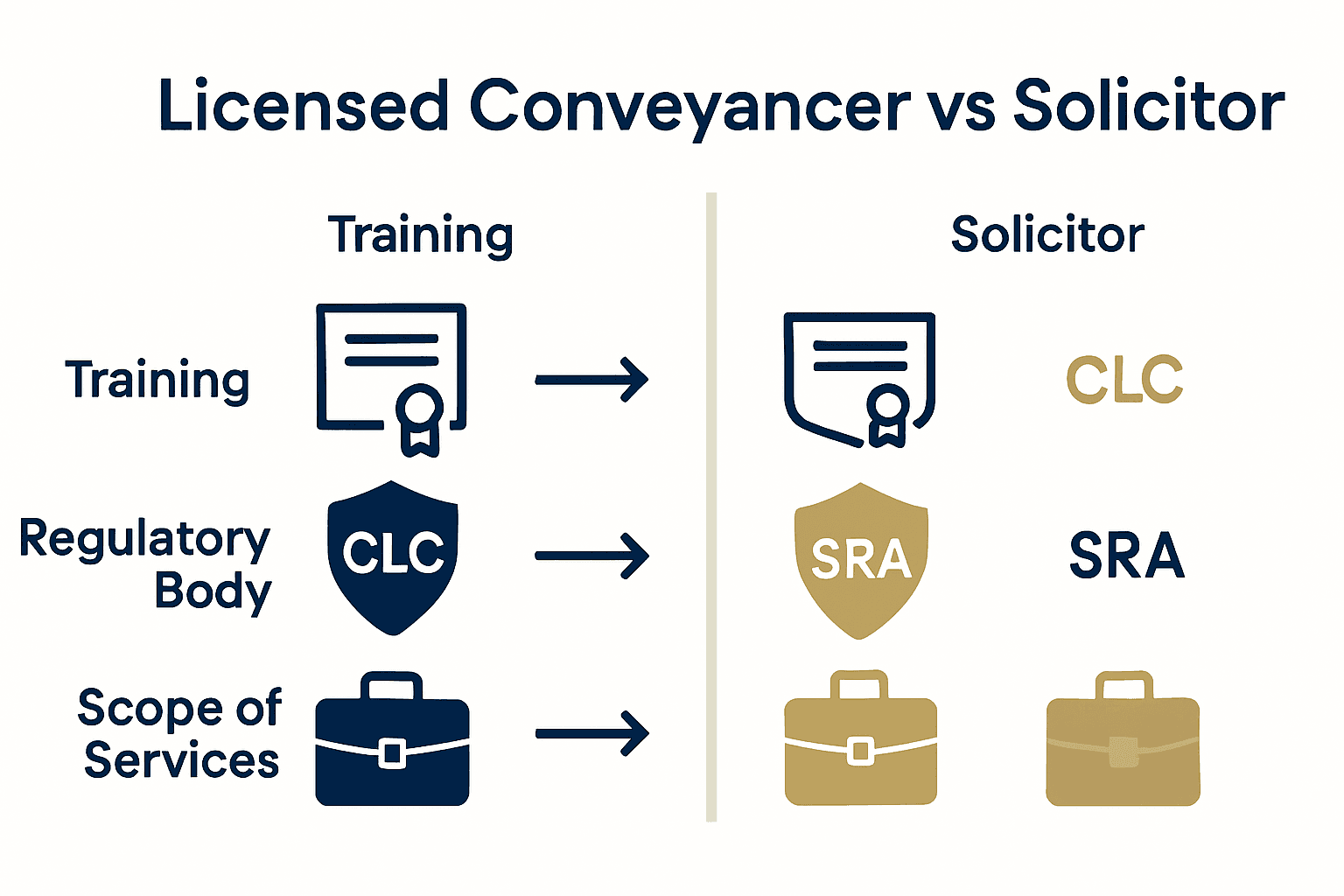
| Aspect | Licensed Conveyancer | Solicitor |
|---|---|---|
| Regulatory Body | Council for Licensed Conveyancers (CLC) | Solicitors Regulation Authority (SRA) |
| Training Focus | Property law only | Broad legal practice |
| Entry Requirements | CLC Technician path CLC Lawyer exams | Law degree or equivalent Legal Practice Course (LPC) |
| Ongoing Development | Mandatory CPD in property law | CPD across legal areas |
| Scope of Services | Residential & commercial property | Multiple legal services |
Typical Services Provided by Each Professional
When navigating property transactions, licensed conveyancers and solicitors offer distinct service portfolios tailored to different client needs. According to Qredible, these professionals provide specialised legal support throughout property transfers.
Licensed conveyancers concentrate exclusively on property law and offer comprehensive residential and commercial property transaction services. Their typical service range includes:
- Conducting comprehensive title investigations
- Drafting and negotiating property transaction contracts
- Managing property exchange and completion processes
- Submitting and processing Land Registry applications
- Performing detailed property searches
- Handling legal documentation for property transfers
As explained by the Homeowners Alliance, solicitors provide a broader spectrum of legal services beyond property transactions. Their conveyancing services typically encompass:
- Conducting property searches and investigations
- Drafting and reviewing legal documents (such as TA6 and TA10 forms)
- Providing advice on leasehold versus freehold properties
- Managing property exchange and completion processes
- Handling Stamp Duty Land Tax submissions
- Coordinating Land Registry registrations
- Offering additional legal advice on related matters like wills and trusts
Learn more about the specific services offered by different legal professionals to determine which expert best matches your property transaction requirements.
Legal Responsibilities and Client Protections
Professional regulation forms the cornerstone of client protection in property legal services. According to Qredible, both licensed conveyancers and solicitors operate under stringent regulatory frameworks designed to safeguard client interests and maintain high professional standards.
Licensed conveyancers, regulated by the Council for Licensed Conveyancers (CLC), have specific legal responsibilities that ensure client protection:
- Mandatory professional indemnity insurance
- Adherence to strict professional conduct codes
- Specialised focus on property transaction legalities
- Transparent fee structures and service commitments
- Regular professional development requirements
- Accountability through formal regulatory mechanisms
As explained by Conveyancing Online, solicitors provide a broader range of legal protections. Their regulatory framework through the Solicitors Regulation Authority (SRA) offers additional safeguards:
- Comprehensive professional indemnity coverage
- Ability to represent clients in legal disputes
- Broader legal advisory capabilities beyond property transactions
- More extensive regulatory oversight
- Power to handle complex legal complications
- Potential court representation if required
Discover more about the legal protections offered by different legal professionals to understand which option provides the most comprehensive protection for your specific property transaction needs.
Choosing Between a Conveyancer and Solicitor
Selecting the right legal professional for your property transaction requires careful consideration of your specific circumstances. According to Smart Choice Money, the decision between a conveyancer and solicitor involves balancing cost, complexity, and potential legal requirements.
For straightforward property transactions, a licensed conveyancer might be the ideal choice. These specialists offer distinct advantages:
- 25-50% lower fees compared to solicitors
- Highly efficient processing of standard property transfers
- Specialised expertise in residential property transactions
- Streamlined and focused service
- Typically faster turnaround times
- Lower overall legal costs
As explained by the Homeowners Alliance, solicitors become more advantageous in scenarios involving:
- Complex legal property disputes
- Boundary or ownership complications
- Need for broader legal advice
- Potential requirement for additional legal services
- Intricate property ownership structures
- Potential court representation
Learn more about selecting the right legal professional to ensure your property transaction receives the most appropriate legal support.
Choose the Right Professional for Your Property Move – With Complete Peace of Mind
If you are feeling uncertain about whether to use a conveyancer or a solicitor for your property transaction, you are not alone. The article explained the crucial differences in regulation, training and the services each can provide. Many buyers and sellers worry about picking the wrong legal support and paying too much or facing hidden risks. This is where an expert, transparent connection to regulated professionals can make all the difference.
At Conveyancing-Solicitor.co.uk, we take the anxiety and guesswork out of choosing between a conveyancer or a solicitor. With vetted, SRA- and CLC-regulated firms and clear, fixed-fee quotes, you get support tailored to your unique needs. Are you ready to avoid costly mistakes and get matched with the right legal expert for your transaction? Get your instant quote now. You can also find out what makes a solicitor different from a licensed conveyancer or read more about how to select the right conveyancing professional. Begin your move with clarity. Find your trusted conveyancer or solicitor today at Conveyancing-Solicitor.co.uk.
Frequently Asked Questions
What is the primary difference between a conveyancer and a solicitor?
The main difference lies in their scope of practice. Conveyancers are specialized legal professionals focused exclusively on property transactions, while solicitors offer broader legal services, including handling various legal issues beyond property law.
What qualifications do licensed conveyancers need?
Licensed conveyancers complete a specialized training pathway that includes becoming a CLC Technician, qualifying as a CLC Lawyer, and passing specific examinations set by the Council for Licensed Conveyancers, along with ongoing professional development in property law.
When should I choose a solicitor over a conveyancer for property transactions?
You should choose a solicitor when dealing with complex legal property disputes, boundary complications, or when you need a range of legal advice beyond property transactions, including court representation or additional legal services.
Are licensed conveyancers more cost-effective than solicitors for property transactions?
Yes, licensed conveyancers are typically more cost-effective for straightforward property transactions, often offering fees that are 25-50% lower than solicitors while providing specialized expertise in residential property transfers.
Recommended
- What is a Conveyancer and How Do They Differ from a Solicitor – Conveyancing Solicitor
- What Makes a Solicitor Different from a Licensed Conveyancer – Conveyancing Solicitor
- The Role of Conveyancers in Property Transactions – Conveyancing Solicitor
- What Does a Conveyancer Do? A Guide to Legal Property Transactions – Conveyancing Solicitor
