
Title Deeds Explained: Protecting Your Property Rights
Title Deeds Explained: Protecting Your Property Rights. Understand how these documents safeguard your UK property ownership. Get an instant quote.
PJ Singh
Co-Founder, Conveyancer Plus | Conveyancing Industry Expert
Co-Founder, Conveyancer Plus \| Conveyancing Industry Expert
Wednesday 4 February 202613 min read
Buying your first home in a UK city can feel exciting but also confusing, especially when legal paperwork appears at every turn. Title deeds are the foundation of property ownership, acting as the crucial proof that links your name to your new home. For many first-time buyers, understanding these documents brings confidence, helping you avoid costly mistakes and ensure your rights are protected. Discover how official records of property details shape and secure every step of your ownership journey.
Table of Contents
Key Takeaways
| Point | Details |
|---|---|
| **Importance of Title Deeds** | Title deeds are crucial for establishing clear ownership rights and proving property ownership in the UK. They help prevent legal disputes and protect your rights as a property owner. |
| **Types of Title Deeds** | The main types of title deeds include Freehold, Leasehold, Copyhold, Mortgage, and Transfer deeds, each with distinct ownership implications and responsibilities. |
| **Registration Requirements** | Registering title deeds is mandatory during property transactions, ensuring legal protection and accurate documentation of ownership. Timely registration avoids potential disputes and complications. |
| **Potential Risks** | Property ownership comes with risks such as boundary disputes and registration errors. Maintaining thorough records and seeking legal guidance can prevent costly issues. |
What Are Title Deeds And Why They Matter
Title deeds are essential legal documents that prove property ownership and rights in the United Kingdom. These critical papers form the backbone of property transactions, establishing a clear and legally recognised chain of ownership for real estate.
At their core, title deeds are official records of property details that document crucial information about a property’s legal status. They typically include:
- The current property owner’s name
- Property boundaries and physical description
- Historical ownership transfers
- Any legal restrictions or obligations attached to the property
- Mortgage details and financial encumbrances
These documents serve multiple critical functions in property law. They provide definitive evidence of ownership, helping to prevent disputes and protect your legal rights. Title documents detail ownership and legal obligations that can impact everything from potential sales to inheritance planning.
Understanding your title deeds is not just a legal formality—it’s a fundamental aspect of responsible property ownership. These documents trace the complete history of a property, revealing important details that could affect its value, transferability, and potential future use.
\_ Pro Tip:\_ \_Always request a comprehensive review of your title deeds during property purchase to uncover any hidden legal complexities or restrictions that might impact your ownership rights.\_
Different Types Of Title Deeds In The UK
Title deeds in the United Kingdom encompass a diverse range of legal documents that define property ownership and rights. Different types of property tenure reflect the complex legal landscape of property ownership across the nation.
The primary types of title deeds in the UK include:
- Freehold Deeds: Provide complete ownership of both the property and the land it stands on, with no time limitations
- Leasehold Deeds: Grant ownership for a specific period, typically long-term (99-125 years), but with restrictions
- Copyhold Deeds: A historical form of tenure traditionally associated with manorial estates
- Mortgage Deeds: Legal documents detailing financial agreements related to property financing
- Transfer Deeds: Record the legal transfer of property ownership between parties
Freehold deeds represent the most straightforward form of property ownership. When you own a freehold property, you own the entire property and the land it sits on indefinitely. This means you have complete control over the property, subject only to planning regulations and local laws.
! Homeowner reviewing official property documents

Leasehold deeds are more complex. Scottish title documents record ownership details and reveal the nuanced nature of property rights. In a leasehold arrangement, you effectively rent the property from the freeholder for a specified period, typically between 99 and 125 years. This means you’ll have certain restrictions and may need to pay ground rent and service charges.
\_ Pro Tip:\_ \_Always carefully review the remaining lease term and associated obligations before purchasing a leasehold property, as these can significantly impact the property’s long-term value and your ownership rights.\_
Here is a summary of the main types of title deeds in the UK and their significance:
| Title Deed Type | Ownership Scope | Typical Duration | Key Considerations |
|---|---|---|---|
| Freehold | Property and land, unlimited | Indefinite | Simple, long-term control |
| Leasehold | Property only, not land | 99–125 years | Lease restrictions apply |
| Copyhold | Historical, manorial estates | No longer in use | For historical title research |
| Mortgage | Secures lender’s interest | Until mortgage repaid | Affects resale until discharged |
| Transfer | Change of ownership | One-off event | Key for buying/selling property |
Legal Requirements For Title Deed Registration
Registering title deeds is a critical legal process in the United Kingdom that protects property ownership rights. Land Registration Act governs title requirements and establishes the framework for documenting property ownership across England and Wales.
The key legal requirements for title deed registration include:
- Compulsory registration when a property is sold or transferred
- Submission of accurate property documentation
- Payment of registration fees
- Providing proof of identity and property ownership
- Completing official Land Registry forms
- Obtaining necessary supporting documents
Compulsory registration became mandatory under the Land Registration Act 2002 for most property transactions. This means that when you purchase a property, transfer ownership, or inherit real estate, you must register the title with HM Land Registry. HM Land Registry practice guides outline the specific procedures for ensuring legal compliance.
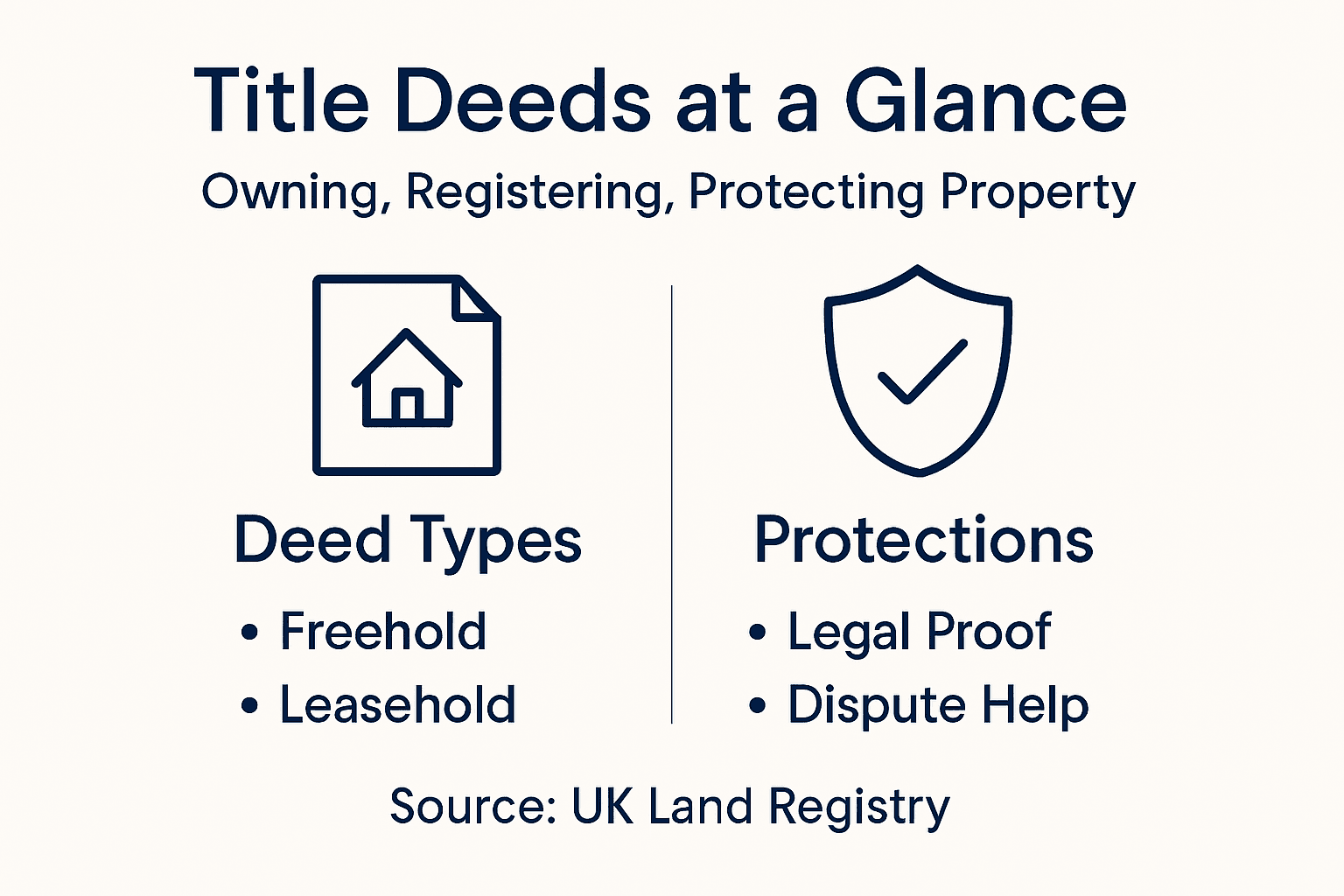
! Infographic summarizing types and protections of title deeds
The registration process serves multiple crucial purposes. It creates an official record of property ownership, protects your legal rights, and provides a transparent system for tracking property transfers. Failure to register can lead to complications in proving ownership, potential legal disputes, and challenges when selling or refinancing the property.
\_ Pro Tip:\_ \_Always keep copies of all original title deed documents and ensure they are submitted accurately and promptly to avoid potential registration delays or legal complications.\_
Your Rights And Responsibilities As A Deed Holder
As a property deed holder, you possess a complex set of legal rights and obligations that are fundamental to responsible property ownership. Land Registry practice guides outline these responsibilities to ensure clear understanding and legal compliance.
Your primary rights as a deed holder include:
- Right to exclusive property occupation
- Right to transfer or sell the property
- Right to modify the property (subject to planning regulations)
- Right to request updates to property records
- Right to protect your legal interests
Property ownership rights extend beyond simple occupation. They encompass a range of legal protections that safeguard your investment and personal interests. Land register updates require careful management to maintain accurate property documentation and legal standing.
With these rights come significant responsibilities. You must maintain accurate registration, comply with local planning regulations, and ensure any property transfers or changes are properly documented. This includes paying relevant fees, submitting correct paperwork, and adhering to any specific covenants or restrictions outlined in your title deeds.
\_ Pro Tip:\_ \_Regularly review your title deeds and consult a legal professional to ensure you fully understand and protect your property rights and obligations.\_
Common Risks, Costs And Resolving Disputes
Property ownership involves navigating a complex landscape of potential risks and legal challenges that can impact your title deeds and overall investment. Land Registry practice guides highlight common property risks that every property owner should understand and anticipate.
The primary risks associated with title deeds include:
- Boundary disputes with neighbouring properties
- Unresolved legal restrictions or covenants
- Errors in property registration
- Potential claims against property ownership
- Unexpected financial liabilities
- Complex inheritance or transfer complications
Financial implications can be substantial when disputes arise. Resolving property conflicts often requires professional legal intervention, which can lead to significant expenses. Neighbour disputes involve multiple resolution strategies that range from informal negotiation to formal legal proceedings.
Successful dispute resolution typically involves a systematic approach. This includes gathering comprehensive documentation, understanding your legal rights, seeking professional mediation, and being prepared to engage legal representation if negotiations fail. Proactive communication and maintaining detailed records can often prevent minor disagreements from escalating into costly legal battles.
\_ Pro Tip:\_ \_Invest in comprehensive property insurance and maintain a thorough file of all title deed documents to protect yourself against potential legal and financial risks.\_
Below is a comparison of common risks in property ownership and recommended proactive strategies:
| Risk Type | Potential Impact | Preventative Action |
|---|---|---|
| Boundary disputes | Legal costs, ownership issues | Maintain clear records, seek mediation |
| Registration errors | Sale or financing delays | Review documents regularly |
| Unresolved restrictions | Limited use or changes | Conduct legal checks pre-purchase |
| Inheritance complications | Delays in transfer, family disputes | Prepare updated will with solicitor |
| Financial encumbrances | Unexpected costs, repossession | Monitor mortgage and charges |
Secure Your Property Rights with Expert Conveyancing Support
Understanding and managing your title deeds is crucial to protecting your property rights and avoiding costly disputes. Whether you own freehold or leasehold property, navigating the legal complexities of registration, restrictions and ownership transfers can feel overwhelming. Key challenges include ensuring accurate document registration and knowing your responsibilities as a deed holder. Missing details or registration errors can delay sales or expose you to financial risks.
Our trusted conveyancing partners simplify this process by providing transparent, fixed-fee services from regulated solicitors and licensed conveyancers nationwide. Avoid costly surprises by getting fast, reliable quotes tailored to your specific property needs. Explore detailed guides on Leasehold vs Freehold Conveyancing Checks and How to Find a Good Conveyancing Solicitor so you can make informed decisions backed by expert advice.
Ready to protect your investment and complete your property transactions with confidence? Get an instant, no-obligation fixed-fee quote today from one of our vetted conveyancing firms. Start securing your legal ownership rights now at Instant Quote and take the most important step towards clear, hassle-free property conveyancing.
Frequently Asked Questions
What are title deeds?
Title deeds are legal documents that prove property ownership and rights. They establish a clear record of ownership, property boundaries, and any legal obligations related to the property.
Why is registering title deeds important?
Registering title deeds is crucial as it protects your ownership rights, provides an official record of property ownership, and helps prevent disputes. Failing to register can complicate ownership claims and property transactions.
What types of title deeds are there?
The primary types of title deeds include freehold deeds (complete ownership), leasehold deeds (ownership for a specific period), copyhold deeds (historical tenure), mortgage deeds (financial agreements) and transfer deeds (record of ownership transfer).
What rights do I have as a title deed holder?
As a title deed holder, you have rights such as exclusive occupation of the property, the ability to transfer or sell the property, and the right to modify it, subject to local planning regulations. You must also maintain accurate registration and comply with any property-related obligations.
About the Author
Verified Expert
PJ Singh
Co-Founder, Conveyancer Plus \| Conveyancing Industry Expert
BSc Computer Science, University of Hertfordshire \| 10+ Years Conveyancing Industry Experience
PJ Singh is Co-Founder of Conveyancer Plus, bringing over 10 years of expertise in the UK conveyancing and property sector. Previously Group Director of Sales and Marketing at Ackroyd Legal and Head of Business Development at Fitzalan Partners (Homeward Legal), PJ has worked with over 70 SRA-regulated solicitors nationwide. His deep understanding of the property transaction process and client journey makes him a trusted voice in simplifying conveyancing for homebuyers.
View all articles by PJ → LinkedIn
More Articles
Article\\ \\ Conveyancing Process Step by Step for UK Home Buyers \\ \\ Understand the UK conveyancing process step-by-step with our expert guide for home buyers. Get clear advice from a trusted conveyancing solicitor.\\ \\ 3 Feb 2026 Article\\ \\ Conveyancing Solicitor UK Delivers Trusted Local Specialist Conveyancing for New Builds England \\ \\ Find trusted, vetted conveyancing solicitors across the UK. Clear, Easy & Affordable conveyancing services with up to 75% savings on legal fees.\\ \\ 18 Dec 2025 Article\\ \\ Transfer of Equity – How It Affects Family Property \\ \\ Understand UK Transfer of Equity & how it affects family property. Get expert conveyancing solicitor advice on changing ownership.\\ \\ 4 Feb 2026
View reviews →
Get Your Free Conveyancing Quote
Compare prices from trusted local solicitors. No obligation, no hidden fees.
Instant quotes
No obligation
Save up to 75%
Get Free Quotes Now
Easy and affordable conveyancing made simple. SRA regulated solicitors across the UK.
Services
Quick Links
Legal
Contact
- 0330 053 2229
- clientservices@conveyancing-solicitor.co.uk
- United Kingdom
Conveyancing-Solicitor.co.uk is a trading name of Home Movers Plus Ltd, with the company registration number 13764928. © 2026 Home Movers Plus Ltd –
About the Author
PJ Singh
Co-Founder, Conveyancer Plus | Conveyancing Industry Expert
PJ Singh is Co-Founder of Conveyancer Plus, bringing over 10 years of expertise in the UK conveyancing and property sector. Previously Group Director of Sales and Marketing at Ackroyd Legal and Head of Business Development at Fitzalan Partners (Homeward Legal), PJ has worked with over 70 SRA-regulated solicitors nationwide. His deep understanding of the property transaction process and client journey makes him a trusted voice in simplifying conveyancing for homebuyers.
More Articles
Remortgage your house: step-by-step guide for UK homeowners
Learn how to remortgage your house in the UK with this clear step-by-step guide covering timing, costs, legal fees, and how to save up to 75% on conveyancing.
Transparency in conveyancing: your guide to clear home moves
Discover what transparency in conveyancing really means, where it breaks down, and how to choose a solicitor who keeps you fully informed with no hidden fees.
Essential conveyancing terms every UK home seller must know
Learn the essential conveyancing terms every UK home seller must know, from TA6 forms to exchange and completion, to avoid costly delays and legal pitfalls.
Get Your Free Conveyancing Quote
Compare prices from trusted local solicitors. No obligation, no hidden fees.