
Property Title Deeds Explained: What Every UK Buyer Needs to Know
Property Title Deeds Explained: What Every UK Buyer Needs to Know. Understand their importance and how conveyancing solicitors assist with this crucial step.
PJ Singh
Co-Founder, Conveyancer Plus | Conveyancing Industry Expert
Co-Founder, Conveyancer Plus \| Conveyancing Industry Expert
Wednesday 4 February 202613 min read
Buying your first British home can feel overwhelming when you face legal terms like property title deeds. Nearly one in four first-time buyers in the United Kingdom encounter hidden costs due to confusion over ownership paperwork. Understanding title deeds is key because they prove who owns a property and protect you from costly mistakes. This guide breaks down what title deeds really mean for British buyers so you can approach your purchase with confidence and clarity.
Table of Contents
Key Takeaways
| Point | Details |
|---|---|
| **Understanding Title Deeds** | Title deeds are legal documents proving property ownership in the UK, with modern systems relying on digital Land Registry records for accuracy. |
| **Types of Deeds** | Various property deeds exist, including Bargain and Sale, Lease, and Mortgage Deeds, each serving specific ownership or transaction purposes. |
| **Legal Protections** | The Land Registry ensures ownership verification and transparency in property transactions, protecting buyers and sellers legally. |
| **Risks and Security** | Property owners face risks such as documentation loss and financial disputes, emphasising the need for secure storage and legal advice. |
What Are Property Title Deeds in the UK
Property title deeds are legal documents that serve as the definitive proof of property ownership in the United Kingdom. These critical documents establish who legally owns a piece of real estate, detailing the rights, restrictions, and specific conditions associated with the property.
In the UK, title deeds have traditionally been physical documents recording property transactions, but modern systems have evolved. The official Land Registry records now maintain the primary legal evidence of property ownership. This shift means that while old paper deeds might still exist, the digital register is now considered the authoritative source of property ownership information.
Title deeds can encompass various types of property interests, including freehold (outright ownership), leasehold (ownership for a specific period), and other less common tenure types. These documents typically include crucial information such as:
- Property boundaries and physical description
- Names of current and previous property owners
- Purchase price and date of acquisition
- Any legal restrictions or covenants affecting the property
- Mortgage details and legal charges
Historically, property ownership was complex, with various documents like abstracts of title, leases, and wills constituting proof of ownership. Today, the process is more streamlined, with digital records providing greater transparency and ease of verification.
! Infographic paper versus digital UK deeds
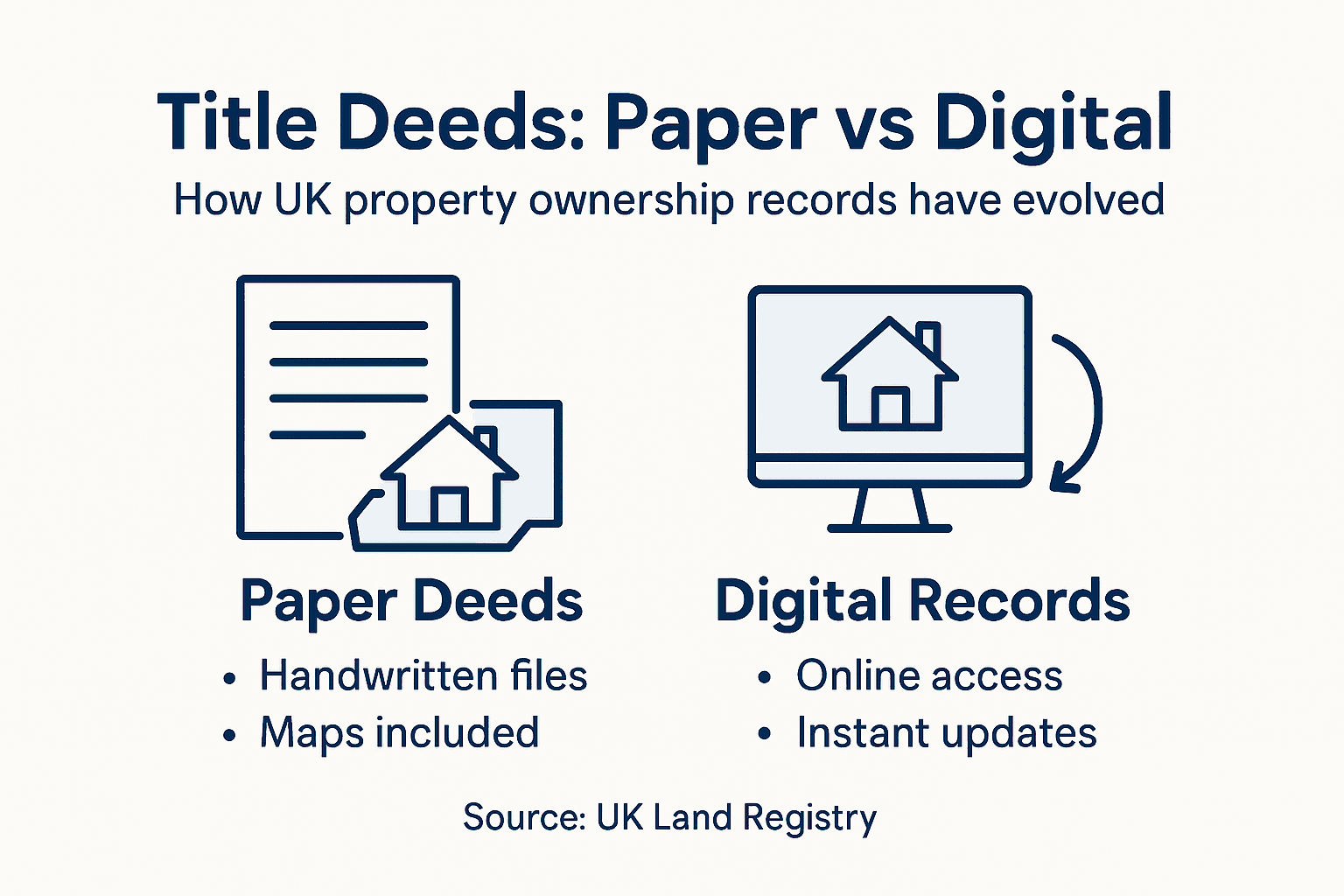
The following table compares traditional paper deeds and modern digital Land Registry records in the UK:
| Aspect | Traditional Paper Deeds | Digital Land Registry Records |
|---|---|---|
| Storage Format | Physical, paper documents | Secure, centralised digital database |
| Risk of Damage | High, due to loss or fire | Minimal, multiple electronic backups |
| Accessibility | Requires physical retrieval | Accessible online via request |
| Legal Authority | Historical evidence | Current definitive legal proof |
| Update Frequency | Changes recorded on paper | Real-time updates upon transactions |
\_ Pro tip:\_ \_Always request a copy of your property’s official Land Registry title register when purchasing a home, as this provides the most up-to-date and legally recognized record of ownership.\_
Types of Property Deeds and Registration Status
Property deeds in the United Kingdom encompass a rich and complex landscape of legal documents that have evolved significantly over time. Historical property registers documented various transaction types, including different ownership transfers and legal arrangements that reflect the intricate nature of property ownership.
The primary types of property deeds include:
- Bargain and Sale Deeds: Transferring property ownership between parties
- Lease Deeds: Defining tenancy and occupation rights
- Mortgage Deeds: Establishing lending arrangements and property security
- Settlement Deeds: Detailing property arrangements within families or trusts
- Surrender Deeds: Formally ending property rights or tenancy agreements
Modern property registration in the UK has transformed dramatically. Diverse deed types now fall under the standardised Land Registry system, which provides a centralised digital record of property ownership. This transition means that while traditional paper deeds still exist, the official digital register now serves as the primary legal proof of ownership.
! Registrar sorting title deed records

Here is a summary of main deed types and their primary purposes:
| Deed Type | Main Purpose | Typical Use Case |
|---|---|---|
| Bargain and Sale | Transfers property ownership | Sale or gift between individuals |
| Lease Deed | Grants temporary occupation | Rental agreements for set terms |
| Mortgage Deed | Secures loan with property | Home purchase with mortgage |
| Settlement Deed | Guides family or trust arrangements | Dividing property rights within a family |
| Surrender Deed | Ends existing tenancy rights | Returning leased land to freeholder |
Registration status varies depending on the property’s age and previous transaction history. Some older properties might rely on traditional deed bundles, while newer properties are comprehensively registered with digital records. The Land Registry’s systematic approach ensures greater transparency, making property ownership verification more straightforward and accessible for buyers, sellers, and legal professionals.
\_ Pro tip:\_ \_Request a comprehensive property search that includes both digital Land Registry records and historical deed documents to ensure you have a complete understanding of your property’s legal history.\_
Key Information Found in Title Deeds
Title deeds are comprehensive documents that provide a detailed historical and legal record of property ownership. UK land registry documents reveal crucial property details, offering potential buyers and owners a comprehensive understanding of their property’s legal status and characteristics.
Typically, title deeds contain several key categories of critical information:
- Property Description
- Physical boundaries
- Land measurements
- Precise geographical location
- Structural details and characteristics
- Ownership Information
- Names of current and previous property owners
- Dates of ownership transfers
- Purchase prices and transaction details
- Ownership type (freehold or leasehold)
- Legal Restrictions and Rights
- Easements and access rights
- Restrictive covenants
- Rights of way
- Potential land use limitations
Historical deed bundles often include additional contextual documents, such as old maps, sale particulars, and supplementary legal paperwork that provide deeper insights into the property’s background. These ancillary documents can reveal important historical information about previous ownership, land use, and potential legal complexities.
Modern digital registers have streamlined this process, creating more accessible and transparent property records. However, understanding the nuanced details within these documents remains crucial for potential buyers seeking a comprehensive view of their prospective property’s legal standing.
\_ Pro tip:\_ \_Always request a comprehensive title register and plan during property transactions to uncover any hidden legal restrictions or potential issues that might impact your ownership.\_
Legal Protections and Land Registry Rules
The United Kingdom’s property ownership system is designed to provide robust legal protections for homeowners and potential buyers. Land Registry maintains official ownership records, creating a comprehensive and legally binding framework that safeguards property transactions and ownership rights.
Key legal protections in the UK property system include:
- Ownership Verification
- Confirmed legal ownership through official registration
- Prevention of fraudulent property transfers
- Clear documentation of property rights
- Transaction Transparency
- Mandatory registration of property sales
- Public accessibility of ownership information
- Standardised legal documentation requirements
- Buyer Protection Mechanisms
- Comprehensive title checks
- Legal recourse for ownership disputes
- Guaranteed accuracy of property records
Approved certificates of title provide additional legal security for property transactions. These certificates involve meticulous checks of title deeds and Land Registry records, ensuring that buyers receive a comprehensive and legally verified overview of the property’s ownership status.
The Land Registry’s rules are designed to create a transparent, secure system that protects both buyers and sellers. By maintaining detailed digital records and requiring thorough documentation, the system minimises legal risks and provides a reliable mechanism for property ownership verification.
\_ Pro tip:\_ \_Always request a comprehensive title search and obtain an approved certificate of title to ensure complete legal protection during your property purchase.\_
Risks, Costs, and How to Secure Your Deeds
Property ownership involves navigating complex legal and financial landscapes, with potential risks that can significantly impact your investment. Government guidelines highlight critical deed protection strategies, ensuring homeowners understand the potential vulnerabilities in property documentation.
Key risks associated with property deeds include:
- Documentation Risks
- Loss or damage of physical deed documents
- Potential fraud or identity misrepresentation
- Incomplete or inaccurate property records
- Financial Risks
- Unexpected legal disputes over property ownership
- Hidden encumbrances or outstanding legal claims
- Potential financial losses from unresolved title issues
- Legal Complexity Risks
- Unclear ownership boundaries
- Unresolved inheritance or joint ownership disputes
- Potential restrictions on property use
Multiple party ownership requires careful legal documentation, such as a Deed of Trust, which protects financial interests when several individuals contribute to a property purchase. This legal instrument provides clarity on ownership shares and offers crucial protection beyond standard Land Registry entries.
Securing your property deeds involves a proactive approach, including digital registration, secure document storage, and regular verification of ownership details. Professional legal advice can help mitigate potential risks and ensure comprehensive protection of your property investment.
\_ Pro tip:\_ \_Create digital backups of all property documents and store physical originals in a secure, fireproof location, while maintaining an up-to-date electronic record with the Land Registry.\_
Secure Your Property Purchase with Expert Conveyancing Support
Owning your property in the United Kingdom depends on clear and reliable title deeds but navigating the complex legal language and verifying ownership can be overwhelming. This article highlights the importance of understanding your deed type, registration status, and key legal protections to avoid costly risks and delays. Whether you are a first-time buyer or experienced homeowner, ensuring your transaction is secure means having expert conveyancing that uncovers any hidden restrictions or legal issues.
Conveyancing-Solicitor.co.uk connects you with qualified, five-star conveyancers regulated by the SRA or CLC who specialise in providing swift, transparent services at fixed fees. Saving up to 75 per cent on legal costs, you benefit from clear advice on title deed verification and legal safeguards that protect your investment. Don’t risk delays or uncertain ownership details. Get an instant, no-obligation quote today, and secure smooth conveyancing handled by trusted experts.
Ready to make your property purchase straightforward and stress-free? Use our Free Quote service to find the right conveyancer for your needs now. With nationwide coverage and vetted professionals, you can have confidence your property transaction is in safe hands.
Frequently Asked Questions
What are property title deeds?
Property title deeds are legal documents that prove ownership of a property in the UK. They detail the rights, restrictions, and conditions associated with the property.
How do modern property title deeds differ from traditional paper deeds?
Modern property title deeds are now primarily maintained in digital formats by the Land Registry, which provides real-time updates and secure storage, whereas traditional paper deeds can be lost or damaged.
What key information can I find in my title deeds?
Title deeds typically contain information such as property boundaries, names of owners, purchase details, legal restrictions, and any mortgages associated with the property.
Why is it important to check the Land Registry records before buying a property?
Checking the Land Registry records helps confirm the legal ownership of the property, reveals any potential issues or restrictions, and protects against fraudulent transactions.
About the Author
Verified Expert
PJ Singh
Co-Founder, Conveyancer Plus \| Conveyancing Industry Expert
BSc Computer Science, University of Hertfordshire \| 10+ Years Conveyancing Industry Experience
PJ Singh is Co-Founder of Conveyancer Plus, bringing over 10 years of expertise in the UK conveyancing and property sector. Previously Group Director of Sales and Marketing at Ackroyd Legal and Head of Business Development at Fitzalan Partners (Homeward Legal), PJ has worked with over 70 SRA-regulated solicitors nationwide. His deep understanding of the property transaction process and client journey makes him a trusted voice in simplifying conveyancing for homebuyers.
View all articles by PJ → LinkedIn
More Articles
Article\\ \\ Conveyancing Process Step by Step for UK Home Buyers \\ \\ Understand the UK conveyancing process step-by-step with our expert guide for home buyers. Get clear advice from a trusted conveyancing solicitor.\\ \\ 3 Feb 2026 Article\\ \\ Conveyancing Solicitor UK Delivers Trusted Local Specialist Conveyancing for New Builds England \\ \\ Find trusted, vetted conveyancing solicitors across the UK. Clear, Easy & Affordable conveyancing services with up to 75% savings on legal fees.\\ \\ 18 Dec 2025 Article\\ \\ Transfer of Equity – How It Affects Family Property \\ \\ Understand UK Transfer of Equity & how it affects family property. Get expert conveyancing solicitor advice on changing ownership.\\ \\ 4 Feb 2026
View reviews →
Get Your Free Conveyancing Quote
Compare prices from trusted local solicitors. No obligation, no hidden fees.
Instant quotes
No obligation
Save up to 75%
Get Free Quotes Now
Easy and affordable conveyancing made simple. SRA regulated solicitors across the UK.
Services
Quick Links
Legal
Contact
- 0330 053 2229
- clientservices@conveyancing-solicitor.co.uk
- United Kingdom
Conveyancing-Solicitor.co.uk is a trading name of Home Movers Plus Ltd, with the company registration number 13764928. © 2026 Home Movers Plus Ltd –
About the Author
PJ Singh
Co-Founder, Conveyancer Plus | Conveyancing Industry Expert
PJ Singh is Co-Founder of Conveyancer Plus, bringing over 10 years of expertise in the UK conveyancing and property sector. Previously Group Director of Sales and Marketing at Ackroyd Legal and Head of Business Development at Fitzalan Partners (Homeward Legal), PJ has worked with over 70 SRA-regulated solicitors nationwide. His deep understanding of the property transaction process and client journey makes him a trusted voice in simplifying conveyancing for homebuyers.
More Articles
Remortgage your house: step-by-step guide for UK homeowners
Learn how to remortgage your house in the UK with this clear step-by-step guide covering timing, costs, legal fees, and how to save up to 75% on conveyancing.
Transparency in conveyancing: your guide to clear home moves
Discover what transparency in conveyancing really means, where it breaks down, and how to choose a solicitor who keeps you fully informed with no hidden fees.
Essential conveyancing terms every UK home seller must know
Learn the essential conveyancing terms every UK home seller must know, from TA6 forms to exchange and completion, to avoid costly delays and legal pitfalls.
Get Your Free Conveyancing Quote
Compare prices from trusted local solicitors. No obligation, no hidden fees.